


Primary biliary cholangitis: pathogenic mechanisms
- PMID: 33332913
- PMCID: PMC7879833
- DOI: 10.1097/MOG.0000000000000703
Primary biliary cholangitis: pathogenic mechanisms
Abstract
Purpose of review: Primary biliary cholangitis (PBC) is characterized by autoimmune damage of intrahepatic bile ducts associated with a loss of tolerance to mitochondrial antigens. PBC etiopathogenesis is intriguing because of different perplexing features, namely: a) although mitochondria are present in all cell types and tissues, the damage is mainly restricted to biliary epithelial cells (BECs); b) despite being an autoimmune disorder, it does not respond to immunosuppressive drugs but rather to ursodeoxycholic acid, a bile salt that induces HCO3- rich choleresis; c) the overwhelming female preponderance of the disease remains unexplained. Here we present an etiopathogenic view of PBC which sheds light on these puzzling facts of the disease.
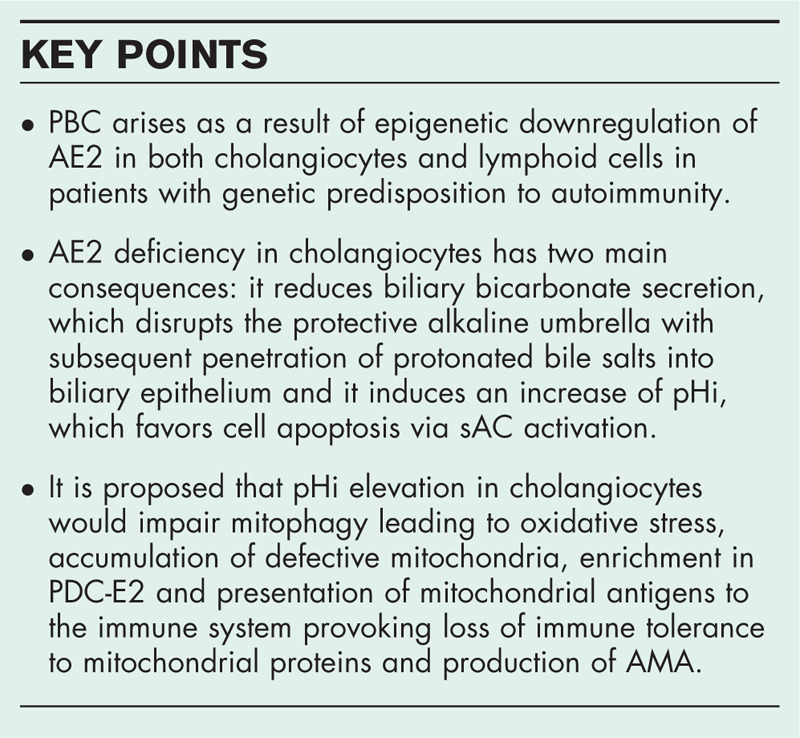
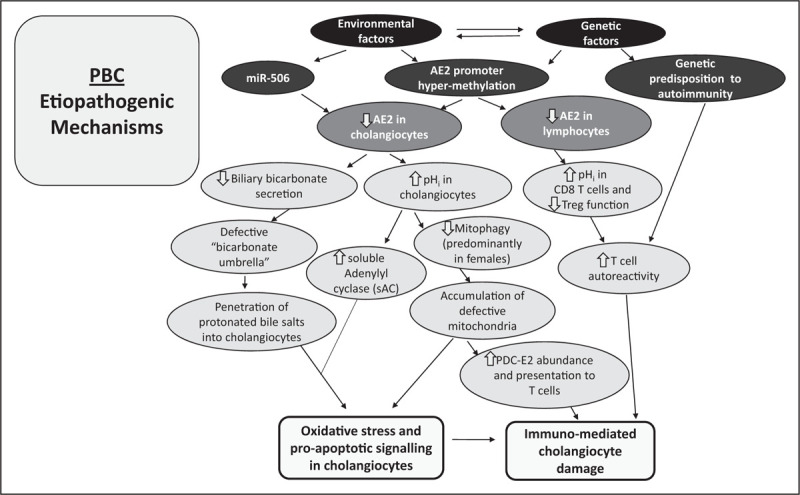
Recent findings: PBC develops in patients with genetic predisposition to autoimmunity in whom epigenetic mechanisms silence the Cl-/HCO3- exchanger AE2 in both cholangiocytes and lymphoid cells. Defective AE2 function can produce BECs damage as a result of decreased biliary HCO3- secretion with disruption of the protective alkaline umbrella that normally prevents the penetration of toxic apolar bile salts into cholangiocytes. AE2 dysfunction also causes increased intracellular pH (pHi) in cholangiocytes, leading to the activation of soluble adenylyl cyclase, which sensitizes BECs to bile salt-induced apoptosis. Recently, mitophagy was found to be inhibited by cytosolic alkalization and stimulated by acidification. Accordingly, we propose that AE2 deficiency may disturb mitophagy in BECs, thus, promoting the accumulation of defective mitochondria, oxidative stress and presentation of mitochondrial antigens to the immune cells. As women possess a more acidic endolysosomal milieu than men, mitophagy might be more affected in women in an AE2-defective background. Apart from affecting BECs function, AE2 downregulation in lymphocytes may also contribute to alter immunoregulation facilitating autoreactive T-cell responses.
Summary: PBC can be considered as a disorder of Cl-/HCO3- exchange in individuals with genetic predisposition to autoimmunity.
Copyright © 2021 The Author(s). Published by Wolters Kluwer Health, Inc.
Conflict of interest statement
JP and JFM none.
JMB: INCYTE: grant for research; ROCHE: grant for research; BAYER: fee for lectures; INTERCEPT: fee for lectures; OWL METABOLOMICS and QED Therapeutics: fee for consulting.
Figures
References
-
- Lindor KD, Bowlus CL, Boyer J, et al. Primary biliary cholangitis: 2018 practice guidance from the American Association for the Study of Liver Diseases. Hepatology 2019; 69:394–419. - PubMed
-
- Hirschfield GM, Beuers U, Corpechot C, et al. EASL Clinical Practice Guidelines: the diagnosis and management of patients with primary biliary cholangitis. J Hepatol 2017; 67:145–172. - PubMed
-
- Terziroli Beretta-Piccoli B, Mieli-Vergani G, Vergani D, et al. The challenges of primary biliary cholangitis: what is new and what needs to be done. J Autoimmun 2019; 105:102328. - PubMed
-
- Rodrigues PM, Perugorria MJ, Santos-Laso A, et al. Primary biliary cholangitis: a tale of epigenetically-induced secretory failure? J Hepatol 2018; 69:1371–1383. - PubMed
-
- Trivedi PJ, Cullen S. Etiopathogenesis of primary biliary cirrhosis: an overview of recent developments. Hepatol Int 2013; 7:28–47. - PubMed
Publication types
MeSH terms
Substances
LinkOut - more resources
Full Text Sources
Other Literature Sources
Research Materials
