Review
. 2020 Dec 15;12(12):3773.
doi: 10.3390/cancers12123773.

Cancer Immunotherapy and Application of Nanoparticles in Cancers Immunotherapy as the Delivery of Immunotherapeutic Agents and as the Immunomodulators

Affiliations
Review

Cancer Immunotherapy and Application of Nanoparticles in Cancers Immunotherapy as the Delivery of Immunotherapeutic Agents and as the Immunomodulators

Tilahun Ayane Debele et al. Cancers (Basel). .

Abstract

In the last few decades, cancer immunotherapy becomes an important tactic for cancer treatment. However, some immunotherapy shows certain limitations including poor therapeutic targeting and unwanted side effects that hinder its use in clinics. Recently, several researchers are exploring an alternative methodology to overcome the above limitations. One of the emerging tracks in this field area is nano-immunotherapy which has gone through rapid progress and revealed considerable potentials to solve limitations related to immunotherapy. Targeted and stimuli-sensitive biocompatible nanoparticles (NPs) can be synthesized to deliver immunotherapeutic agents in their native conformations to the site of interest to enhance their antitumor activity and to enhance the survival rate of cancer patients. In this review, we have discussed cancer immunotherapy and the application of NPs in cancer immunotherapy, as a carrier of immunotherapeutic agents and as a direct immunomodulator.

Keywords: cancer; cancer immunotherapy; immunomodulators; immunotherapeutic agent; nanoparticles.


Conflict of interest statement

The authors declare no conflict of interest.

Figures
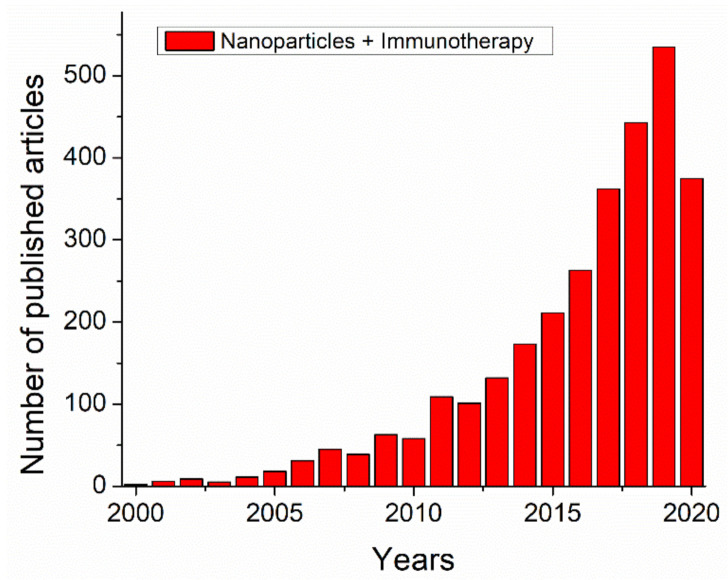
Figure 1
Figure 1
A number of published papers for the last two decades (i.e., 2000–2020) by searching on PubMed using key words “nanoparticles + immunotherapy”.
Figure 2
Figure 2
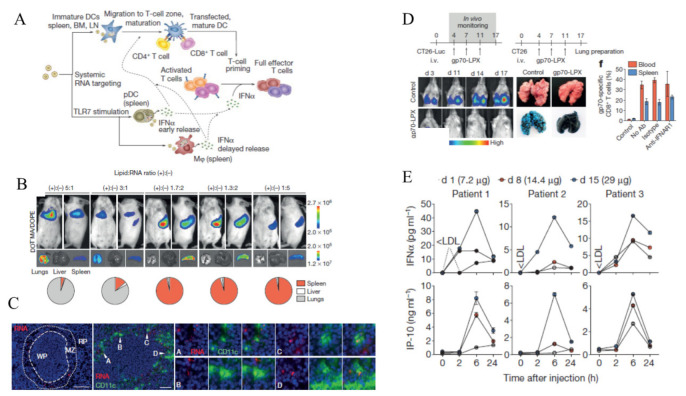
RNA-lipoplexes (RNA-LPX) delivery to DCs. (A) Mechanism action of RNA-LPX to induce anti-tumor immune responses, (B) Bioluminescence imaging of BALB/c mice, (C) Splenic localization of CD11c and Cy3 double-positive cells in BALB/c mice after 1 h of Cy3-labelled RNA-LPX i.v. injection, (D) in vivo studies in CT26 tumor bearing BALB/c mice immunized with gp70-LPX, and (E) Clinically administered RNA-LPX vaccines induce systemic INFα in dose-dependently manner. Reproduced with permission from [82]. Copyright 2016, Springer Nature.
Figure 3
Figure 3
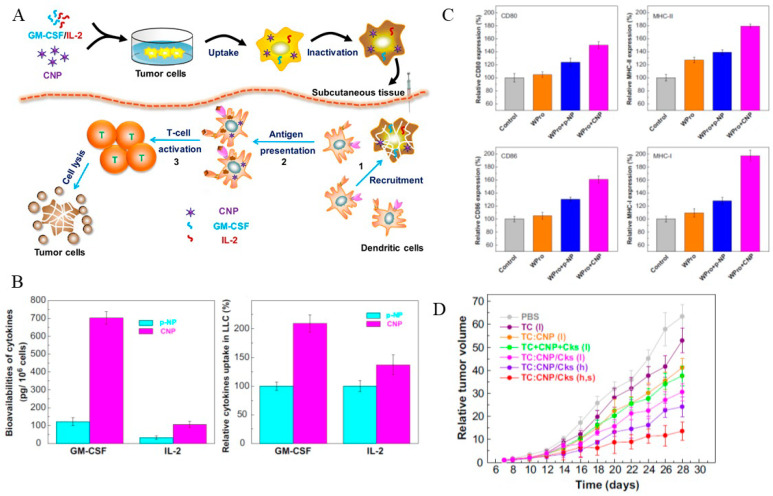
(A) Scheme of multi-adjuvant WCTV to initiate anti-tumor immunity, (B) bioavailability and cellular up take of GM-CSF and IL-2 in LLC cells after incubating with nanoparticles (NPs) for 24 h, (C) relative expressions of CD80, CD86, MHC II, and MHC-I molecules after treatment with whole tumor cell lysate protein (WPro), p-NP, and CNP for 24 h and (D) Relative tumor volume of LLC tumor bearing mice after immunization with multi-adjuvant WCTVs compared with other vaccine groups. Reproduced with permission from [93]. Copyright 2013, Elsevier Ltd.
Figure 4
Figure 4
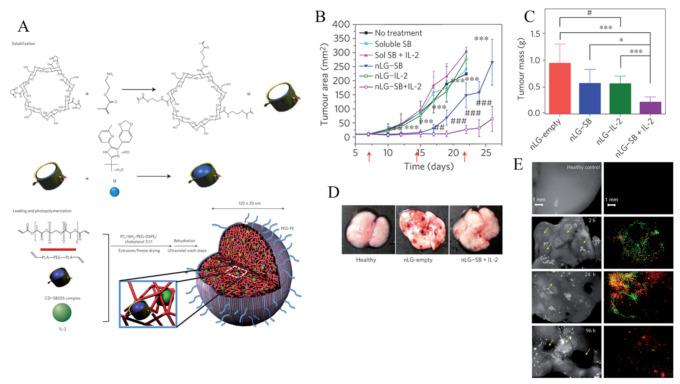
(A) The synthesis approach of the liposomal polymeric gel (nLG) particle system. (B) Plot of tumor area versus time. Red arrows indicate treatments (via intratumoral injection). (p < 0.05, *, p < 0.001, ***, By ANOVA with Turkey’s multiple comparison test. p < 0.05, #, by two-tailed t-test. (C) Tumor masses vs nLG-treated groups, p < 0.001, ***, p < 0.01, **, p < 0.05, *, By ANOVA using Turkey’s post-test. (D) Images of lung immediately before collection of lung-infiltrating lymphocytes from mice, (E) Uptake of lipid carrier (green) and rhodamine payload (red) around individual lung tumors at 2 h post injection. Reproduced with permission from [107]. Copyright 2012, Nature Publishing Group.
Figure 5
Figure 5
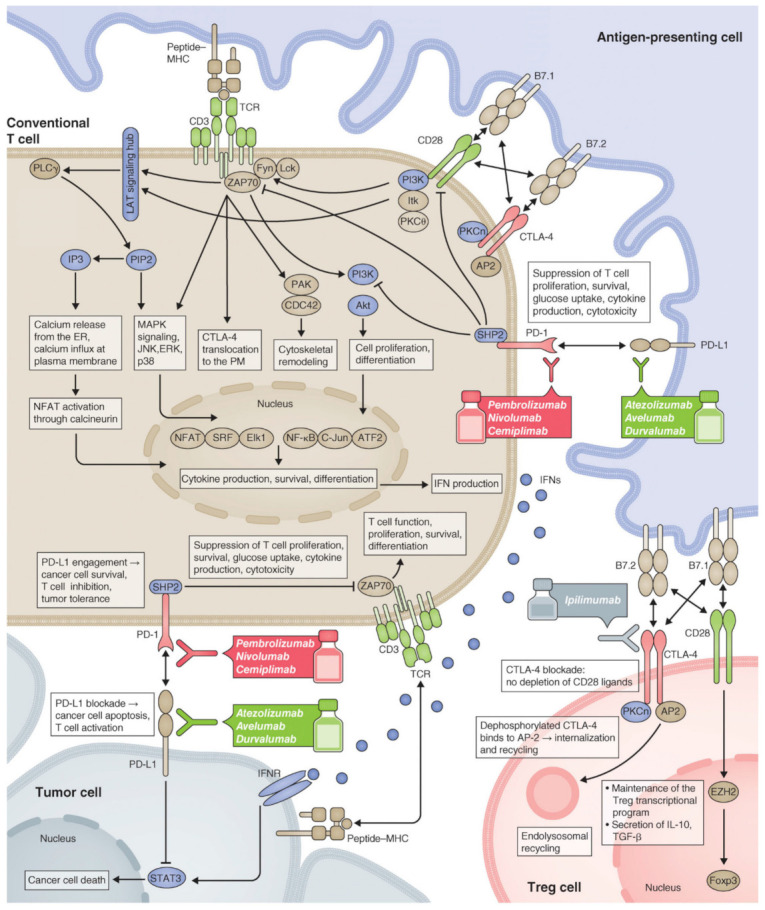
Mechanism action of Immune Checkpoint Inhibitors (ICIs). Reproduced with permission from the Journal of Cell Biology [124].
Figure 6
Figure 6
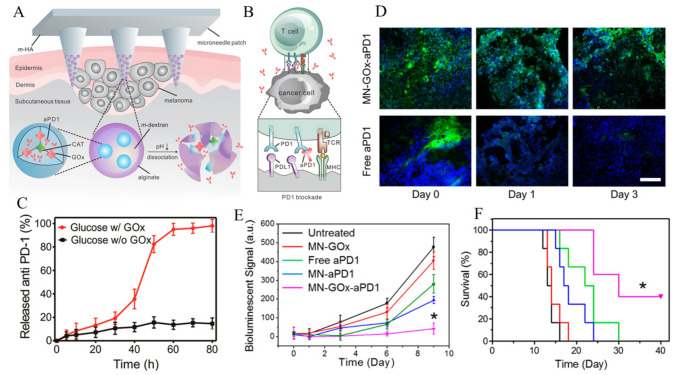
(A) Scheme of aPD1 delivery via microneedle (MN) patch, (B) Mechanism action of aPD1 to activate T-cell, (C) aPD1 release (%) from the MN patches in the presence of 100 mg/dL glucose solution at 37 °C, (D) Immunofluorescence staining of tumors treated with MN-GOx-aPD1 or free aPD1 at different time points (green: aPD1, blue: nucleus), (E) Bioluminescence signals vs. time after treatment with different groups, and (F) % Survival plot of mice after MN patch-assisted delivery of aPD1 therapy. P value: *, p < 0.05. Reproduced with permission from [126]. Copyright 2016, American Chemical Society.
Figure 7
Figure 7
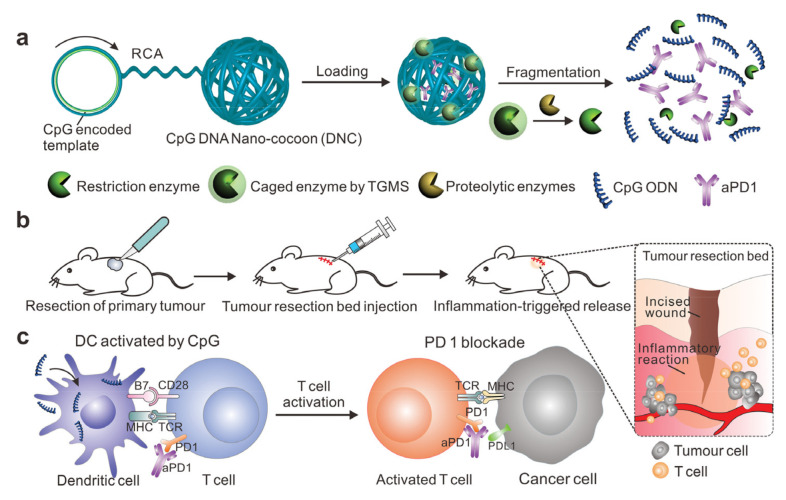
Schematic illustration of (a) aPD1 and caged restriction enzyme loaded DNA nanococoon (DNC), (b) In vivo tumor immunotherapy after primary tumor resection, local injection, and treatment of DNC-based delivery system and (c) Activation of DCs by CpG which in turn activates T cell response with aPD1 for PD 1 blockade. Reproduced with permission from [127]. Copyright 2016, WILEY-VCH Verlag GmbH & Co. KGaA, Weinheim.
Figure 8
Figure 8
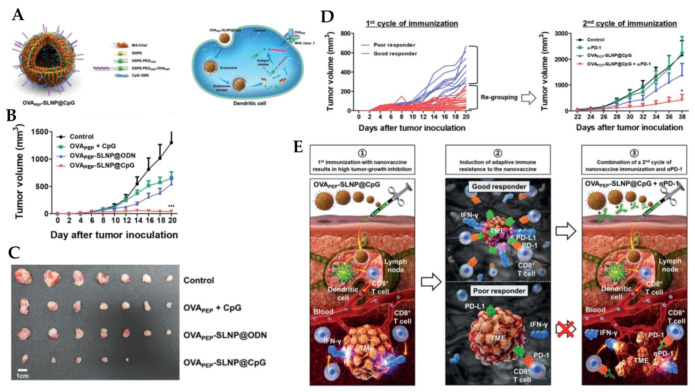
(A) Scheme and mechanism action of OVAPEP-SLNP@CpG nanovaccine, (B) Therapeutic efficacy of OVAPEP-SLNP@CpG nanovaccine in an established tumor model, (C) representative image of tumors. Scale bar = 1 cm, (D) First cycle and second cycle of immunization, (E) Overall process of sequential and timely combination strategy between cancer nanovaccine. p < 0.001, ***, p < 0.05, *, Reproduced with permission from [136]. Copyright 2020, Wiley-VCH Verlag GmbH & Co. KGaA, Weinheim.

References

    1. McCormack V.A., Boffetta P. Today’s lifestyles, tomorrow’s cancers: Trends in lifestyle risk factors for cancer in low- and middle-income countries. Ann. Oncol. 2011;22:2349–2357. doi: 10.1093/annonc/mdq763. - DOI - PubMed
    1. Blackadar C.B. Historical review of the causes of cancer. World J. Clin. Oncol. 2016;7:54–86. doi: 10.5306/wjco.v7.i1.54. - DOI - PMC - PubMed
    1. Bray F., Ferlay J., Soerjomataram I., Siegel R.L., Torre L.A., Jemal A. Global cancer statistics 2018: GLOBOCAN estimates of incidence and mortality worldwide for 36 cancers in 185 countries. CA Cancer J. Clin. 2018;68:394–424. doi: 10.3322/caac.21492. - DOI - PubMed
    1. Arruebo M., Vilaboa N., Sáez-Gutierrez B., Lambea J., Tres A., Valladares M., González-Fernández A. Assessment of the evolution of cancer treatment therapies. Cancers. 2011;3:3279–3330. doi: 10.3390/cancers3033279. - DOI - PMC - PubMed
    1. Suo X., Zhang J., Zhang Y., Liang X.J., Zhang J., Liu D. A nano-based thermotherapy for cancer stem cell-targeted therapy. J. Mater. Chem. B. 2020;8:3985–4001. doi: 10.1039/D0TB00311E. - DOI - PubMed

LinkOut - more resources