


Maternal mortality in six low and lower-middle income countries from 2010 to 2018: risk factors and trends
- PMID: 33334343
- PMCID: PMC7745363
- DOI: 10.1186/s12978-020-00990-z
Maternal mortality in six low and lower-middle income countries from 2010 to 2018: risk factors and trends
Abstract
Background: Maternal mortality is a public health problem that disproportionately affects low and lower-middle income countries (LMICs). Appropriate data sources are lacking to effectively track maternal mortality and monitor changes in this health indicator over time.
Methods: We analyzed data from women enrolled in the NICHD Global Network for Women's and Children's Health Research Maternal Newborn Health Registry (MNHR) from 2010 through 2018. Women delivering within research sites in the Democratic Republic of Congo, Guatemala, India (Nagpur and Belagavi), Kenya, Pakistan, and Zambia are included. We evaluated maternal and delivery characteristics using log-binomial models and multivariable models to obtain relative risk estimates for mortality. We used running averages to track maternal mortality ratio (MMR, maternal deaths per 100,000 live births) over time.
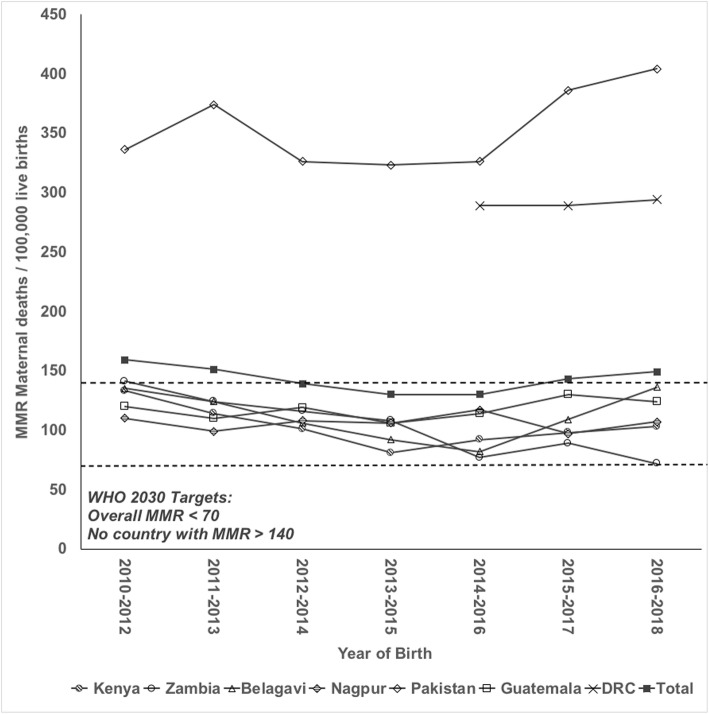
Results: We evaluated 571,321 pregnancies and 842 maternal deaths. We observed an MMR of 157 / 100,000 live births (95% CI 147, 167) across all sites, with a range of MMRs from 97 (76, 118) in the Guatemala site to 327 (293, 361) in the Pakistan site. When adjusted for maternal risk factors, risks of maternal mortality were higher with maternal age > 35 (RR 1.43 (1.06, 1.92)), no maternal education (RR 3.40 (2.08, 5.55)), lower education (RR 2.46 (1.54, 3.94)), nulliparity (RR 1.24 (1.01, 1.52)) and parity > 2 (RR 1.48 (1.15, 1.89)). Increased risk of maternal mortality was also associated with occurrence of obstructed labor (RR 1.58 (1.14, 2.19)), severe antepartum hemorrhage (RR 2.59 (1.83, 3.66)) and hypertensive disorders (RR 6.87 (5.05, 9.34)). Before and after adjusting for other characteristics, physician attendance at delivery, delivery in hospital and Caesarean delivery were associated with increased risk. We observed variable changes over time in the MMR within sites.
Conclusions: The MNHR is a useful tool for tracking MMRs in these LMICs. We identified maternal and delivery characteristics associated with increased risk of death, some might be confounded by indication. Despite declines in MMR in some sites, all sites had an MMR higher than the Sustainable Development Goals target of below 70 per 100,000 live births by 2030.
Trial registration: The MNHR is registered at NCT01073475 .
Keywords: Global network; Low-resource countries; Maternal mortality; Sustainable development goals.
Conflict of interest statement
The authors declare that they have no competing interests.
Figures

References
-
- SDG 3: Ensure healthy lives and promote wellbeing for all at all ages [https://www.who.int/sdg/targets/en/] Accessed 14 Jan 2020.
MeSH terms
Associated data
Grants and funding
LinkOut - more resources
Full Text Sources
Medical
