Review
. 2021 Jan-Jun:296:100191.
doi: 10.1074/jbc.REV120.015203. Epub 2020 Dec 20.

Frameworks for targeting RNA with small molecules

Affiliations
Review

Frameworks for targeting RNA with small molecules

Aline Umuhire Juru et al. J Biol Chem. 2021 Jan-Jun.

Abstract

Since the characterization of mRNA in 1961, our understanding of the roles of RNA molecules has significantly grown. Beyond serving as a link between DNA and proteins, RNA molecules play direct effector roles by binding to various ligands, including proteins, DNA, other RNAs, and metabolites. Through these interactions, RNAs mediate cellular processes such as the regulation of gene transcription and the enhancement or inhibition of protein activity. As a result, the misregulation of RNA molecules is often associated with disease phenotypes, and RNA molecules have been increasingly recognized as potential targets for drug development efforts, which in the past had focused primarily on proteins. Although both small molecule-based and oligonucleotide-based therapies have been pursued in efforts to target RNA, small-molecule modalities are often favored owing to several advantages including greater oral bioavailability. In this review, we discuss three general frameworks (sets of premises and hypotheses) that, in our view, have so far dominated the discovery of small-molecule ligands for RNA. We highlight the unique merits of each framework as well as the pitfalls associated with exclusive focus of ligand discovery efforts within only one framework. Finally, we propose that RNA ligand discovery can benefit from using progress made within these three frameworks to move toward a paradigm that formulates RNA-targeting questions at the level of RNA structural subclasses.

Keywords: RNA folding; RNA structure; RNA-targeted therapies; drug discovery; long noncoding RNA; miRNA; riboswitch; small molecule; trinucleotide repeat disease.


Conflict of interest statement

Conflict of interest The authors declare that they have no conflicts of interest with the contents of this article.

Figures
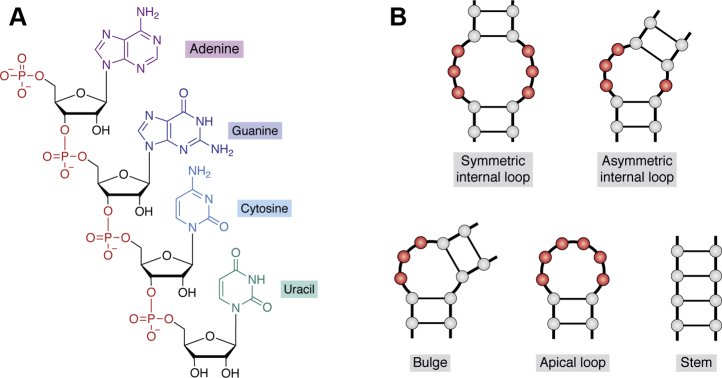
Figure 1
Figure 1
Chemical composition and secondary structure motifs of RNA.A, chemical structure of a sample RNA strand composed of the four bases found in RNA. Because they utilize only four monomers, RNA molecules are often considered to have low chemical diversity compared to proteins that are made of 22 amino acids (46). In addition, unlike proteins that exhibit a wide range of net charge, RNA molecules are negatively charged at physiological pH because of the acidic phosphate backbone. B, canonical secondary structure motifs of RNA. RNA molecules fold through complementary base pairing. In addition to the canonical A–U and G–C base pairs, RNA folding also utilizes non-Watson–Crick base pairs such as the well-studied G–U wobble pair (47) and several others (48). Unpaired regions are highlighted in red.
Figure 2
Figure 2
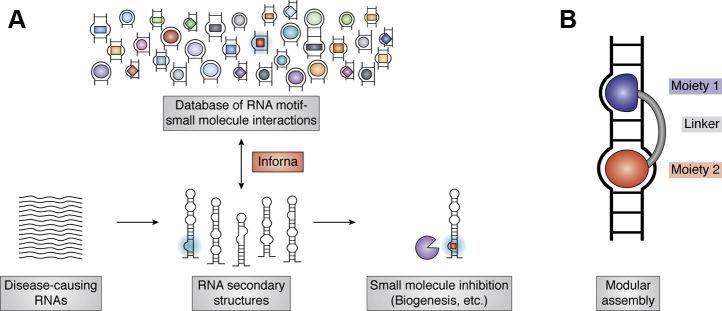
Example study in Framework 1. A, illustration of how the Inforna database is used to identify small molecules interacting with a disease-causing RNA of interest. Inforna compares secondary structure motifs in the target of interest with those found in the database and then outputs small molecules predicted to bind to one or more of the secondary structure motifs in the target RNA. The figure was adapted from Disney and Angelbello (56) with permission. Copyright (2016) American Chemical Society. B, the modular assembly technique where moieties binding neighboring secondary structure motifs are linked together to increase potency.
Figure 3
Figure 3
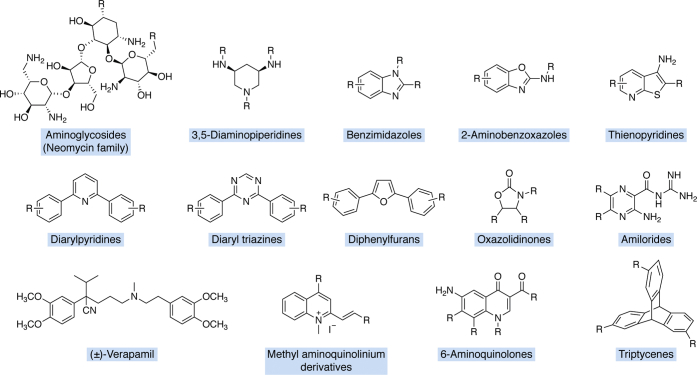
Example of small-molecule classes that have been pursued through scaffold-based synthesis. R groups represent substituents used to diversify the central core scaffold.
Figure 4
Figure 4
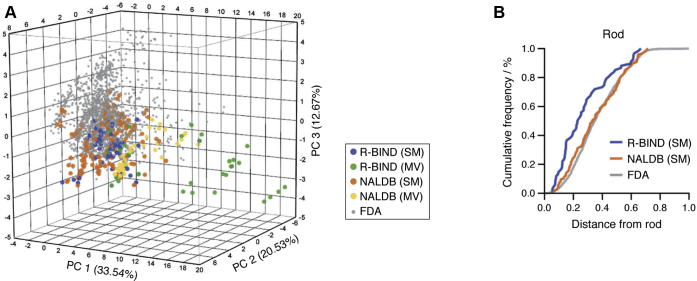
Comparison of molecules in the RNA-targeted BIoactive ligaNd Database (R-BIND) to Food and Drug Administration (FDA)–approved drugs and general nucleic acid–binding ligands (NALDBs). A, principal component analysis on 20 calculated cheminformatics parameters. R-BIND ligands occupy a focused region of the chemical space defined by the three libraries. B, ligand shape expressed in terms of rod likeness. The R-BIND database is enriched in molecules with rod-like character compared with the FDA and NALDB libraries. SM denotes the monovalent small-molecule category within R-BIND and NALDB, whereas MV denotes multivalent compounds defined as having two binding moieties connected by a linker and a molecular weight greater than 500 amu. The figure was adapted from Morgan et al. (112) with permission. Copyright (2017) Wiley-VCH Verlag GmbH & Co KGaA, Weinheim.
Figure 5
Figure 5
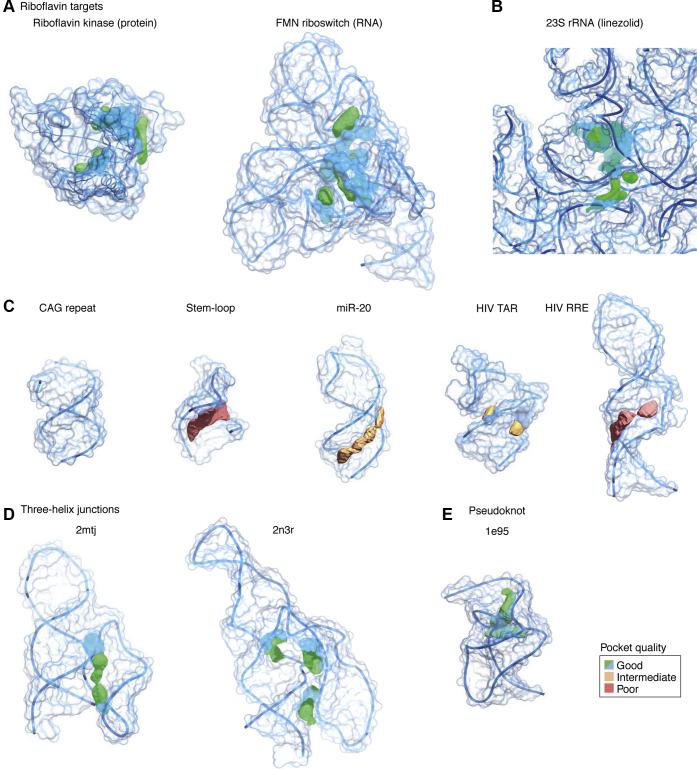
Pocket analysis in RNA structures performed by Warner et al. (17). Complex structures have good quality pockets (green/blue), whereas stem loops have poorer pockets (orange and red). A and B, currently targeted RNA structures with good quality pockets. C, currently targeted RNA structures with low-to-medium quality pockets. D and E, aspirational targets with potential good quality pockets. The figure was reprinted with permission from Springer Nature Customer Service Centre GmbH: Springer Nature, Nature Reviews Drug Discovery (17), Copyright 2018.

References

    1. Boivin A., Vendrely R. Sur le rôle possible des deux acides nucléiques dans la cellule vivante. Experientia. 1947;3:32–34. - PubMed
    1. Cobb M. Who discovered messenger RNA? Curr. Biol. 2015;25:R526–R532. - PubMed
    1. Brenner S., Jacob F., Meselson M. An unstable intermediate carrying information from genes to ribosomes for protein synthesis. Nature. 1961;190:576–581. - PubMed
    1. Gros F., Hiatt H., Gilbert W., Kurland C.G., Risebrough R.W., Watson J.D. Unstable ribonucleic acid revealed by pulse labelling of Escherichia coli. Nature. 1961;190:581–585. - PubMed
    1. Jarroux J., Morillon A., Pinskaya M. History, discovery, and classification of lncRNAs. In: Rao M.R.S., editor. Long Non Coding RNA Biology. Springer Singapore; Singapore: 2017. pp. 1–46. - PubMed

Publication types