Review
. 2020 Dec 18;5(1):288.
doi: 10.1038/s41392-020-00361-x.

Targeting multiple signaling pathways: the new approach to acute myeloid leukemia therapy

Affiliations
Review

Targeting multiple signaling pathways: the new approach to acute myeloid leukemia therapy

Jenna L Carter et al. Signal Transduct Target Ther. .

Abstract

Acute myeloid leukemia (AML) is the most common form of acute leukemia in adults and the second most common form of acute leukemia in children. Despite this, very little improvement in survival rates has been achieved over the past few decades. This is partially due to the heterogeneity of AML and the need for more targeted therapeutics than the traditional cytotoxic chemotherapies that have been a mainstay in therapy for the past 50 years. In the past 20 years, research has been diversifying the approach to treating AML by investigating molecular pathways uniquely relevant to AML cell proliferation and survival. Here we review the development of novel therapeutics in targeting apoptosis, receptor tyrosine kinase (RTK) signaling, hedgehog (HH) pathway, mitochondrial function, DNA repair, and c-Myc signaling. There has been an impressive effort into better understanding the diversity of AML cell characteristics and here we highlight important preclinical studies that have supported therapeutic development and continue to promote new ways to target AML cells. In addition, we describe clinical investigations that have led to FDA approval of new targeted AML therapies and ongoing clinical trials of novel therapies targeting AML survival pathways. We also describe the complexity of targeting leukemia stem cells (LSCs) as an approach to addressing relapse and remission in AML and targetable pathways that are unique to LSC survival. This comprehensive review details what we currently understand about the signaling pathways that support AML cell survival and the exceptional ways in which we disrupt them.


Conflict of interest statement

Y.G. has received research funding from MEI Pharma, Inc. J.Y. has received research funding from Janssen Pharmaceuticals, Arog Pharmaceuticals, Forma, and AstraZeneca. All other authors declare no competing interests.

Figures
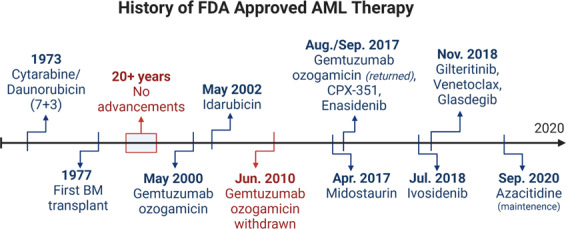
Fig. 1
Fig. 1
History of AML therapies. Timeline of approved clinical therapies in the United States for the treatment of AML
Fig. 2
Fig. 2
Targeting antiapoptotic proteins induces apoptosis in AML. a Antiapoptotic proteins Mcl-1 and Bcl-2 bind and sequester apoptotic effector proteins Bak/Bax to prevent Bak/Bax oligomerization and subsequent induction of apoptosis. b BH3 mimetics bind to the BH3-binding site of antiapoptotic proteins, Bcl-2 and Mcl-1, and release Bax/Bak to promote oligomerization and MOMP, which leads to subsequent induction of apoptosis. c Oblimersen is an anti-sense oligonucleotide that binds specifically to Bcl-2 mRNA to prevent Bcl-2 translation and promote AML cell apoptosis. Selinexor (KPT330) inhibits XPO1 expression and subsequently decreases Mcl-1 stability to promote AML cell apoptosis. CDK9 inhibitors prevent the transcription of Mcl-1 gene to promote apoptosis of AML cells
Fig. 3
Fig. 3
Inhibition of RTKs in AML. Class III (FLT3 and c-Kit) and TAM (MERTK and AXL) RTKs are implicated in leukemogenesis and progression of AML. RTKs support proliferation and survival through PI3K/AKT, Ras/Ref/MEK/ERK, and JAK/STAT signaling pathways. c-Kit is commonly overexpressed in AML and FLT3 mutations in the tyrosine kinase domain (TKD) or ITD in the juxtadomain result in constitutive activation. MERTK and AXL are overexpressed in AML as is their ligand Gas6. Inhibition of RKTs (via inhibitors listed) inhibits downstream signaling and suppresses proliferation and survival of AML cells
Fig. 4
Fig. 4
Targeting AML cell mitochondria function. Expression of gain-of-function mutant IDH1/2 (mIDH) results in the production of oncometabolite, 2-HG, which inhibits maturation of hematopoietic cells and promotes leukemia. Inhibitors specific to mIDH (enasidenib, AGI-6780, ivosidenib, AGI-5198, FT2102, BAY143602, IDH305) prevent the production of 2-HG and promote differentiation of leukemia cells. CB893, a glutaminase-specific inhibitor, prevents the production of α-ketoglutarate (α-KG)—a key metabolite for mIDH cell survival. IACS-010759 and ME-344 target AML cell OXPHOS through inhibition of ETC complex I. ONC201/ONC212 induce mitochondrial stress through activation of mitochondrial protease, ClpP, which leads to subsequent mitochondrial dysfunction and AML cell stress (ISR)
Fig. 5
Fig. 5
Targeting c-Myc signaling in AML. a c-Myc (MYC) transcription is promoted through interactions with Brd4 and P-TEFb, which includes CDK9. Targeted therapies that suppress the initiation of transcription include the Brd4 inhibitor, JQ-1, and inhibitors of CDK9. Other inhibitors of c-Myc transcription include the G-quadruplex (G4) ligand, GQC-05, and the dual inhibitor of PI3K and HDAC, CUDC-907. Inhibitors of HDAC may work to inhibit c-Myc transcription through HDAC6, which stabilizes a transcription factor that influences c-Myc expression. PI3K/AKT signaling also promotes c-Myc transcription and is inhibited via RTK inhibitors. b c-Myc translation is dependent on the formation of the translation-initiation complex, eIF4F, and the assembly of ribosomal subunit, 40S, which are both promoted through the activity of mTORC1. mTORC1 is indirectly suppressed through inhibition PI3K/AKT via RTK inhibitors and CUDC-907. Additionally, c-Myc translation is repressed via ASOs binding to c-Myc mRNA transcripts. c c-Myc promotes AML cell survival and proliferation and is reliant on interactions with its co-factor Max to promote transcription of survival signals. 10058-F4 inhibits the interaction of c-Myc and Max to prevent transcription and promote AML cell death. c-Myc represses Sp1, a transcription factor, to also promote cell survival. HDAC inhibitors induce acetylation of c-Myc to free Sp1 to promote cell death
Fig. 6
Fig. 6
Targeting LSCs. LSCs have been found to express CD34, CD33, CD123, and CD47 surface antigens. Gemtuzumab ozogamicin is an antibody–drug conjugate that recognizes CD33 on LSCs and cellular internalization results in apoptosis via cytotoxic effects of the drug conjugate, ozogamicin. CAR-T cells that recognize surface antigens on LSCs are able to induce apoptosis in LSCs following binding. Tagraxofusp (IL-3 fusion toxin), talacotuzumab (anti-CD123 monoclonal antibody), and IMGN632 (CD123 antibody–drug conjugate) are CD123-specific immunotherapies. Magrolimab (anti-CD47 monoclonal antibody), CC-9002 (anti-CD47 monoclonal antibody), and TTI-621 (SIRPα-Fc fusion protein antibody) are CD47-specific immunotherapies. LSCs are uniquely reliant on oxidative phosphorylation for cell survival and amino acid metabolism and fatty acid oxidation are important for supplying intermediates for the TCA cycle in LSCs. Inhibition of mitochondrial respiration via direct ETC inhibitors (IACS-010759, ME-344) and indirectly via Bcl-2 inhibition (venetoclax) represents possible LSC therapeutics. ST1326 inhibits an enzyme in fatty acid oxidation (FAO) and limits FAO support of TCA cycle to indirectly inhibit mitochondrial respiration in LSCs
Fig. 7
Fig. 7
Therapies targeting AML pathways. Summary of newly approved therapeutics, therapeutics currently under clinical investigations, preclinical therapies, and failed clinical therapies in AML

References

    1. Garcia-Manero G, et al. Pracinostat plus azacitidine in older patients with newly diagnosed acute myeloid leukemia: results of a phase 2 study. Blood Adv. 2019;3:508–518. doi: 10.1182/bloodadvances.2018027409. - DOI - PMC - PubMed
    1. American Cancer Society. Key statistics for acute myeloid leukemia. https://www.cancer.org/cancer/acute-myeloid-leukemia/about/key-statistic... (2020).
    1. National Cancer Institute (SEER). Cancer stat facts: leukemia - acute myeloid leukemia. https://seer.cancer.gov/statfacts/html/amyl.html (2020).
    1. Granfeldt Østgård LS, et al. Epidemiology and clinical significance of secondary and therapy-related acute myeloid leukemia: a national population-based cohort study. J. Clin. Oncol. 2015;33:3641–3649. doi: 10.1200/JCO.2014.60.0890. - DOI - PubMed
    1. Caldwell JT, Ge Y, Taub JW. Prognosis and management of acute myeloid leukemia in patients with Down syndrome. Expert Rev. Hematol. 2014;7:831–840. doi: 10.1586/17474086.2014.959923. - DOI - PMC - PubMed

MeSH terms

Substances
