. 2020 Dec 17;10(1):22235.
doi: 10.1038/s41598-020-79000-y.

Exploring the effectiveness of a COVID-19 contact tracing app using an agent-based model

Affiliations

Exploring the effectiveness of a COVID-19 contact tracing app using an agent-based model

Jonatan Almagor et al. Sci Rep. .

Abstract

A contact-tracing strategy has been deemed necessary to contain the spread of COVID-19 following the relaxation of lockdown measures. Using an agent-based model, we explore one of the technology-based strategies proposed, a contact-tracing smartphone app. The model simulates the spread of COVID-19 in a population of agents on an urban scale. Agents are heterogeneous in their characteristics and are linked in a multi-layered network representing the social structure-including households, friendships, employment and schools. We explore the interplay of various adoption rates of the contact-tracing app, different levels of testing capacity, and behavioural factors to assess the impact on the epidemic. Results suggest that a contact tracing app can contribute substantially to reducing infection rates in the population when accompanied by a sufficient testing capacity or when the testing policy prioritises symptomatic cases. As user rate increases, prevalence of infection decreases. With that, when symptomatic cases are not prioritised for testing, a high rate of app users can generate an extensive increase in the demand for testing, which, if not met with adequate supply, may render the app counterproductive. This points to the crucial role of an efficient testing policy and the necessity to upscale testing capacity.


Conflict of interest statement

The authors declare no competing interests.

Figures
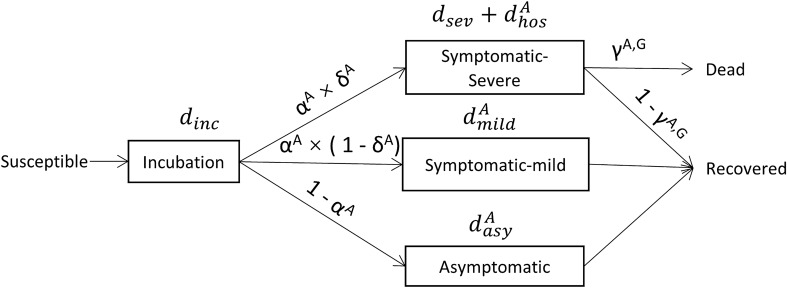
Figure 1
Figure 1
Disease progression. Rectangles represent states of the disease and arrows the transition between states. dstateA denotes the duration of the disease state given the age A of the agent. Agents with severe symptomatic disease spend dsev days at home before being admitted to the hospital for a duration of dhosA days. Transition between disease states occurs with age dependent probabilities; where αA and 1-αA denote the probability of an agent of age A being symptomatic and asymptomatic, respectively. δA denotes the probability for a symptomatic agent to progress into severe disease; γA,G denotes the probability of a severely ill agent of age A and gender G to die. For details of parameter values see: Supplementary Table S1.
Figure 2
Figure 2
Procedure for testing, self-isolation and CTA notification. Once symptomatic agent i becomes aware of the disease, the agent seeks testing. If tests are available, the agent gets tested. Following a positive result the agent will self-isolate. Household members h of agent i will self-isolate with probability ωh and relatives will be notified. If the agent is a pupil all classmates will self-isolate and seek testing. If agent i uses the CTA all the recorded contacts will be notified. When tests are unavailable, agent i will self-isolate with probability ωi. In case the agent self-isolates the aforementioned procedure of self-isolation will take place without the notification to CTA contacts. Otherwise the agent will continue as usual. Once CTA user j is notified, agent j will seek testing. If testing is unavailable, agent j may self-isolate with probability ωjΩ.
Figure 3
Figure 3
Distribution of daily contacts and epidemic dynamics, for scenarios with and without social distancing. (a) Distribution of number of daily contacts. (b) Distribution of infection sources by type of contact. (c) Infection prevalence by day, from beginning to end of the epidemic.
Figure 4
Figure 4
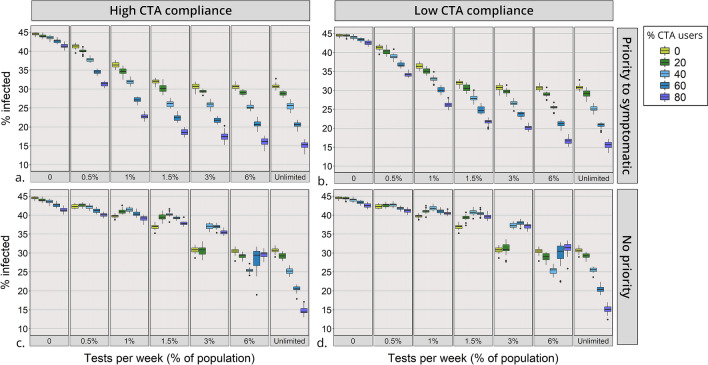
Percentage of the population infected during the course of epidemic. Scenarios vary by testing capacity (x-axis) and percentage of CTA users (boxplot’s colour). Diagrams are organized by testing policy and compliance with self-isolation of CTA users: (a) High compliance and priority for testing symptomatic cases; (b) Low compliance and priority for testing symptomatic cases; (c) High compliance and no priority for testing symptomatic cases; (d) Low compliance and no priority for testing symptomatic cases. The boxplots show the median and interquartile range of multiple simulation runs.
Figure 5
Figure 5
Reduction in infection prevalence at the peak of the epidemic. Reduction is relative to the peak of the epidemic in the baseline scenario and measured as percent reduction of this value. Scenarios vary by percent of CTA users (x-axis) and testing capacity (y-axis) and organised by testing policy and compliance with self-isolation of CTA users: (a) high compliance and priority for testing symptomatic cases; (b) low compliance and priority for testing symptomatic cases; (c) high compliance and no priority for testing symptomatic cases; (d) low compliance and no priority for testing symptomatic cases.
Figure 6
Figure 6
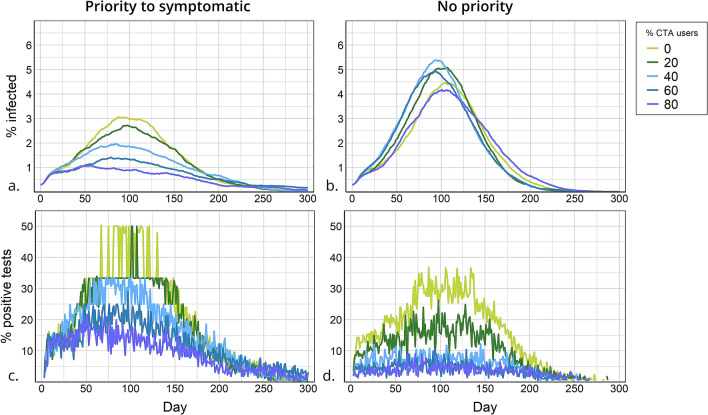
Infection prevalence and positive tests for a testing policy with and without priority to symptomatic cases. Percentage infected (a) and percentage of positive tests (c) by day, for a testing policy with priority to symptomatic. Percentage infected (b) and percentage positive tests (d) by day, for a testing policy without priority. Percentage of CTA users in the scenario is marked by line colour. In these scenarios: testing capacity = 1.5% and CTA compliance is high. Note that in the scenarios with no CTA users, although only symptomatic cases are tested, the percentage of positive tests is not 100% because of cases with influenza-like illness that are also being tested.

References

    1. World Health Organization. Coronavirus disease pandemic. https://www.who.int/emergencies/diseases/novel-coronavirus-2019 (2020).
    1. Ferguson, N. M. et al. Report 9: impact of non-pharmaceutical interventions (NPIs) to reduce COVID-19 mortality and healthcare demand. Technical report March (2020). 10.25561/77482. - PMC - PubMed
    1. Flaxman, S., Mishra, S., Gandy, A. & Al, E. Report 13: estimating the number of infections and the impact of non-pharmaceutical interventions on COVID-19 in 11 European countries. Technical report March (2020). 10.25561/77731.
    1. Fraser C, Riley S, Anderson RM, Ferguson NM. Factors that make an infectious disease outbreak controllable. Proc. Nat. Acad. Sci. USA. 2004;101:6146–6151. doi: 10.1073/pnas.0307506101. - DOI - PMC - PubMed
    1. Lavezzo E, et al. Suppression of COVID-19 outbreak in the municipality of Vo, Italy. medRxiv. 2020 doi: 10.1101/2020.04.17.20053157. - DOI

Publication types