


A bio-ecological framing of evidence on the determinants of adolescent mental health - A scoping review of the international Health Behaviour in School-Aged Children (HBSC) study 1983-2020
- PMID: 33335971
- PMCID: PMC7732871
- DOI: 10.1016/j.ssmph.2020.100697
A bio-ecological framing of evidence on the determinants of adolescent mental health - A scoping review of the international Health Behaviour in School-Aged Children (HBSC) study 1983-2020
Abstract
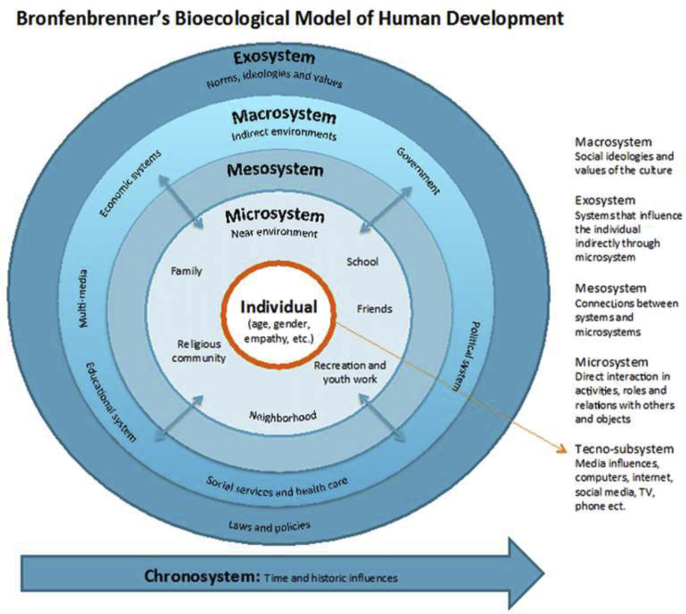
This paper extracts, organises and summarises findings on adolescent mental health from a major international population study of young people using a scoping review methodology and applying a bio-ecological framework. Population data has been collected from more than 1.5 million adolescents over 37 years by the Health Behaviour in School-Aged Children: WHO Cross-National (HBSC) Study. The paper reviews the contribution that this long standing study has made to our understanding of the individual, developmental, social, economic, cultural determinants of adolescent mental health by organising the findings of 104 empirical papers that met inclusion criteria, into individual, microsystem, mesosystem and macrosystem levels of the framework. Of these selected papers, 68 were based on national data and the other 36 were based on international data, from varying numbers of countries. Each paper was allocated to a system level in the bio-ecological framework according to the level of its primary focus. The majority (51 papers) investigate individual level determinants. A further 28 concentrate primarily on the microsystem level, 6 on the mesosystem level, and 29 on the macrosystem level. The paper identifies where there is evidence on the determinants of mental health, summarises what we have learned, and highlights research gaps. Implications for the future development of this population health study are discussed in terms of how it may continue to illuminate our understanding of adolescent mental health in a changing world and where new directions are required.
Keywords: Adolescent; Bio-ecological framework; Cross-national survey; Determinants of mental health; HBSC; Population mental health; Social determinants.
© 2020 The Author(s).
Figures
References
-
- Aarø L.E., Wold B., Kannas L., Rimpelä M. Health behaviour in schoolchildren A WHO cross-national survey: A presentation of philosophy, methods and selected results of the first survey. Health Promotion International. 1986;1(1):17–33.
-
- Antaramian S.P., Huebner E.S., Hills K.J., Valois R.F. A dual‐factor model of mental health: Toward a more comprehensive understanding of youth functioning. American Journal of Orthopsychiatry. 2010;80(4):462. - PubMed
-
- Antonovsky A. The salutogenic perspective: Toward a new view of health and illness. Advances. 1987;4(1):47–55.
-
- Arksey H., O'Malley L. Scoping studies: Towards a methodological framework. International Journal of Social Research Methodology. 2005;8(1):19–32.
-
- Arnarsson A., Nygren J., Nyholm M., Torsheim T., Augustine L., Bjereld Y.…Nielsen L. Cyberbullying and traditional bullying among Nordic adolescents and their impact on life satisfaction. Scandinavian Journal of Public Health. 2020;48(5):502–510. - PubMed
Publication types
LinkOut - more resources
Full Text Sources
Miscellaneous
