


The effect of dual-task training on cognition of people with different clinical conditions: An overview of systematic reviews
- PMID: 33336101
- PMCID: PMC7733129
- DOI: 10.1016/j.ibror.2020.06.005
The effect of dual-task training on cognition of people with different clinical conditions: An overview of systematic reviews
Abstract
Background: The number of patients with cognitive impairment increases as the population becomes older. This perspective may persist a burden on health care systems unless considered new options of prevention and treatment. The aim of this meta-synthesis is to analyze different systematic reviews on the effectiveness of dual-task training (DTT) on cognition and motor function of different people.
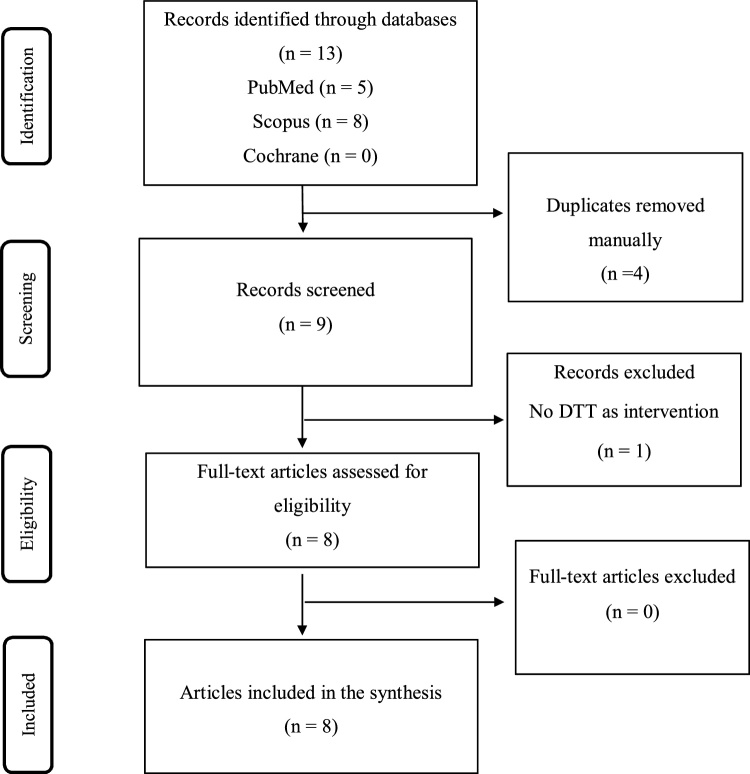
Methods: A systematic search of systematic reviews published until October 2019 was conducted in PubMed/Medline, Scopus and Cochrane databases addressing studies which investigated the effect of DTT compared to control or other intervention on cognitive functions of healthy or unhealthy individuals. Three steps were followed to retrieve studies: reading title, abstract and full text. Checklist Assessing the Methodological Quality of Systematic Reviews (AMSTAR) was used to assess the quality of selected articles.
Results: In terms of quality of evidence, according to AMSTAR, 62.5 % of the reviews were rated as being "low" and 37.5 % were graded as "moderate" quality. Two main themes were identified among the studies' outcomes: Improvement on mobility performance or postural stability; and beneficial effect on cognitive function. In terms of effect size, there were reported an important variation, having more significant results for findings involving mobility and modest effect for findings regarding cognitive function.
Conclusion: People with different clinical conditions could benefit from dual-task training. The benefits may encompass general cognitive functions, memory, physical performance, gait and balance, to name a few aspects.
Keywords: Cognition; Decision making; Dual-task intervention; Dual-task training; Executive functions; Memory; Motor cognitive training; Spatial navigation.
© 2020 The Author(s).
References
-
- Alzheimer’s Association 2018 Alzheimer’s disease facts and figures. Alzheimer’s & Dementia. 2018;14(3):367–429. doi: 10.1016/j.jalz.2018.02.001. - DOI
-
- Brustio P.R., Rabaglietti E., Formica S., Liubicich M.E. Dual-task training in older adults: the effect of additional motor tasks on mobility performance. Arch. Gerontol. Geriatr. 2018;75:119–124. - PubMed
-
- Cohen J. Routledge; 2013. Statistical Power Analysis for the Behavioral Sciences.
LinkOut - more resources
Full Text Sources
Medical
