


Is Reluctance to Share Alzheimer's Disease Biomarker Status with a Study Partner a Barrier to Preclinical Trial Recruitment?
- PMID: 33336225
- PMCID: PMC8112206
- DOI: 10.14283/jpad.2020.36
Is Reluctance to Share Alzheimer's Disease Biomarker Status with a Study Partner a Barrier to Preclinical Trial Recruitment?
Abstract
Background: Preclinical Alzheimer's disease clinical trials test candidate treatments in individuals with biomarker evidence but no cognitive impairment. Participants are required to co-enroll with a knowledgeable study partner, to whom biomarker information is disclosed.
Objective: We investigated whether reluctance to share biomarker results is associated with viewing the study partner requirement as a barrier to preclinical trial enrollment.
Design: We developed a nine-item assessment on views toward the study partner requirement and performed in-person interviews based on a hypothetical clinical trial requiring biomarker testing and disclosure.
Setting: We conducted interviews on campus at the University of California, Irvine.
Participants: Two hundred cognitively unimpaired older adults recruited from the University of California, Irvine Consent-to-Contact Registry participated in the study.
Measurements: We used logistic regression models, adjusting for potential confounders, to examine potential associations with viewing the study partner requirement as a barrier to preclinical trial enrollment.
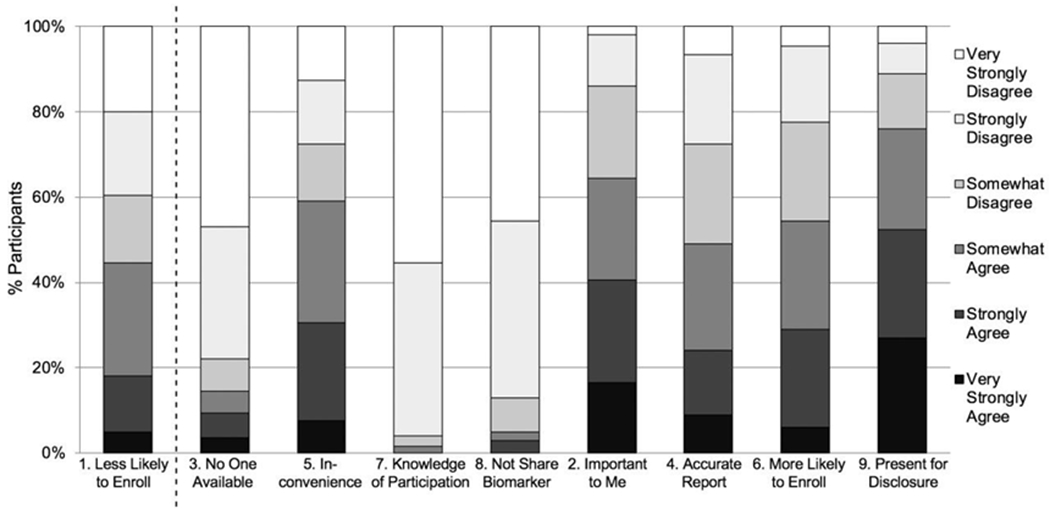
Results: Eighteen percent of participants reported strong agreement that the study partner requirement was a barrier to enrollment. Ten participants (5%) agreed at any level that they would be reluctant to share their biomarker result with a study partner. The estimated odds of viewing the study partner requirement as a barrier to enrollment were 26 times higher for these participants (OR=26.3, 95% CI 4.0, 172.3), compared to those who strongly disagreed that they would be reluctant to share their biomarker result. Overall, participants more frequently agreed with positive statements than negative statements about the study partner requirement, including 76% indicating they would want their study partner with them when they learned biomarker results.
Conclusions: This is one of the first studies to explore how potential preclinical Alzheimer's disease trial participants feel about sharing their personal biomarker information with a study partner. Most participants viewed the study partner as an asset to trial enrollment, including having a partner present during biomarker disclosure.
Keywords: Alzheimer’s disease; biomarker; disclosure.
Conflict of interest statement
The authors declare no conflicts of interest.
Figures
References
-
- Lim YY, Maruff P, Getter C, Snyder PJ. Disclosure of positron emission tomography amyloid imaging results: A preliminary study of safety and tolerability. Alzheimers Dement. 2015. - PubMed
-
- Wake T, Tabuchi H, Funaki K, Ito D, Yamagata B, Yoshizaki T, et al. Disclosure of Amyloid Status for Risk of Alzheimer Disease to Cognitively Normal Research Participants With Subjective Cognitive Decline: A Longitudinal Study. Am J Alzheimers Dis Other Demen. 2020;35:1533317520904551. - PMC - PubMed
-
- Wake T, Tabuchi H, Funaki K, Ito D, Yamagata B, Yoshizaki T, et al. The psychological impact of disclosing amyloid status to Japanese elderly: a preliminary study on asymptomatic patients with subjective cognitive decline. Int Psychogeriatr. 2018;30(5):635–9. - PubMed