Review
. 2021 May;473(5):823-840.
doi: 10.1007/s00424-020-02496-w. Epub 2020 Dec 17.

Age-related hearing loss pertaining to potassium ion channels in the cochlea and auditory pathway

Affiliations
Review

Age-related hearing loss pertaining to potassium ion channels in the cochlea and auditory pathway

Barbara Peixoto Pinheiro et al. Pflugers Arch. 2021 May.

Abstract

Age-related hearing loss (ARHL) is the most prevalent sensory deficit in the elderly and constitutes the third highest risk factor for dementia. Lifetime noise exposure, genetic predispositions for degeneration, and metabolic stress are assumed to be the major causes of ARHL. Both noise-induced and hereditary progressive hearing have been linked to decreased cell surface expression and impaired conductance of the potassium ion channel KV7.4 (KCNQ4) in outer hair cells, inspiring future therapies to maintain or prevent the decline of potassium ion channel surface expression to reduce ARHL. In concert with KV7.4 in outer hair cells, KV7.1 (KCNQ1) in the stria vascularis, calcium-activated potassium channels BK (KCNMA1) and SK2 (KCNN2) in hair cells and efferent fiber synapses, and KV3.1 (KCNC1) in the spiral ganglia and ascending auditory circuits share an upregulated expression or subcellular targeting during final differentiation at hearing onset. They also share a distinctive fragility for noise exposure and age-dependent shortfalls in energy supply required for sustained surface expression. Here, we review and discuss the possible contribution of select potassium ion channels in the cochlea and auditory pathway to ARHL. We postulate genes, proteins, or modulators that contribute to sustained ion currents or proper surface expressions of potassium channels under challenging conditions as key for future therapies of ARHL.

Keywords: BK; Kv3.1; Kv7.1; Kv7.4; Presbycusis; SK2.


Conflict of interest statement

The authors declare that they have no conflict of interest.

Figures
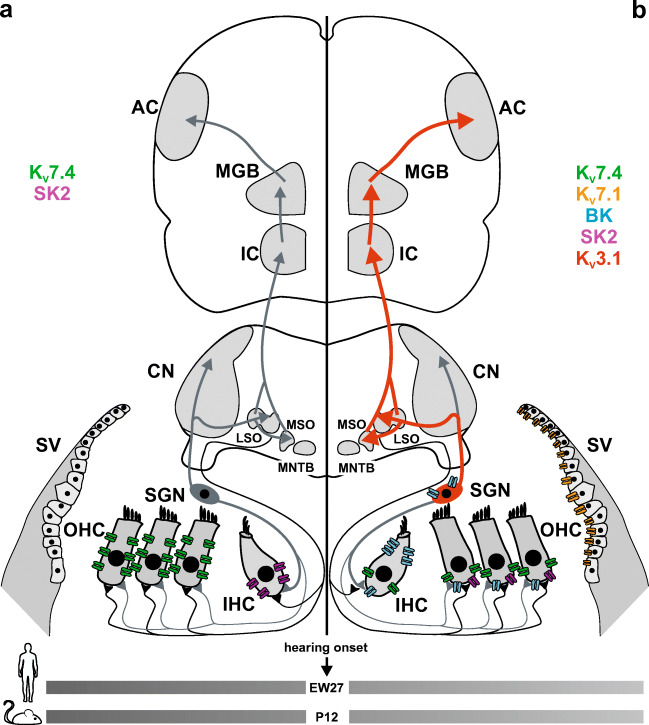
Fig. 1
Fig. 1
K+ expression along the ascending auditory pathway before and after hearing onset. a Before the onset of hearing, potassium ion (K+) channels are mainly expressed in the organ of Corti. In the outer hair cells (OHC), KV7.4 (KCNQ4, green) is found along the entire basolateral membrane, while the inner hair cells (IHCs) express the calcium-activated potassium channel SK2 (KCNN2, purple) before postnatal day (P) 12 in mice, corresponding to embryonic week (EW) 27 in humans. For reference, afferent (gray) and efferent (black) neural projections are shown. b In the mature organ of Corti, the endolymph of the scala media contains a high concentration of K+, which is mediated by KV7.1 (KCNQ1, orange) channels in the apical marginal cells of the stria vascularis (SV). During auditory stimulation, endolymphatic K+ enter the OHC at the basolateral membrane, and leave the cell via KV7.4, BK (KCNMA1, blue), and SK2 channels. In the IHC, K+ exits the cell through KV7.4 and BK channels. The expression of BK channels was identified at the lateral wall of IHC as well as in the cell bodies of spiral ganglion neurons (SGNs). The auditory signal is then transmitted from the cochlea to the cochlear nucleus (CN) via rapidly firing neurons containing KV3.1 (KCNC1, red arrows) channels. From here, parvalbumin-positive interneurons project onto the lateral and medial superior olive (LSO and MSO, respectively) and the medial nucleus of the trapezoid body (MNTB), whose fibers also express KV3.1. The inferior colliculus (IC) receives input from the contralateral (not shown) and ipsilateral superior olivary complex. The fibers from the IC project to the medial genicular body (MGB) and the signals are then transmitted to the auditory cortex (AC) via rapid firing, KV3.1 expressing neurons
Fig. 2
Fig. 2
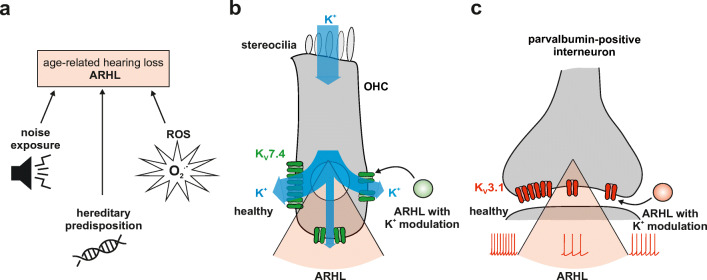
a In the challenged auditory system leading to age-related hearing loss (ARHL), the key causing factors are postulated to be lifetime noise exposure, hereditary predisposition, and the accumulation of reactive oxygen species (ROS). b In a healthy outer hair cell (OHC), potassium ions (K+) enter the cell through apical mechanosensitive channels and are then transported to the supporting cells through KV7.4 (KCNQ4, green) channels on the basolateral membrane of OHC. However, in the challenged system, the expression of KV7.4 is reduced, resulting in a poor K+ efflux. This state can be influenced by the addition of K+ channel modulators (green circle) in a way where cell surface expression remains stable but the efflux rate can be increased. c In fast-spiking, parvalbumin-positive interneurons, KV3.1 (KCNC1, red) is required for the high-frequency repetitive firing. A decline in KV3.1 cell surface expression leads to an incapacity of neurons to maintain high-frequency firing action potentials. Modulators that bind to KV3.1 (red circle) may lower action potential latencies and duration and increase the firing pattern of these neurons

References

    1. Bowl MR, Dawson SJ (2019) Age-related hearing loss. Cold Spring Harb Perspect Med:9. 10.1101/cshperspect.a033217 - PMC - PubMed
    1. Lin FR, Yaffe K, Xia J, Xue QL, Harris TB, Purchase-Helzner E, Satterfield S, Ayonayon HN, Ferrucci L, Simonsick EM, Health ABCSG. Hearing loss and cognitive decline in older adults. JAMA Intern Med. 2013;173:293–299. doi: 10.1001/jamainternmed.2013.1868. - DOI - PMC - PubMed
    1. Kamil RJ, Betz J, Powers BB, Pratt S, Kritchevsky S, Ayonayon HN, Harris TB, Helzner E, Deal JA, Martin K, Peterson M, Satterfield S, Simonsick EM, Lin FR, Health ABCs Association of hearing impairment with incident frailty and falls in older adults. J Aging Health. 2016;28:644–660. doi: 10.1177/0898264315608730. - DOI - PMC - PubMed
    1. Rutherford BR, Brewster K, Golub JS, Kim AH, Roose SP. Sensation and psychiatry: linking age-related hearing loss to late-life depression and cognitive decline. Am J Psychiatry. 2018;175:215–224. doi: 10.1176/appi.ajp.2017.17040423. - DOI - PMC - PubMed
    1. Lin FR, Ferrucci L, Metter EJ, An Y, Zonderman AB, Resnick SM. Hearing loss and cognition in the Baltimore Longitudinal Study of Aging. Neuropsychology. 2011;25:763–770. doi: 10.1037/a0024238. - DOI - PMC - PubMed

Publication types

Substances

LinkOut - more resources