


Diagnostic accuracy of infrared thermal imaging for detecting COVID-19 infection in minimally symptomatic patients
- PMID: 33336385
- PMCID: PMC7883263
- DOI: 10.1111/eci.13474
Diagnostic accuracy of infrared thermal imaging for detecting COVID-19 infection in minimally symptomatic patients
Abstract
Introduction: Despite being widely used as a screening tool, a rigorous scientific evaluation of infrared thermography for the diagnosis of minimally symptomatic patients suspected of having COVID-19 infection has not been performed.
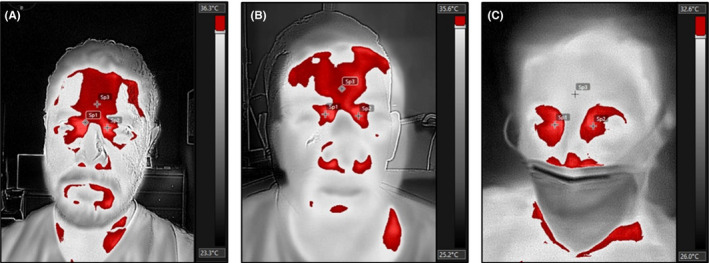
Methods: A consecutive sample of 60 adult individuals with a history of close contact with COVID-19 infected individuals and mild respiratory symptoms for less than 7 days and 20 confirmed COVID-19 negative healthy volunteers were enrolled in the study. Infrared thermograms of the face were obtained with a mobile camera, and RT-PCR was used as the reference standard test to diagnose COVID-19 infection. Temperature values and distribution of the face of healthy volunteers and patients with and without COVID-19 infection were then compared.
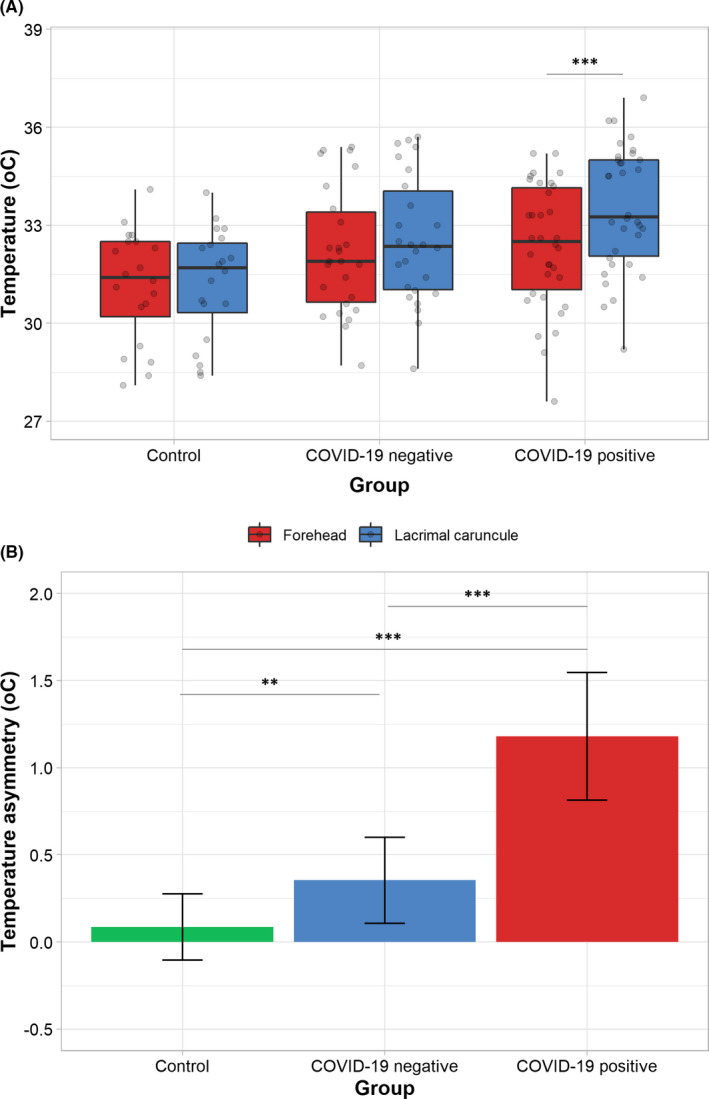
Results: Thirty-four patients had an RT-PCR confirmed diagnosis of COVID-19 and 26 had negative test results. The temperature asymmetry between the lacrimal caruncles and the forehead was significantly higher in COVID-19 positive individuals. Through a random forest analysis, a cut-off value of 0.55°C was found to discriminate with an 82% accuracy between patients with and without COVID-19 confirmed infection.
Conclusions: Among adults with a history of COVID-19 exposure and mild respiratory symptoms, a temperature asymmetry of ≥ 0.55°C between the lacrimal caruncle and the forehead is highly suggestive of COVID-19 infection. This finding questions the widespread use of the measurement of absolute temperature values of the forehead as a COVID-19 screening tool.
Keywords: COVID-19; diagnosis; machine learning; screening; thermography.
© 2020 Stichting European Society for Clinical Investigation Journal Foundation. Published by John Wiley & Sons Ltd.
Conflict of interest statement
None declared. MMJ receives doctoral support from the Mexican National Council for Science and Technology (CONACYT). JLRG holds a Mitacs Elevate Postdoctoral Fellowship. The funding agencies were not involved in the study design, data collection, analysis, or decision of where to publish.
Figures
References
-
- Vo‐Dinh T. Thermal Imaging for Biological and Medical Diagnostics. Biomedical Photonics Handbook. 10.1201/9780203008997-25. - DOI
Publication types
MeSH terms
LinkOut - more resources
Full Text Sources
Medical
