


Lower urinary tract and bowel dysfunction in spinocerebellar ataxias
- PMID: 33338328
- PMCID: PMC7886036
- DOI: 10.1002/acn3.51266
Lower urinary tract and bowel dysfunction in spinocerebellar ataxias
Abstract
Background: Little information is available in spinocerebellar ataxias (SCAs) regarding pelvic organ symptoms. The aim of this study was to characterize the lower urinary tract (LUT) and bowel dysfunction in autosomal dominant spinocerebellar ataxias.
Methods: Patients with confirmed SCAs attending a tertiary care service were approached about LUT and bowel complaints, and completed validated questionnaires: urinary symptom profile (USP), Qualiveen-Short form, International Prostate Symptom Score, and Neurogenic Bowel Dysfunction Score. SCA3 and SCA7 patients with urological complaints additionally underwent urodynamic studies (UDS). Patients' characterization included demographic, clinical (Scale for the Assessment and Rating of Ataxia (SARA), Inventory of Non-Ataxia Signs (INAS)), and genetic variables. Descriptive and comparative analyses were performed.
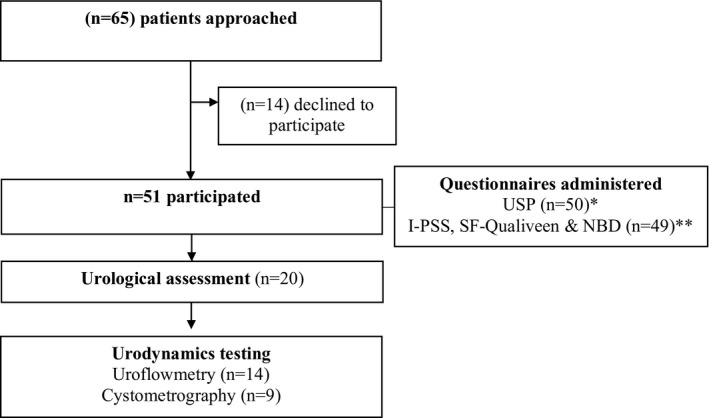
Results: Fifty-one patients participated: SCA1 (n = 4), SCA2 (n = 11), SCA3 (n = 13), SCA6 (n = 17), and SCA7 (n = 6). The prevalence of self-reported LUT symptoms was 60.8% (n = 31), whereas LUT symptoms was reported in 86.3%(n = 44) using the USP. Both storage and voiding symptoms were reported, urinary frequency and urgency being the most frequent (n = 34, 68%). Although LUT symptoms were most often classed as mild (n = 27, 61.4%), they impacted QoL in 38 patients (77.6%). Of these, 21 (55.3%) were not on pharmacological treatment for urinary dysfunction. Most common abnormalities in UDS (n = 14) were detrusor overactivity (storage phase) and detrusor underactivity (voiding phase). Bowel symptoms were less common (31.4%, n = 16) and of mild severity.
Conclusion: LUT symptoms are prevalent in SCA patients and impact QoL, whereas bowel symptoms tend to be mild. These symptoms are overlooked by patients and physicians due to the complexity of neurological involvement in SCA, and therefore a multidisciplinary management approach should be adopted.
© 2020 The Authors. Annals of Clinical and Translational Neurology published by Wiley Periodicals LLC on behalf of American Neurological Association.
Conflict of interest statement
The authors decline any conflict of interest.
Figures
References
-
- Harding AE. Clinical features and classification of the inherited ataxias. Adv Neurol 1993;61:1–14. - PubMed
-
- Matilla A, Gould R, Giunti P. Molecular pathogenesis of the spinocerebellar ataxias. Brain 2006;129:1357–1370. - PubMed
-
- van de Warrenburg BP, Sinke RJ, Verschuuren‐Bemelmans CC, et al. Spinocerebellar ataxias in the Netherlands: prevalence and age at onset variance analysis. Neurology 2002;58:702–708. - PubMed
-
- Ruano L, Melo C, Silva MC, et al. The global epidemiology of hereditary ataxia and spastic paraplegia: a systematic review of prevalence studies. Neuroepidemiology 2014;42:174–183. - PubMed
-
- Durr A. Autosomal dominant cerebelar ataxias: polyglutamine expansions and beyond. Lancet Neurol 2010;9:885–894. - PubMed
Publication types
MeSH terms
Grants and funding
LinkOut - more resources
Full Text Sources
Research Materials
