Review
. 2020 Dec 16;9(12):474.
doi: 10.3390/biology9120474.

Lipid Metabolism and Resistance to Anticancer Treatment

Affiliations
Review

Lipid Metabolism and Resistance to Anticancer Treatment

Nicolas Germain et al. Biology (Basel). .

Abstract

Metabolic reprogramming is crucial to respond to cancer cell requirements during tumor development. In the last decade, metabolic alterations have been shown to modulate cancer cells' sensitivity to chemotherapeutic agents including conventional and targeted therapies. Recently, it became apparent that changes in lipid metabolism represent important mediators of resistance to anticancer agents. In this review, we highlight changes in lipid metabolism associated with therapy resistance, their significance and how dysregulated lipid metabolism could be exploited to overcome anticancer drug resistance.

Keywords: antimetabolic cooperativity; cancer drug resistance; lipid metabolism; synthetic lethality.


Conflict of interest statement

The authors declare no conflict of interest.

Figures
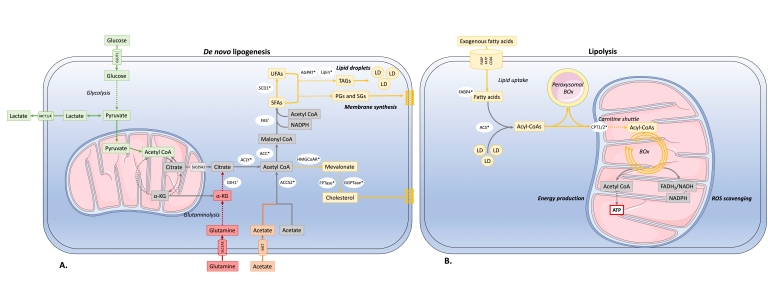
Figure 1
Figure 1
Simplified diagram of changes in lipid metabolism of cancer cells (see text for details) (A) De novo lipogenesis Glucose- and glutamine-derived citrate, which results from the increased glycolysis and glutaminolysis, is first converted to acetyl-coenzyme A (acetyl-CoA) by ATP-citrate lyase (ACLY). Acetyl-CoA can also be derived from acetate. Acetyl-CoA is then carboxylated to malonyl-CoA by acetyl-CoA carboxylase (ACC) and condensed by fatty acid (FA) synthase (FAS) in a repeat reaction to generate saturated FAs (SFAs) then desaturated by stearoyl-CoA desaturases (SCD1) into unsaturated FAs (UFAs). Synthesis of glycerolipids from long-chain FAs involved the enzymes 1-acylglycerol-3-phosphate acyltransferases (AGPAT) and lipin which are deregulated in resistant cancers. These lipids can be used for storage in lipid droplets, membrane biosynthesis, and signaling processes. Alternatively, acetyl-CoA can enter the mevalonate pathway to generate cholesterol. Key regulatory proteins dysregulated in resistant cancers are HMG-CoA reductase (HMG-CoAR), farnesyl prenyl transferase (FPTase) and geranylgeranyl prenyl transferase (GGPTase) (B) Lipolysis. FAs generated through the metabolism of triglycerides from lipid droplets (de novo synthesis) and from exogenous uptake constitute the pool of intracellular FAs that undergo fatty acid oxidation (FAO). Activation of FAs into acyl-CoA is catalyzed by Acyl coenzyme A (CoA) synthetase (ACS), then converted into FA carnitines by carnitine palmitoyl transferase 1 (CPT1) and broken down by mitochondrial β-oxidation (Box). Alternatively, peroxisomal β-oxidation catalyze the chain shortening of Acyl-CoA. FAO generates ATP production and participates to ROS scavenging through NADPH-producing reactions. Dysregulated enzymes altered in treatment-resistant cancer are indicated with an * (see text for details).

References

    1. Hanahan D., Weinberg R.A. Hallmarks of Cancer: The Next Generation. Cell. 2011;144:646–674. doi: 10.1016/j.cell.2011.02.013. - DOI - PubMed
    1. Marchetti P., Guerreschi P., Mortier L., Kluza J. Integration of Mitochondrial Targeting for Molecular Cancer Therapeutics. Int. J. Cell Biol. 2015;2015:283145. doi: 10.1155/2015/283145. - DOI - PMC - PubMed
    1. Corazao-Rozas P., Guerreschi P., André F., Gabert P.-E., Lancel S., Dekiouk S., Fontaine D., Tardivel M., Savina A., Quesnel B., et al. Mitochondrial Oxidative Phosphorylation Controls Cancer Cell’s Life and Death Decisions upon Exposure to MAPK Inhibitors. Oncotarget. 2016;7:39473–39485. doi: 10.18632/oncotarget.7790. - DOI - PMC - PubMed
    1. Chen X., Chen S., Yu D. Metabolic Reprogramming of Chemoresistant Cancer Cells and the Potential Significance of Metabolic Regulation in the Reversal of Cancer Chemoresistance. Metabolites. 2020;10:289. doi: 10.3390/metabo10070289. - DOI - PMC - PubMed
    1. Plaitakis A., Kalef-Ezra E., Kotzamani D., Zaganas I., Spanaki C. The Glutamate Dehydrogenase Pathway and Its Roles in Cell and Tissue Biology in Health and Disease. Biology. 2017;6:11. doi: 10.3390/biology6010011. - DOI - PMC - PubMed

LinkOut - more resources
