Review
. 2020 Dec 16;9(12):4067.
doi: 10.3390/jcm9124067.

Experience in Multiple Sclerosis Patients with COVID-19 and Disease-Modifying Therapies: A Review of 873 Published Cases

Affiliations
Review

Experience in Multiple Sclerosis Patients with COVID-19 and Disease-Modifying Therapies: A Review of 873 Published Cases

Nora Möhn et al. J Clin Med. .

Abstract

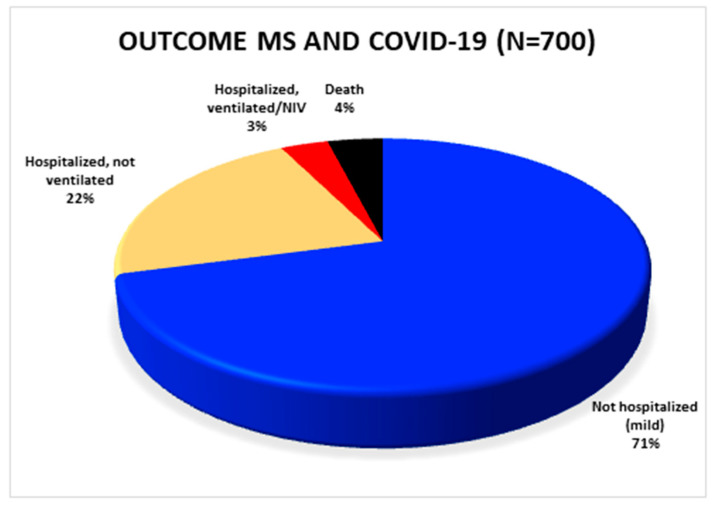
The severe acute respiratory syndrome coronavirus-2 (SARS-CoV-2) pandemic is a challenge for all participants in the healthcare system. At the beginning of the pandemic, many physicians asked themselves what risk their patients, especially those with chronic diseases, were exposed to. We present an overview of all patients with multiple sclerosis (MS) and SARS-CoV-2 infection published in the literature so far. In total, there are publications on 873 SARS-CoV-2 positive MS patients and information on the outcome can be given for 700 patients. With regard to the different disease modifying therapies (DMTs), by far the most cases were described under anti-CD20 treatment (n = 317). The mortality rate of all MS patients was 4% and a further 3% required invasive or non-invasive ventilation. When looking at the severe and fatal cases, it is particularly noticeable that patients without DMTs, with previous cardiovascular diseases, or with a severe degree of disability are at risk. Immunosuppressive therapy itself does not appear to be a substantial risk factor. Rather, it is reasonable to assume that the therapies could be protective, either directly, by mitigating the cytokine storm, or indirectly, by reducing the disease activity of MS.

Keywords: COVID-19; SARS-CoV-2 pandemic; disease-modifying therapies; multiple sclerosis.


Conflict of interest statement

The authors declare no conflict of interest.

Figures
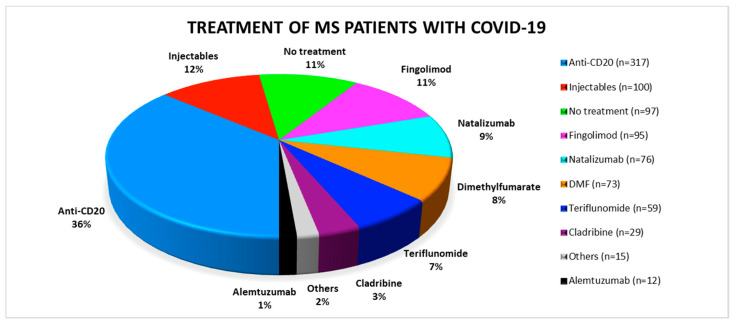
Figure 1
Figure 1
Distribution of the respective disease modifying therapies among the published SARS-CoV-2 positive multiple sclerosis patients. COVID-19: coronavirus disease 2019; DMF: dimethyl-fumarate; MS: multiple sclerosis.
Figure 2
Figure 2
Overview of the outcome of all published SARS-CoV-2 positive MS patients in whom the outcome is known. COVID-19: coronavirus disease 2019; MS: multiple sclerosis.
Figure 3
Figure 3
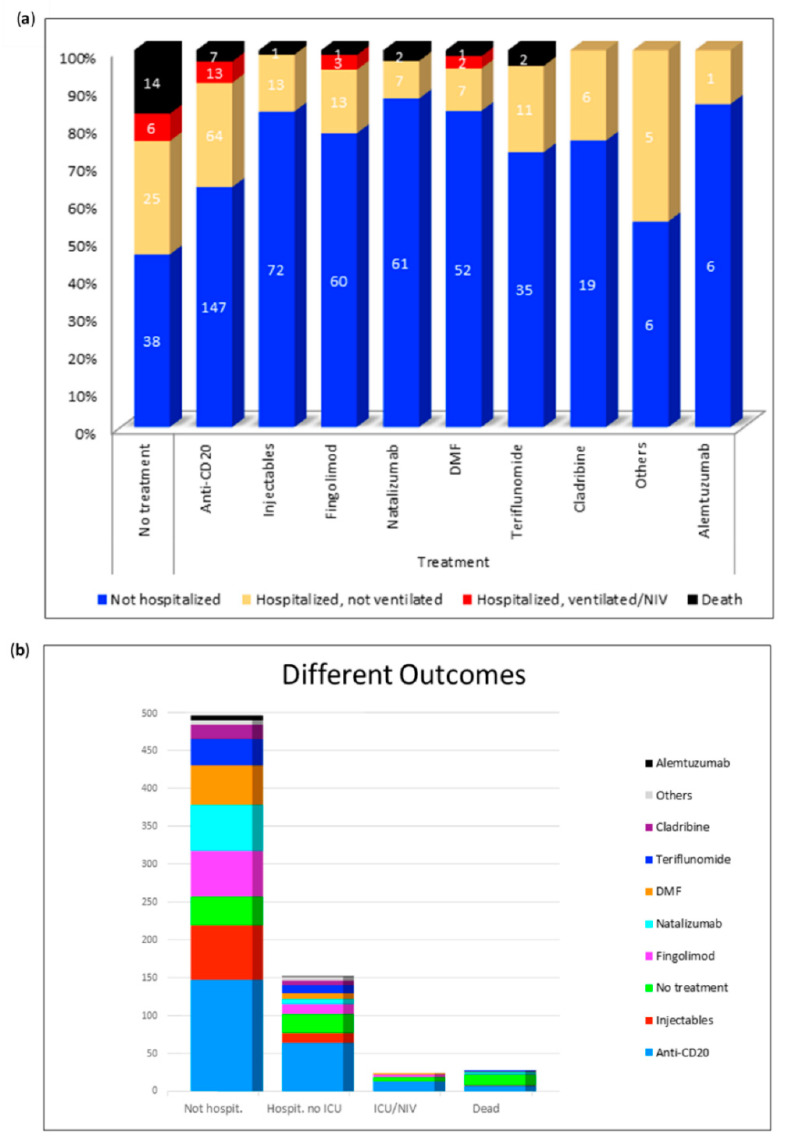
Distribution of the respective outcomes depending on the disease modifying therapies. (a) Distribution of different outcomes per DMT; (b) Number of non-hospitalized, hospitalized, ventilated, and deceased patients. DMF: dimethyl-fumarate; Hospit.: hospitalized; ICU: intensive care unit; NIV: non-invasive ventilation. Others: stem cell therapy (n = 5), immunoglobulins (n = 4), mycophenolate mofetil (n = 3), azathioprine (n = 1), cyclophosphamide (n = 1), methotrexate (n = 1).

References

    1. Dong E., Du H., Gardner L. An interactive web-based dashboard to track COVID-19 in real time. Lancet Infect. Dis. 2020;20:533–534. doi: 10.1016/S1473-3099(20)30120-1. - DOI - PMC - PubMed
    1. Force A.D.T., Ranieri V.M., Rubenfeld G.D., Thompson B.T., Ferguson N.D., Caldwell E., Fan E., Camporota L., Slutsky A.S. Acute respiratory distress syndrome: The Berlin Definition. JAMA. 2012;307:2526–2533. doi: 10.1001/jama.2012.5669. - DOI - PubMed
    1. Chu D.K.W., Pan Y., Cheng S.M.S., Hui K.P.Y., Krishnan P., Liu Y., Ng D.Y.M., Wan C.K.C., Yang P., Wang Q., et al. Molecular diagnosis of a novel coronavirus (2019-nCoV) causing an outbreak of pneumonia. Clin. Chem. 2020;66:549–555. doi: 10.1093/clinchem/hvaa029. - DOI - PMC - PubMed
    1. Ashour H.M., Elkhatib W.F., Rahman M.M., Elshabrawy H.A. Insights into the Recent 2019 Novel coronavirus (SARS-CoV-2) in light of past human coronavirus outbreaks. Pathogens. 2020;9:186. doi: 10.3390/pathogens9030186. - DOI - PMC - PubMed
    1. Moore J.B., June C.H. Cytokine release syndrome in severe COVID-19. Science. 2020;368:473–474. doi: 10.1126/science.abb8925. - DOI - PubMed

LinkOut - more resources