


Estimating prevalence of subjective cognitive decline in and across international cohort studies of aging: a COSMIC study
- PMID: 33339532
- PMCID: PMC7749505
- DOI: 10.1186/s13195-020-00734-y
Estimating prevalence of subjective cognitive decline in and across international cohort studies of aging: a COSMIC study
Abstract
Background: Subjective cognitive decline (SCD) is recognized as a risk stage for Alzheimer's disease (AD) and other dementias, but its prevalence is not well known. We aimed to use uniform criteria to better estimate SCD prevalence across international cohorts.
Methods: We combined individual participant data for 16 cohorts from 15 countries (members of the COSMIC consortium) and used qualitative and quantitative (Item Response Theory/IRT) harmonization techniques to estimate SCD prevalence.
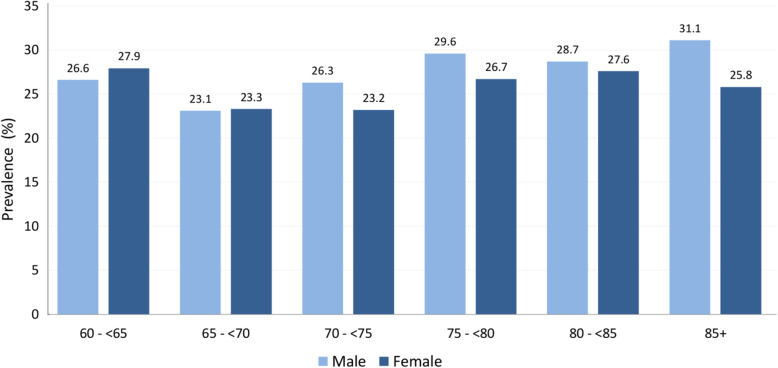
Results: The sample comprised 39,387 cognitively unimpaired individuals above age 60. The prevalence of SCD across studies was around one quarter with both qualitative harmonization/QH (23.8%, 95%CI = 23.3-24.4%) and IRT (25.6%, 95%CI = 25.1-26.1%); however, prevalence estimates varied largely between studies (QH 6.1%, 95%CI = 5.1-7.0%, to 52.7%, 95%CI = 47.4-58.0%; IRT: 7.8%, 95%CI = 6.8-8.9%, to 52.7%, 95%CI = 47.4-58.0%). Across studies, SCD prevalence was higher in men than women, in lower levels of education, in Asian and Black African people compared to White people, in lower- and middle-income countries compared to high-income countries, and in studies conducted in later decades.
Conclusions: SCD is frequent in old age. Having a quarter of older individuals with SCD warrants further investigation of its significance, as a risk stage for AD and other dementias, and of ways to help individuals with SCD who seek medical advice. Moreover, a standardized instrument to measure SCD is needed to overcome the measurement variability currently dominant in the field.
Keywords: Cohort study; Data harmonization; Epidemiology; Individual participant data; Prevalence; Subjective cognitive decline.
Conflict of interest statement
None.
Figures
References
-
- Alzheimer’s Disease International: World Alzheimer Report 2016 - Improving healthcare for people living with dementia: Coverage, quality and costs now and in the future. https://www.alzint.org/u/WorldAlzheimerReport2016.pdf. Accessed 5 Nov 2020.
Publication types
MeSH terms
Grants and funding
LinkOut - more resources
Full Text Sources
