Review
. 2021 Feb 15:174:112830.
doi: 10.1016/j.bios.2020.112830. Epub 2020 Nov 27.

Diagnosis of COVID-19 for controlling the pandemic: A review of the state-of-the-art

Affiliations
Review

Diagnosis of COVID-19 for controlling the pandemic: A review of the state-of-the-art

Nastaran Taleghani et al. Biosens Bioelectron. .

Abstract

To date, health organizations and countries around the world are struggling to completely control the spread of the coronavirus disease 2019 (COVID-19). Scientists and researchers are developing tests for the rapid detection of individuals who may carry the severe acute respiratory syndrome coronavirus 2 (SARS-CoV-2), while striving to find a suitable vaccine to immunize healthy individuals. As there are clinically reported cases of asymptomatic carriers of SARS-CoV-2, fast and accurate diagnosis plays an important role in the control and further prevention of this disease. Herein, we present recent technologies and techniques that have been implemented for the diagnosis of COVID-19. We summarize the methods created by different research institutes as well as the commercial devices and kits developed by companies for the detection of SARS-CoV-2. The description of the existing methods is followed by highlighting their advantages and challenges. Finally, we propose some promising techniques that could potentially be applied to the detection of SARS-CoV-2, and tracing the asymptomatic carriers of COVID-19 rapidly and accurately in the early stages of infection, based on reviewing the research studies on the detection of similar infectious viruses, especially severe acute respiratory syndrome (SARS) coronavirus, and Middle East respiratory syndrome (MERS) coronavirus.

Keywords: COVID-19; Diagnostics; Pneumonia; SARS-CoV-2; Serology tests; Virus detection.


Conflict of interest statement

The authors declare that they have no known competing financial interests or personal relationships that could have appeared to influence the work reported in this paper.

Figures

Image 1
Graphical abstract
Fig. 1
Fig. 1
Illustration of the main technologies for the diagnosis of the suspected COVID-19 cases. A) The principle of the molecular test is the transcription of viral RNA into DNA and then targeting the DNA for amplification and replication to the point that it can be detected by the detectors. B) The serological test works based on the principle of the interaction of immobilized antibody and the antibody present in the sample, either on a lateral flow platform or ELISA. C) Chest CT is performed in healthcare facilities with special equipment. D) Other methods such as FET-based sensing and plasmonic sensing have been developed but have not yet been applied in healthcare facilities (Qiu et al., 2020; Seo et al., 2020).
Fig. 2
Fig. 2
Schematic diagram of a 2D illustration of the SARS-CoV-2 structural proteins and genome.
Fig. 3
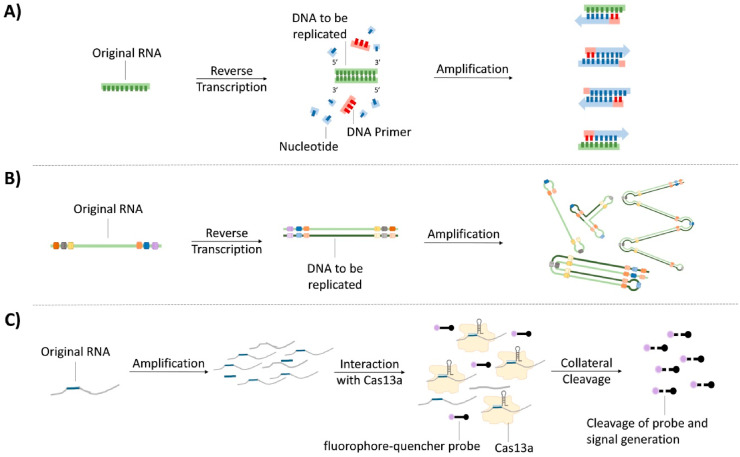
Fig. 3
Illustration of the molecular methods for the detection of SARS-CoV-2. A) The principle of target viral RNA detection based on reverse transcription of target RNA into DNA and the amplification. B) Illustration of the LAMP technology with the final accumulated DNA structures; this method is explained in detail in Fig. 4. C) A schematic of the SHERLOCK assay started with the amplification of target RNA and its interaction with Cas13a, which is followed by the cleavage of the probe and generation of fluorescent signal.
Fig. 4
Fig. 4
Illustration of LAMP technology to amplify the target double-strand DNA. A) Based on the sequence of the target DNA, four or six primers are designed for the amplification process. B) First, the two strands detach, and the forward inner primer attaches to initiate the DNA synthesis. C) This is followed by the second separation of strands, formation of a self-hybridizing loop in one of the strands, and then attachment of the forward outer primer to the other strand and initiation of DNA synthesis. D) The same process happens with the backward primers, thus leading to the formation of a LAMP dumbbell structure. E) As the dumbbell structure has more initiation sites for DNA synthesis, the concatemers are formed which have even more sites for the DNA synthesis initiation. F) In the end, multiple double-strand DNA structures are accumulated which are enough to be detected by various types of detectors.
Fig. 5
Fig. 5
The approximate level of IgM and IgG antibodies generated against SARS-CoV-2 at different weeks after the infection. Based on conducted studies, there would be one or two weeks with no symptoms and no antibodies in the blood sample, that is, during the incubation time. Then, IgM antibodies are produced as an initial immune response that is followed by the formation of IgG antibodies to develop a more specific immune response.
Fig. 6
Fig. 6
Schematic illustration of the serology tests for the COVID-19 diagnosis. A) The main detection principle of anti-SARS-CoV-2 antibody on a lateral flow assay is that, after adding the sample, the blood moves through the test strip, and antibodies present in the sample reach the test line and control line, leading to a change of color in those lines; this method is explained in detail in Fig. 9. B) An illustration of the ELISA plate and the composition of each well. After adding the sample, the anti-SARS-CoV-2 antibodies attach to the immobilized antibody, after which the labeled antibodies are added to get a signal. C) An illustration of chemiluminescent microparticle immunoassay (CMIA); specific antibodies are immobilized on each particle to interact with the target antibody after the sample is added, and then labeled antibodies are used to provide a signal indicating the presence of target antibody. (For interpretation of the references to color in this figure legend, the reader is referred to the Web version of this article.)
Fig. 7
Fig. 7
Schematic diagram of the detection process performed by the graphene-based FET biosensor. The principle of operation is based on the interaction of the SARS-CoV-2 S protein with the SARS-CoV-2 S protein antibodies immobilized on the graphene sensing material. After taking the sample and adding the clinical transport medium, the prepared sample is transferred to the laboratory, where the FET biosensor is used for the detection of SARS-CoV-2.
Fig. 8
Fig. 8
Schematic diagram illustrating the capability of each detection method with regard to the post infection time of SARS-CoV-2. As the cone cross section increases, the results from the detection method become more reliable for the COVID-19 diagnosis. Chest CT would be the most sensitive method of detection at early stages and as time passes the sensitivity of molecular methods especially RT-PCR increases. Serology tests would be more suitable at the late stages and even after recovery, as the antibodies are still available in the patient's sample.
Fig. 9
Fig. 9
Illustration of an LFA, the mechanism of detection, and the final result's appearance. In the presence of a SARS-CoV-2 positive result, the anti-SARS-CoV-2 antibodies attach to their label on the conjugation pad and make a complex. The complex reaches the test line using capillary forces and attaches to the antibodies immobilized there. Regarding the control line, as the sample flows through the assay, the labeled antibodies for the control line move toward the control line and attach to the immobilized antibodies on the control line. In the absence of SARS-CoV-2, there is no formation of a complex and no attachment on the test line. However, as the flow passes through the assay, the labeled antibodies for the control line move toward the control line, and attach on the control line.

References

    1. Abbott Laboratories 2020. https://www.abbott.com/corpnewsroom/product-and-innovation/detect-covid-...
    1. Abbott Laboratories 2020. https://www.abbott.com/corpnewsroom/product-and-innovation/abbott-launch...
    1. Ai T., Yang Z., Hou H., Zhan C., Chen C., Lv W., Tao Q., Sun Z., Xia L. Radiology. 2020 doi: 10.1148/radiol.2020200642. 200642. - DOI - PMC - PubMed
    1. Andersen K.G., Rambaut A., Lipkin W.I., Holmes E.C., Garry R.F. Nat. Med. 2020;26:450–452. doi: 10.1038/s41591-020-0820-9. - DOI - PMC - PubMed
    1. Anker J.N., Hall W.P., Lyandres O., Shah N.C., Zhao J., Van Duyne R.P. Nat. Mater. 2008;7:442–453. doi: 10.1038/nmat2162. - DOI - PubMed