. 2020 Dec 18;10(1):22346.
doi: 10.1038/s41598-020-79170-9.

The relationship between resting-state functional connectivity, antidepressant discontinuation and depression relapse

Affiliations

The relationship between resting-state functional connectivity, antidepressant discontinuation and depression relapse

Isabel M Berwian et al. Sci Rep. .

Abstract

The risk of relapsing into depression after stopping antidepressants is high, but no established predictors exist. Resting-state functional magnetic resonance imaging (rsfMRI) measures may help predict relapse and identify the mechanisms by which relapses occur. rsfMRI data were acquired from healthy controls and from patients with remitted major depressive disorder on antidepressants. Patients were assessed a second time either before or after discontinuation of the antidepressant, and followed up for six months to assess relapse. A seed-based functional connectivity analysis was conducted focusing on the left subgenual anterior cingulate cortex and left posterior cingulate cortex. Seeds in the amygdala and dorsolateral prefrontal cortex were explored. 44 healthy controls (age: 33.8 (10.5), 73% female) and 84 patients (age: 34.23 (10.8), 80% female) were included in the analysis. 29 patients went on to relapse and 38 remained well. The seed-based analysis showed that discontinuation resulted in an increased functional connectivity between the right dorsolateral prefrontal cortex and the parietal cortex in non-relapsers. In an exploratory analysis, this functional connectivity predicted relapse risk with a balanced accuracy of 0.86. Further seed-based analyses, however, failed to reveal differences in functional connectivity between patients and controls, between relapsers and non-relapsers before discontinuation and changes due to discontinuation independent of relapse. In conclusion, changes in the connectivity between the dorsolateral prefrontal cortex and the posterior default mode network were associated with and predictive of relapse after open-label antidepressant discontinuation. This finding requires replication in a larger dataset.


Conflict of interest statement

The authors declare no competing interests.

Figures
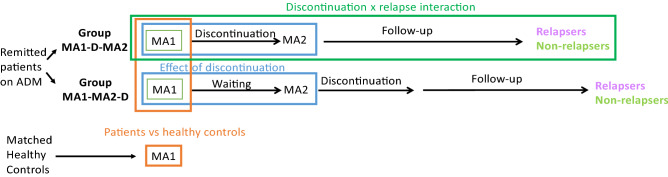
Figure 1
Figure 1
Study Design: Remitted patients on antidepressant medication (ADM) and matched healthy controls were included in the study and assessed during main assessment 1 (MA1). Patients were randomised to groups MA1-D-MA2 or MA1-MA2-D, where the name indicates the order of events and "D" indicates discontinuation. In group MA1-D-MA2, they underwent MA1, then discontinued their medication followed by main assessment 2 (MA2). In group MA1-MA2-D, they underwent MA1 and MA2 first and only discontinued thereafter. After discontinuation, all patients were followed up for six months to ascertain relapses. Comparison of patient and control groups at MA1 was used to examine the remitted medicated state cross-sectionally (orange). Data collected at MA1 from all patients who subsequently completed the study as relapsers or non-relapsers, i.e. relapsers and non-relapsers from both groups combined were examined to examine associations with relapse. The interaction between time point (MA1 and MA2) with group (MA1-D-MA2 and MA1-MA2-D) examined the impact of discontinuation (blue). Finally, the interaction between time point (MA1 and MA2) and relapse in group MA1-D-MA2 was used to examine changes due to discontinuation that led to relapse or resilience (dark green).
Figure 2
Figure 2
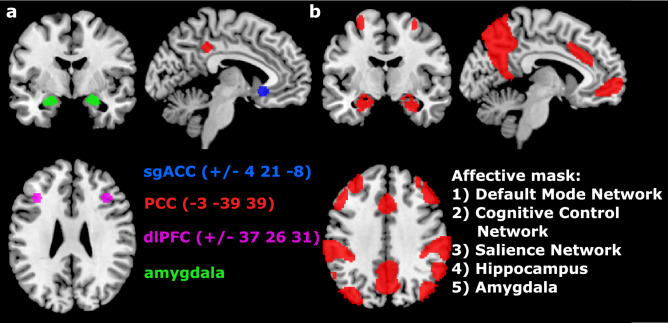
Seeds and Mask: Depicted are the seeds (a) used in the analysis and the affective mask (b) containing all voxels of interest. sgACC subgenual anterior cingulate cortex, PCC posterior cingulate cortex, dlPFC dorsolateral prefrontal cortex.
Figure 3
Figure 3
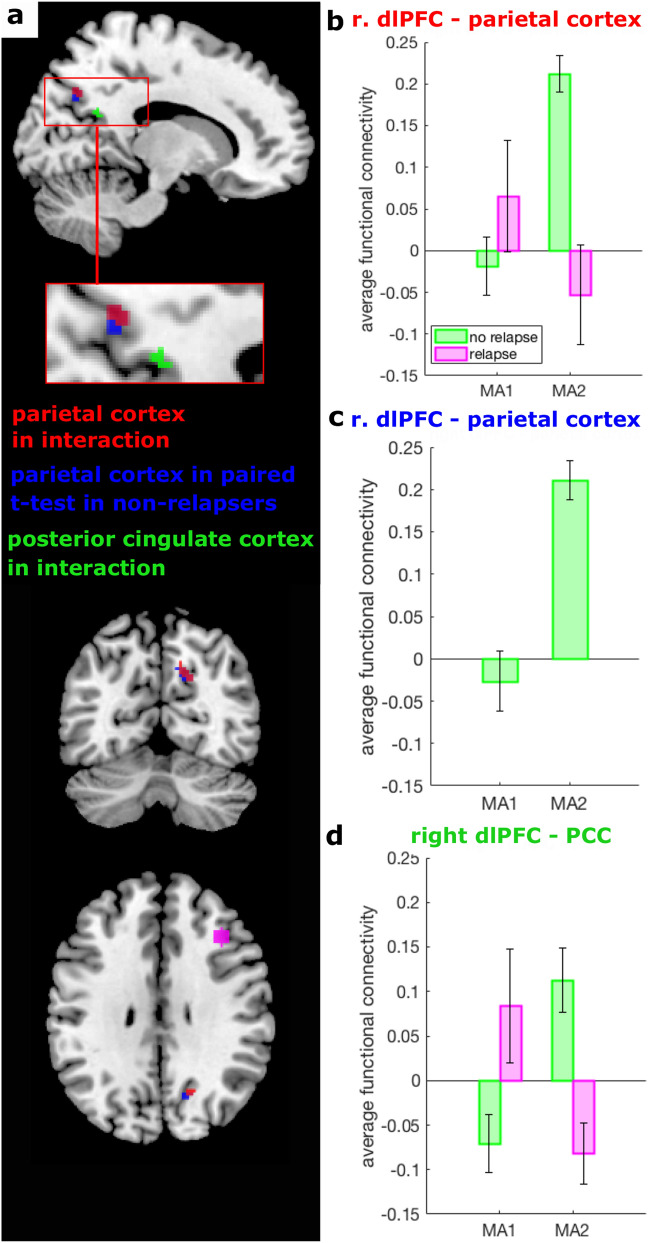
Discontinuation relapse interaction effect: (a) Depicted are clusters for significant interactions between discontinuation and relapse between our choosen seed in the right dorsolateral prefrontal cortex (dlPFC, magenta) and the parietal cortex (red) and the posterior cingulate cortex (PCC, green) and a paired t-test in non-relapsers only for RSFC between right dlPFC and the parietal cortex (blue). (bd) The Fisher z-transformed average functional connectivity between the right dlPFC and the surviving clusters in the parietal cortex and the PCC is depicted for the interaction between relapsers and non-relapsers (b, d, respectively). Specifically, depicted are significant interaction effects with p < 0.0083 which survive our threshold corrected for multiple comparison. Exact p values are given in Table 2. (c) The paired post-hoc t-test in non-relapsers for the interaction effect in relation to the parietal cortex shown in (b). Error bars indicate standard errors.

References

    1. Rush AJ, et al. Bupropion-SR, sertraline, or venlafaxine-XR after failure of SSRIs for depression. N. Engl. J. Med. 2006;354:1231–1242. doi: 10.1056/NEJMoa052963. - DOI - PubMed
    1. Geddes JR, et al. Relapse prevention with antidepressant drug treatment in depressive disorders: a systematic review. Lancet. 2003;361:653–661. doi: 10.1016/S0140-6736(03)12599-8. - DOI - PubMed
    1. Angst J, Gamma A, Sellaro R, Lavori PW, Zhang H. Recurrence of bipolar disorders and major depression. A life-long perspective. Eur. Arch. Psychiatry Clin. Neurosci. 2003;253:236–240. doi: 10.1007/s00406-003-0437-2. - DOI - PubMed
    1. Lépine J-P, Briley M. The increasing burden of depression. Neuropsychiatr. Dis. Treat. 2011;7:3–7. - PMC - PubMed
    1. Berwian IM, Walter H, Seifritz E, Huys QJ. Predicting relapse after antidepressant discontinuation a systematic review. Psychol. Med. 2017;47:426–437. doi: 10.1017/S0033291716002580. - DOI - PMC - PubMed

Publication types

MeSH terms

Substances