


Transvaginal hybrid-NOTES vs. traditional laparoscopic sigmoid resection for diverticulitis: a short-term comparative study
- PMID: 33339895
- PMCID: PMC7749103
- DOI: 10.1038/s41598-020-79461-1
Transvaginal hybrid-NOTES vs. traditional laparoscopic sigmoid resection for diverticulitis: a short-term comparative study
Abstract
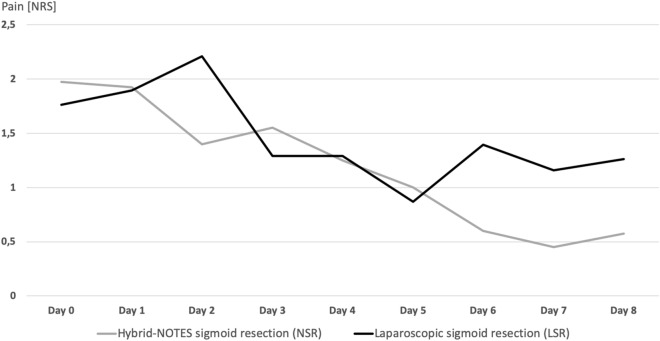
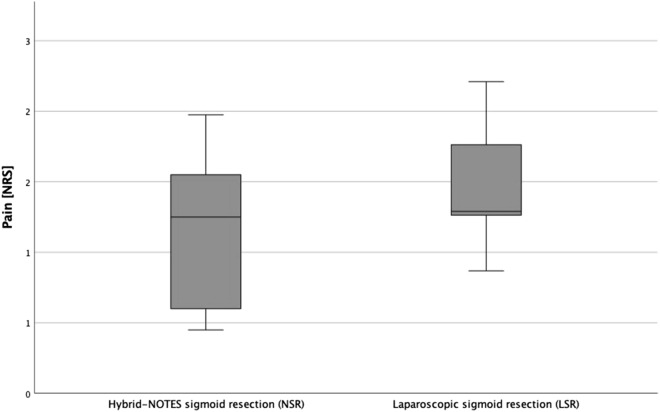
The aim was to compare short-term results of transvaginal hybrid-NOTES (NSR) with traditional laparoscopic technique in sigmoid resection (LSR) in cases of diverticulitis. Natural Orifice Transluminal Endoscopic Surgery has been evolved as a minimally invasive procedure to reduce the operative trauma due to the absence of specimen extraction through the abdominal wall causing less postoperative pain, and shorter hospital stay. Despite the increasing use and published case series of NSR for diverticulitis as a laparoscopic procedure with transvaginal stapling and specimen extraction, there are no studies comparing this procedure with LSR. Twenty NSR patients operated at the Cologne-Merheim Medical Center have been documented and compared with 20 female LSR patients matched for body mass index, American Society of Anesthesiologists-classification (ASA), Hansen/Stock classification, and age. To ensure comparability regarding peri- and postoperative care, only procedures performed by the same surgeon were included. Procedural time, intra- and postoperative complications, conversion rate, postoperative pain, the duration of an epidural catheter, analgesic consumption, and postoperative length of hospital stay were analyzed. There were no significant differences in the sum of pain levels (p = 0.930), length of procedure (p = 0.079), intra- and postoperative complications, as well as duration of an epidural catheter. On the contrary, there were significant positive effects for NSR on morphine requirement at day seven and eight (p = 0.019 and p = 0.035 respectively) as well as the postoperative length of hospital stay (p = 0.031). This retrospective study reveals significant positive effects for NSR compared to LSR regarding length of hospital stay as well as morphine consumption after removal of the epidural catheter, whereas there were no significant differences in complication rate and procedural time. In summary, NSR is an adequate alternative to traditional laparoscopic sigmoid resection considering the surgeons experience and the patient's personal preferences.
Conflict of interest statement
Drs. Marie Derstadt, Panagiotis Thomaidis, Claudia Simone Seefeldt, Jonas Lange, Jurgen Meyer, Michael Alfred Stroehlein, Markus Maria Heiss and Dirk Rolf Bulian have no conflicts of interest or financial ties to disclose.
Figures




References
-
- Ott D. Ventroscopia. Zhurnal Akusherstva I Zhenskikh Boleznel. 1901;15:1045–1049.
-
- Zornig C, Emmermann A, von Waldenfels HA, Felixmuller C. Colpotomy for specimen removal in laparoscopic surgery. Der Chirurg Z. Gebiete Oper. Medizen. 1994;65:883–885. - PubMed
-
- Emmermann A, Zornig C, Peiper M, Weh HJ, Broelsch CE. Laparoscopic splenectomy. Technique and results in a series of 27 cases. Surg. Endosc. 1995;9:924–927. - PubMed
-
- Delvaux G, Devroey P, De Waele B, Willems G. Transvaginal removal of gallbladders with large stones after laparoscopic cholecystectomy. Surg. Laparosc. Endosc. 1993;3:307–309. - PubMed
-
- Flora ED, Wilson TG, Martin IJ, O'Rourke NA, Maddern GJ. A review of natural orifice translumenal endoscopic surgery (NOTES) for intra-abdominal surgery: Experimental models, techniques, and applicability to the clinical setting. Ann. Surg. 2008;247:583–602. doi: 10.1097/SLA.0b013e3181656ce9. - DOI - PubMed
Publication types
MeSH terms
LinkOut - more resources
Full Text Sources
Medical
