Review
. 2021 May;289(5):629-635.
doi: 10.1111/joim.13201. Epub 2020 Dec 19.

Alveolar progenitor cells and the origin of lung cancer

Affiliations
Review

Alveolar progenitor cells and the origin of lung cancer

J Sainz de Aja et al. J Intern Med. 2021 May.

Abstract

Lung Cancer is the leading cause of cancer-related deaths worldwide. This is mainly due to late diagnosis and therefore advanced stage of the disease. Understanding the cell of origin of cancer and the processes that lead to its transformation will allow for earlier diagnosis and more accurate prediction of tumour type, ultimately leading to better treatments and lower patient morbidity. In this review, we focus on alveolar type 2 (AT2) cells as the cell of origin of lung adenocarcinoma (LUAD), the most common type of lung cancer. We first elaborate on the different oncogenes that are associated with LUAD and other lung cancers. After, we lay out in detail what is known about AT2 biology, to further delve into AT2 cells as cell of origin for adenocarcinoma. Understanding the precursors of LUAD and identifying the molecular changes during its progression will allow for earlier detection and better molecular targeting of the disease in early stages.

Keywords: cancer; lung adenocarcinoma.


Figures

Fig. 1
Fig. 1
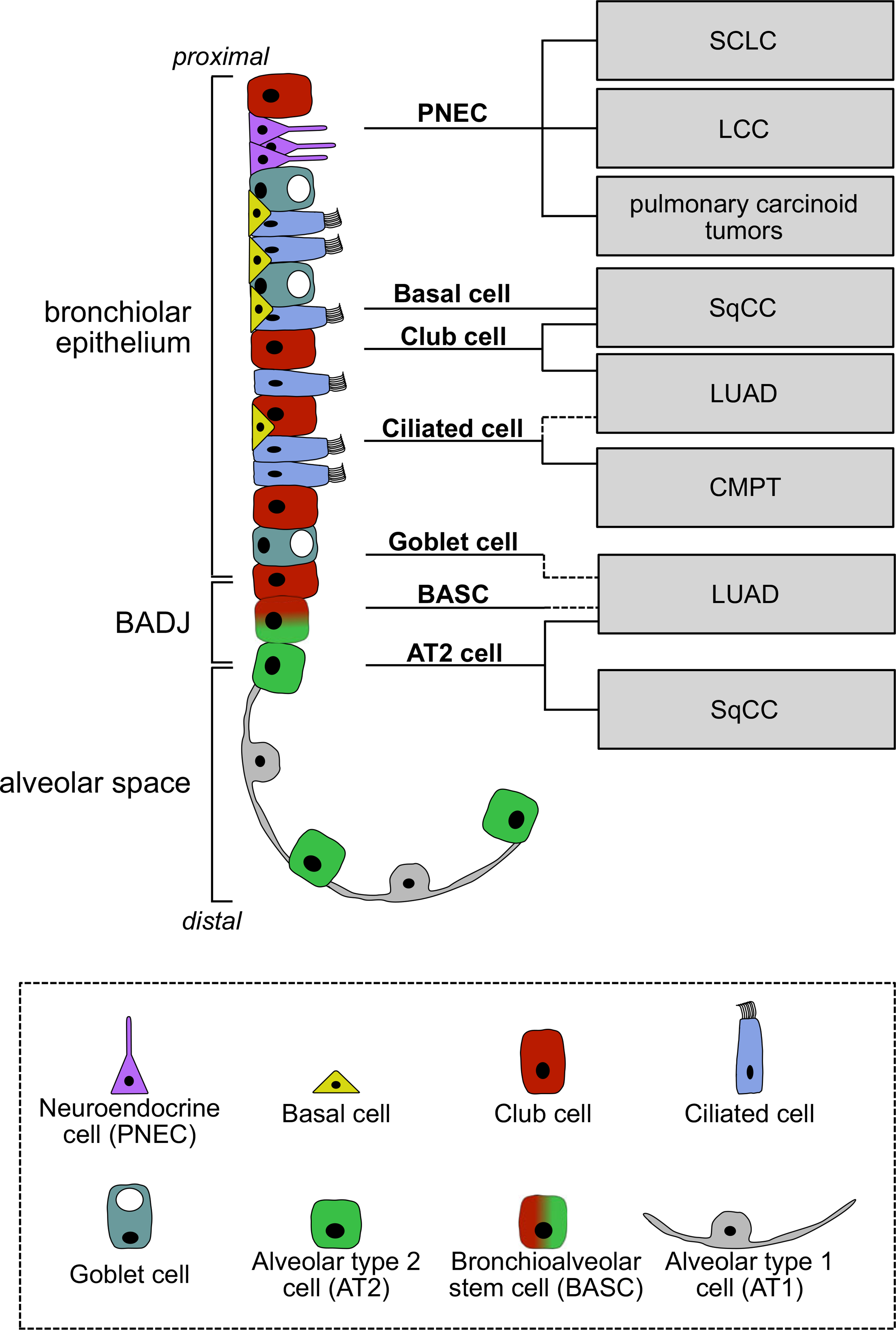
Lung epithelial cells as cells of origin of lung cancer. Different epithelial cell types line the epithelium of the different regions of the lung, the bronchiolar epithelium, the bronchioalveolar duct junction (BADJ) and the alveolar space. PNECs have been shown to be the cell of origin for small cell lung carcinoma (SCLC) and large cell lung carcinoma (LCC); basal cells, club cells and AT2 cells can give rise to squamous cell carcinoma (SqCC). AT2 cells are a confirmed cell of origin for lung adenocarcinoma (LUAD), whilst ciliated cells, goblet cells and bronchioalveolar stem cells (BASCs) are suspected to be able to give rise to LUAD in specific conditions (dotted lines). There is no evidence for AT1 cells as a cell of origin for lung cancer.

References

    1. The Cancer Genome Atlas Research Network. Comprehensive molecular profiling of lung adenocarcinoma. Nature 2014; 511: 543–50. - PMC - PubMed
    1. Rock JR, Onaitis MW, Rawlins El et al. Basal cells as stem cells of the mouse trachea and human airway epithelium. Proc Natl Acad Sci USA 2009; 106: 12771–5. - PMC - PubMed
    1. Rawlins EL, Okubo T, Xue Y et al. The role of Scgb1a1+ clara cells in the long-term maintenance and repair of lung airway, but not alveolar, epithelium. Cell Stem Cell 2009; 4: 525–34. - PMC - PubMed
    1. Rawlins EL, Hogan BLM. Ciliated epithelial cell lifespan in the mouse trachea and lung. Am J Physiol Lung Cell Mol Physiol 2008; 295: L231–234. - PMC - PubMed
    1. Desai TJ, Brownfield DG, Krasnow MA. Alveolar progenitor and stem cells in lung development, renewal and cancer. Nature 2014; 507: 190–4. - PMC - PubMed

MeSH terms

Substances