Review
. 2021 Jun:70:37-43.
doi: 10.1016/j.ceb.2020.11.003. Epub 2020 Dec 16.

The Integrator complex at the crossroad of coding and noncoding RNA

Affiliations
Review

The Integrator complex at the crossroad of coding and noncoding RNA

Nina Kirstein et al. Curr Opin Cell Biol. 2021 Jun.

Abstract

Genomic transcription is fundamental to all organisms. In metazoans, the Integrator complex is required for endonucleolytic processing of noncoding RNAs, regulation of RNA polymerase II pause-release, and premature transcription attenuation at coding genes. Recent insights into the structural composition and evolution of Integrator subunits have informed our understanding of its biochemical functionality. Moreover, studies in multiple model organisms point to an essential function of Integrator in signaling response and cellular development, highlighting a key role in neuronal differentiation. Indeed, alterations in Integrator complex subunits have been identified in patients with neurodevelopmental diseases and cancer. Taken together, we propose that Integrator is a central regulator of transcriptional processes and that its evolution reflects genomic complexity in regulatory elements and chromatin architecture.

Keywords: Cancer; INTS evolution; Integrator complex; Neurodevelopmental diseases; RNA processing; Transcription regulation.


Conflict of interest statement

Conflict of interest statement The authors declare that they have no known competing financial interests or personal relationships that could have appeared to influence the work reported in this paper.

Figures
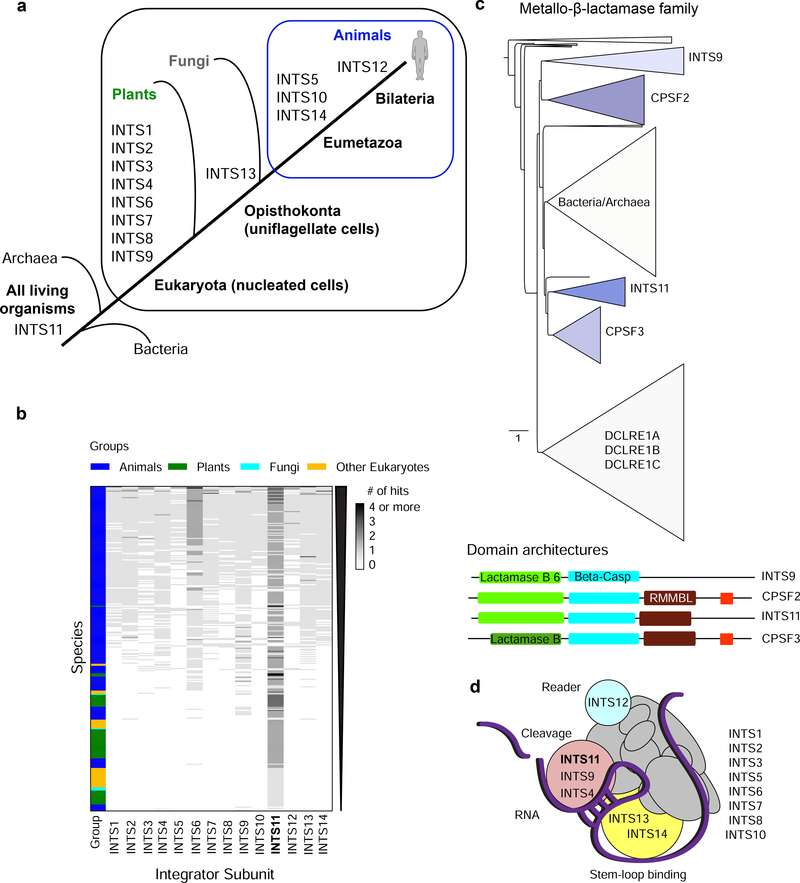
Figure 1.
Figure 1.. Evolution of the Integrator complex.
a) Overview of the INTS gene ages throughout evolution. Eukarya (nucleated cells), Opisthokonta (uniflagellate cells), Eumetazoa (animals, except sponges), Bilateria (animals with bilateral body symmetry and three germ layers). b) Heatmap of the presence/absence of Integrator-homologous proteins in >300 species (compared to full-length human sequences with the following cut-offs: 30% pair-wise sequence identity, and 50% coverage of the human proteins, in addition to blastp default parameters [29]). Grayscale accounts for the number of hits in one species that aligned to a human INTS. c) Phylogenetic tree of the metallo-β-lactamase superfamily from eggNOG 4.5.1 (COG1236) [33]. Triangle length indicates divergence and triangle height the number of species. Below: domain architecture of human INTS9, CPSF2, INTS11, and CPSF3, as retrieved from Pfam 33.1 [32]. In red CPSF73–100_C domain. d) Model of INTS and their modular interactions. Cleavage module depicted in pink, stem-loop binding module in yellow, and reader module in cyan. Bold: catalytic subunit INTS11.
Figure 2.
Figure 2.. Integrator’s main functions on coding genes in human and Drosophila.
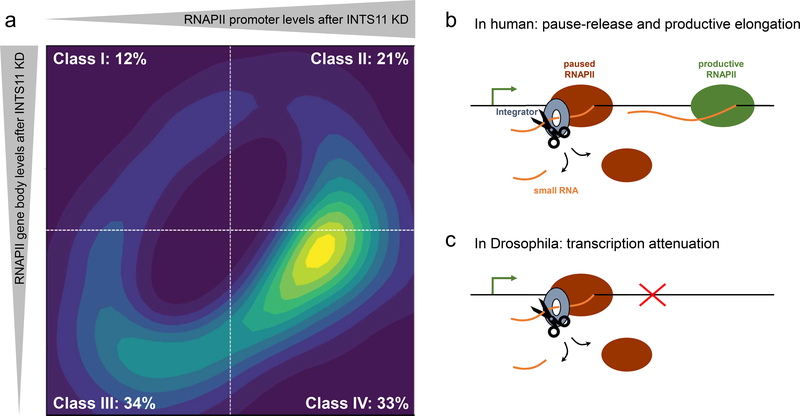
a) The travelling matrix separates positional RNAPII changes at promoters and gene bodies into four classes. Graphical depiction of ~3100 significant Integrator-responsive genes [19]. In human, INTS11 depletion predominantly leads to downregulation of actively engaged RNAPII (class III and IV: 67%). Class IV genes are additionally characterized by increased RNAPII pause (33%). b and c) Model representation of Integrator’s functions in human and Drosophila. b) The Integrator complex cleaves promoter-associated small transcripts to allow paused RNAPII eviction and transcriptional elongation by productive RNAPII (class IV). c) Integrator is required for the premature termination (attenuation) of RNAPII transcription.

References

    1. Baillat D, Hakimi M-A, Näär AM, Shilatifard A, Cooch N, Shiekhattar R: Integrator, a Multiprotein Mediator of Small Nuclear RNA Processing, Associates with the C-Terminal Repeat of RNA Polymerase II. Cell 2005, 123:265–276. - PubMed
    1. Egloff S, Szczepaniak SA, Dienstbier M, Taylor A, Knight S, Murphy S: The integrator complex recognizes a new double mark on the RNA polymerase II carboxyl-terminal domain. Journal of Biological Chemistry 2010, 285:20564–20569. - PMC - PubMed
    1. Ebmeier CC, Erickson B, Allen BL, Allen MA, Kim H, Fong N, Jacobsen JR, Liang K, Shilatifard A, Dowell RD, et al. : Human TFIIH Kinase CDK7 Regulates Transcription-Associated Chromatin Modifications. CellReports 2017, 20:1173–1186. - PMC - PubMed
    1. Shah N, Maqbool MA, Yahia Y, El Aabidine AZ, Esnault C, Forné I, Decker T-M, Martin D, Schüller R, Krebs S, et al. : Tyrosine-1 of RNA Polymerase II CTD Controls Global Termination of Gene Transcription in Mammals. Molecular cell 2018, 69:48–61.e46. - PubMed
    1. Albrecht TR, Shevtsov SP, Wu Y, Mascibroda LG, Peart NJ, Huang K-L, Sawyer IA, Tong L, Dundr M, Wagner EJ: Integrator subunit 4 is a ‘Symplekin-like’ scaffold that associates with INTS9/11 to form the Integrator cleavage module. Nucleic Acids Research 2018, 46:4241–4255. - PMC - PubMed

Publication types

LinkOut - more resources