


Genetic Gains for Grain Yield in CIMMYT's Semi-Arid Wheat Yield Trials Grown in Suboptimal Environments
- PMID: 33343013
- PMCID: PMC7691759
- DOI: 10.2135/cropsci2018.01.0017
Genetic Gains for Grain Yield in CIMMYT's Semi-Arid Wheat Yield Trials Grown in Suboptimal Environments
Abstract
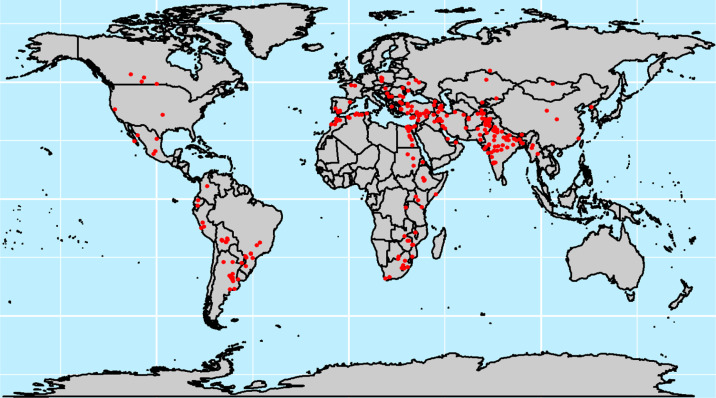
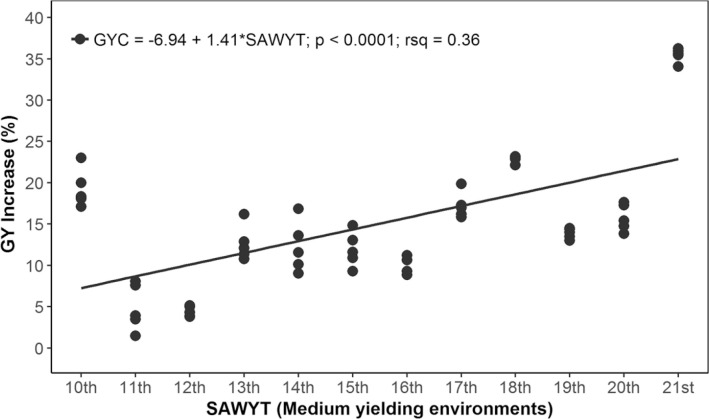
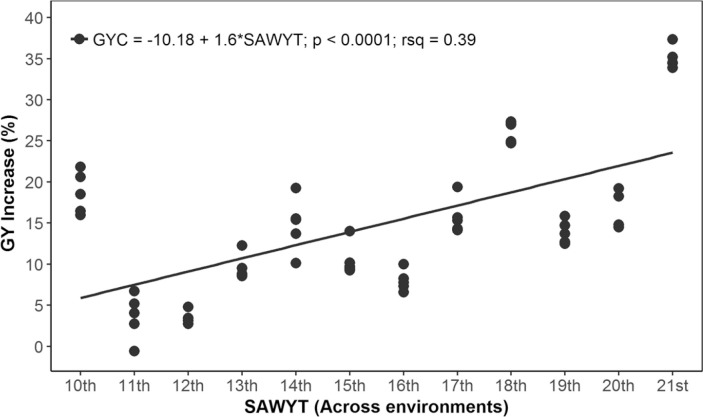
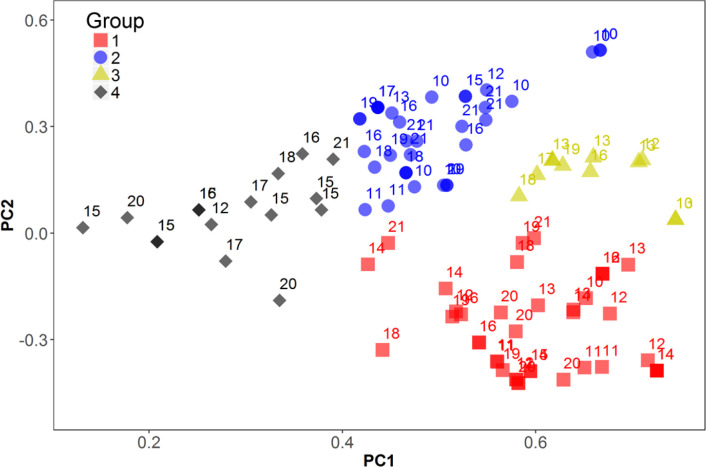
Wheat (Triticum aestivum L.) is a major staple food crop grown worldwide on >220 million ha. Climate change is regarded to have severe effect on wheat yields, and unpredictable drought stress is one of the most important factors. Breeding can significantly contribute to the mitigation of climate change effects on production by developing drought-tolerant wheat germplasm. The objective of our study was to determine the annual genetic gain for grain yield (GY) of the internationally distributed Semi-Arid Wheat Yield Trials, grown during 2002-2003 to 2013-2014 and developed by the Bread Wheat Breeding program at the CIMMYT. We analyzed data from 740 locations across 66 countries, which were classified in low-yielding (LYE) and medium-yielding (MYE) environments according to a cluster analysis. The rate of GY increase (GYC) was estimated relative to four drought-tolerant wheat lines used as constant checks. Our results estimate that the rate of GYC in LYE was 1.8% (38.13 kg ha-1 yr-1), whereas in MYE, it was 1.41% (57.71 kg ha-1 yr-1). The increase in GYC across environments was 1.6% (48.06 kg ha-1 yr-1). The pedigrees of the highest yielding lines through the coefficient of parentage analysis indicated the utilization of three primary sources-'Pastor', 'Baviacora 92', and synthetic hexaploid derivatives-to develop drought-tolerant, high and stably performing wheat lines. We conclude that CIMMYT's wheat breeding program continues to deliver adapted germplasm for suboptimal conditions of diverse wheat growing regions worldwide.
© Crop Science Society of America.
Conflict of interest statement
The authors declare that there is no conflict of interest.
Figures


References
-
- Aisawi K.A.B., Reynolds M.P., Singh R.P., and Foulkes M.J.. 2015. The physiological basis of the genetic progress in yield potential of CIMMYT spring wheat cultivars from 1966 to 2009. Crop Sci. 55:1749–1764. doi: 10.2135/cropsci2014.09.0601 - DOI
-
- Alexandratos N., and Bruinsma J.. 2012. World agriculture towards 2030/2050: The 2012 revision. FAO, Rome.
-
- Anjum S.A., Xie X., Wang L., Saleem M.F., Man C., and Lei W.. 2011. Morphological, physiological and biochemical responses of plants to drought stress. Afr. J. Agric. Res. 6:2026–2032.
-
- Annamalai H., Hafner J., Sooraj K.P., Pillai P., Annamalai H., Hafner J., et al. 2013. Global warming shifts the monsoon circulation, drying South Asia. J. Clim. 26:2701–2718. doi: 10.1175/JCLI-D-12-00208.1 - DOI
LinkOut - more resources
Full Text Sources
Research Materials