


Quality Control of Radix Astragali (The Root of Astragalus membranaceus var. mongholicus) Along Its Value Chains
- PMID: 33343346
- PMCID: PMC7746871
- DOI: 10.3389/fphar.2020.562376
Quality Control of Radix Astragali (The Root of Astragalus membranaceus var. mongholicus) Along Its Value Chains
Abstract
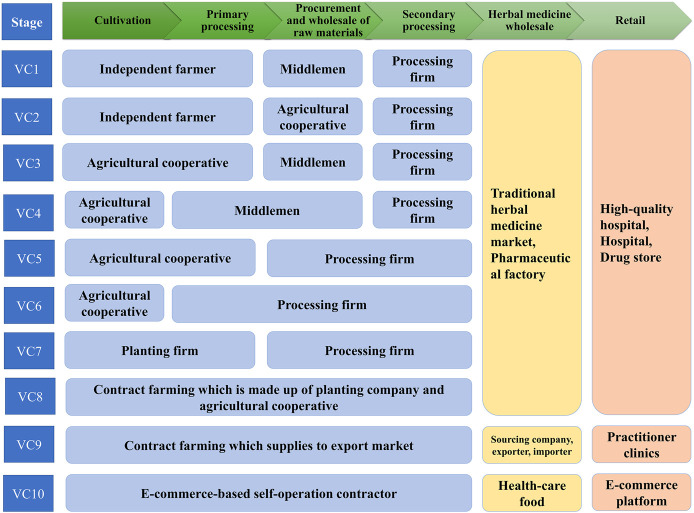
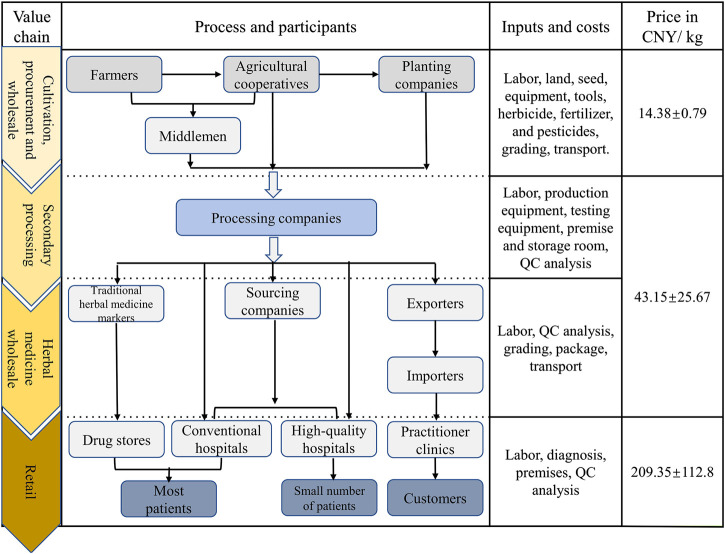
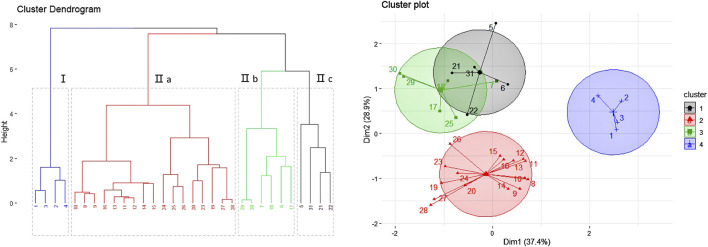
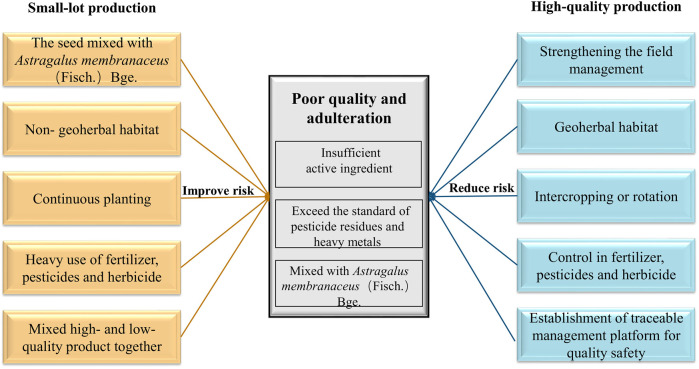
Radix Astragali (RA), the root of Astragalus membranaceus var. mongholicus (Bunge) P.K. Hsiao, known as "Huangqi" in Chinese, has been used as a traditional herbal medicine or food in China for more than 2,000 years and is now consumed globally. Unfortunately, the increasing demand for RA has led to the overexploitation of its wild stock, as well as quality problems, including adulteration and contamination. Therefore, the sustainable cultivation of RA is urgently needed. In the present research, semi-structured interviews and key informant interviews were conducted, over a 2-year period, to collect data from stakeholders in the main production areas; moreover, a targeted chemical analysis-based quality assessment strategy was applied to understand the quality of RA. Accordingly, 10 different types of value chains (VCs) were identified in RA production; meanwhile, the contents of the main active ingredients (astragaloside and calycosin-7-O-β-D-glucoside) were analyzed by HPLC-ELSD-UV and the yield of medicinal material was demined and further analyzed using k-means clustering analysis. The results show that the tight relationship between quality of the RA and stakeholders' revenues among the VCs, which reflects a more general trend in the production system. Over the past few decades, vertical coordination has emerged increasingly in VCs of RA, which leads to a more coherent traceability system and rigorous regulations in the supply chains. Daodi herbs can be considered to be a standard that is distinctive with good quality characteristics that emphasize the origins of the medicinal plants. We find that the suitability of geographical areas and vertical integration can improve the VCs of RA, which further contributes to its quality control, as well as its sustainable production.
Keywords: daodi herb; grade; quality; radix astragali; value chain.
Copyright © 2020 Bi, Bao, Zhang, Yao and Li.
Conflict of interest statement
The authors declare that the research was conducted in the absence of any commercial or financial relationships that could be construed as a potential conflict of interest.
Figures
References
-
- Booker A., Frommenwiler D., Johnston D., Umealajekwu C., Reich E., Heinrich M. (2014). Chemical variability along the value chains of turmeric (Curcuma longa): a comparison of nuclear magnetic resonance spectroscopy and high performance thin layer chromatography. J. Ethnopharmacol. 152 (2), 292–301. 10.1016/j.jep.2013.12.042 - DOI - PubMed
-
- Booker A., Johnston D., Heinrich M. (2016). The welfare effects of trade in phytomedicines: a multi-disciplinary analysis of turmeric production. World Dev. 77, 221–230. 10.1016/j.worlddev.2015.08.024 - DOI
-
- British Standards Institution (BS) (2015). Traditional chinese medicine - determination of heavy metals in herbal medicines used in traditional chinese medicine. BS ISO 18664: 2015 10.3403/30281528U - DOI
LinkOut - more resources
Full Text Sources
Miscellaneous
