Review
. 2020 Nov 9:11:570893.
doi: 10.3389/fphar.2020.570893. eCollection 2020.

Potential Therapeutic Effect of Traditional Chinese Medicine on Coronavirus Disease 2019: A Review

Affiliations
Review

Potential Therapeutic Effect of Traditional Chinese Medicine on Coronavirus Disease 2019: A Review

Qin Qiu et al. Front Pharmacol. .

Abstract

The Coronavirus disease 2019 (COVID-19) pandemic caused by severe acute respiratory syndrome coronavirus 2 has been rapidly spreading globally and has caused worldwide social and economic disruption. Currently, no specific antiviral drugs or clinically effective vaccines are available to prevent and treat COVID-19. Traditional Chinese medicine (TCM) can facilitate syndrome differentiation and treatment according to the clinical manifestations of patients and has demonstrated effectiveness in epidemic prevention and control. In China, TCM intervention has helped to control the epidemic; however, TCM has not been fully recognized worldwide. In this review, we summarize the epidemiology and etiological characteristics of severe acute respiratory syndrome coronavirus 2 and the prevention and treatment measures of COVID-19. Additionally, we describe the application of TCM in the treatment of COVID-19 and the identification of small molecules of TCM that demonstrate anti-coronavirus activity. We also analyze the current problems associated with the recognition of TCM. We hope that, through the contribution of TCM, combined with modern technological research and the support of our international counterparts, COVID-19 can be effectively controlled and treated.

Keywords: COVID-19; SARS-CoV-2; technology; therapeutic effect; traditional Chinese medicine.


Figures

FIGURE 1
FIGURE 1
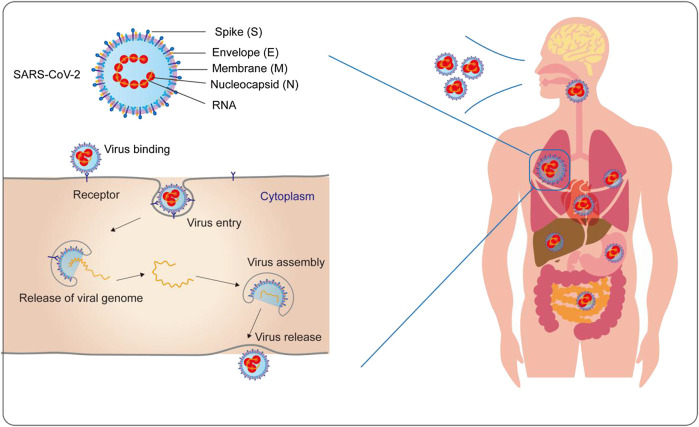
Severe Acute Respiratory Syndrome Coronavirus 2 (SARS-COV-2) is an enveloped RNA virus, comprising RNA and four major structural proteins [the nucleocapsid (N) protein, membrane (M) glycoprotein, envelope (E) protein, and spike (S) glycoprotein]. The pathogenic mechanism includes the four steps: attachment and entry, replication and transcription, assembly, and release. The virus mainly invades the host through the respiratory tract and directly or indirectly causes systemic multiple organ damage by identifying specific receptors on the host cell membrane.
FIGURE 2
FIGURE 2
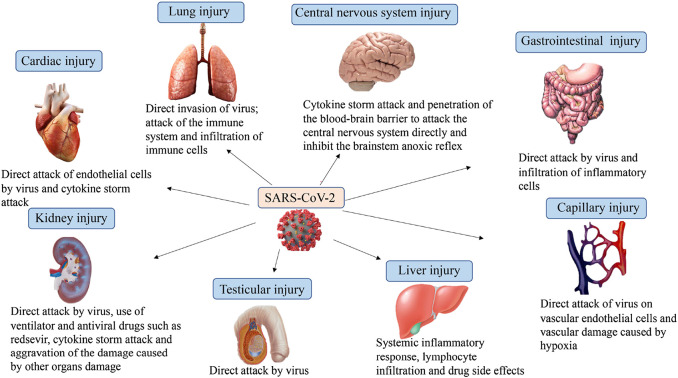
Multi-organ dysfunction caused by SARS-CoV-2 infection includes heart injury, kidney injury, liver injury, lung injury, central nervous system injury, testicular injury, capillary injury, and gastrointestinal injury. Most organ damage is caused by direct virus attack and cytokine storm attack.

References

    1. Abbott T. R., Dhamdhere G., Liu Y., Lin X., Goudy L., Zeng L., et al. (2020). Development of CRISPR as an antiviral strategy to combat SARS-CoV-2 and influenza. Cell 181, 865–876.e12. 10.1016/j.cell.2020.04.020 - DOI - PMC - PubMed
    1. Ackermann M., Verleden S. E., Kuehnel M., Haverich A., Welte T., Laenger F., et al. (2020). Pulmonary vascular endothelialitis, thrombosis, and angiogenesis in COVID-19. N. Engl. J. Med. 383, 120–128. 10.1056/NEJMoa2015432 - DOI - PMC - PubMed
    1. Adem S., Eyupoglu V., Sarfraz I., Rasul A., Ali M. (2020). Identification of potent COVID-19 main protease (Mpro) inhibitors from natural polyphenols: an in silico strategy unveils a hope against CORONA. Preprints . 10.20944/preprints202003.0333.v1 - DOI - PMC - PubMed
    1. Aggarwal B. B., Sung B. (2009). Pharmacological basis for the role of curcumin in chronic diseases: an age-old spice with modern targets. Trends Pharmacol. Sci. 30, 85–94. 10.1016/j.tips.2008.11.002 - DOI - PubMed
    1. Akman T., Guven M., Aras A. B., Ozkan A., Sen H. M., Okuyucu A., et al. (2015). The neuroprotective effect of glycyrrhizic acid on an experimental model of focal cerebral ischemia in rats. Inflammation 38, 1581–1588. 10.1007/s10753-015-0133-1 - DOI - PubMed