


Detection of additional abnormalities or co-morbidities in women with suspected intrahepatic cholestasis of pregnancy
- PMID: 33343695
- PMCID: PMC7726172
- DOI: 10.1177/1753495X19868873
Detection of additional abnormalities or co-morbidities in women with suspected intrahepatic cholestasis of pregnancy
Abstract
Background: Current guidelines recommend viral, autoimmune, coagulation and liver ultrasound testing in intrahepatic cholestasis of pregnancy to exclude alternative diagnoses.
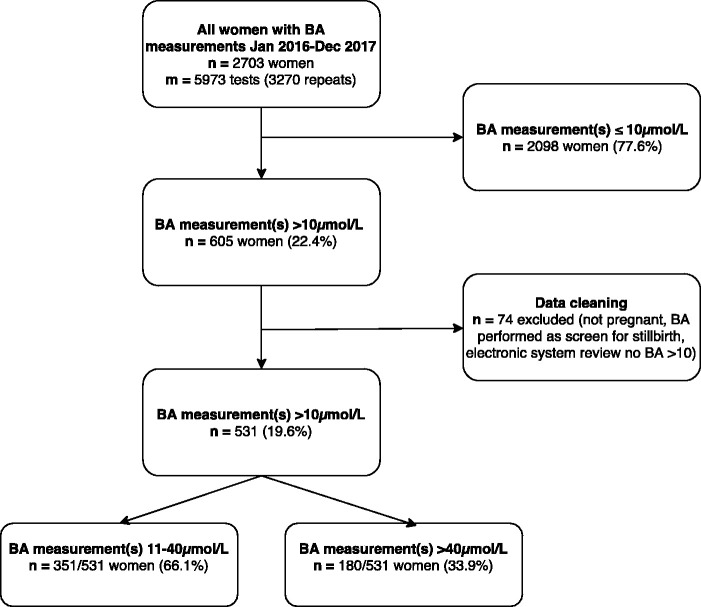
Methods: Electronic health records were searched for investigations and diagnoses in women with raised bile acid concentrations (>10 µmol/L) between January 2016 and December 2017 at two UK maternity units.
Results: Five hundred and thirty-one women had a raised bile acid concentration (median (IQR): 18 (13-32 µmol/L)) at a median gestation of 35.1 (IQR 31.8-37.0) weeks. Out of 531 women, 250 (47.1%) had full virology, autoimmune and ultrasound tests, and 348 (65.5%) had coagulation performed. Positive hepatitis B and C results were previously known. No new Epstein-Barr virus, cytomegalovirus or hepatitis A diagnoses were made. There were 11 positive autoimmune results, but no new diagnoses. No woman had an unexplained prolonged prothrombin time. No ultrasound liver (n = 38) or gallbladder (n = 85) abnormalities were of acute clinical significance.
Conclusion: Intrahepatic cholestasis of pregnancy investigations provided no new diagnoses that influenced clinical management during pregnancy.
Keywords: Cholestasis; pregnancy.
© The Author(s) 2019.
Conflict of interest statement
Declaration of conflicting interests: The author(s) declared no potential conflicts of interest with respect to the research, authorship, and/or publication of this article.
Figures
References
-
- Ovadia C, Williamson C. Intrahepatic cholestasis of pregnancy: recent advances. Clin Dermatol 2016; 34: 327–334. - PubMed
-
- Dixon PH, Williamson C. The pathophysiology of intrahepatic cholestasis of pregnancy. Clin Res Hepatol Gastroenterol 2016; 40: 141–153. - PubMed
-
- Marschall H-U. Management of intrahepatic cholestasis of pregnancy. Expert Rev Gastroenterol Hepatol 2015; 9: 1273–1279. - PubMed
-
- Abedin P, Weaver JB, Egginton E. Intrahepatic cholestasis of pregnancy: prevalence and ethnic distribution. Ethn Health 1999; 4: 35–37. - PubMed
Grants and funding
LinkOut - more resources
Full Text Sources