


EFFECT OF BLOOD FLOW RESTRICTION TRAINING ON MUSCULAR PERFORMANCE, PAIN AND VASCULAR FUNCTION
- PMID: 33344005
- PMCID: PMC7727422
- DOI: 10.26603/ijspt20200892
EFFECT OF BLOOD FLOW RESTRICTION TRAINING ON MUSCULAR PERFORMANCE, PAIN AND VASCULAR FUNCTION
Abstract
Background: Blood flow restriction (BFR) training enhances muscular strength and hypertrophy in several populations including older adults and injured athletes. However, the efficacy of emerging BFR technologies on muscular adaptations, vascular health, and pain is unclear.
Purpose: The purpose of this study was to examine muscular performance, pain and vascular function in response to eight weeks of BFR compared to traditional resistance training and a control group.
Study design: Randomized control trial.
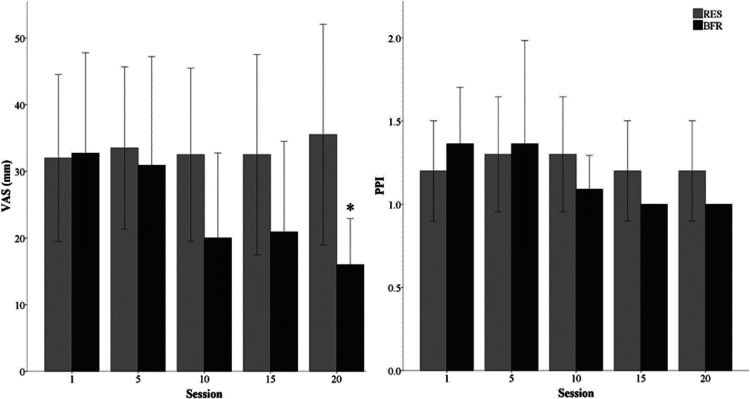
Methods: Thirty-one overtly healthy participants (age: 23 ± 4y, 65% female) underwent eight weeks of supervised high load resistance training (RES), low load resistance training with BFR (BFR) or no training (control, CON). RES and BFR (with pneumatic bands) performed seven upper and lower body exercises, two to three sessions per week at 60% and 30% of one-repetition maximum (1RM), respectively. Twenty-four hours post-exercise, general muscle soreness was assessed via a visual analog scale (VAS) and present pain intensity (PPI) of the McGill Pain Questionnaire. At baseline and after eight weeks, participants underwent one-repetition maximum (1RM), and flow-mediated dilation (FMD) testing.
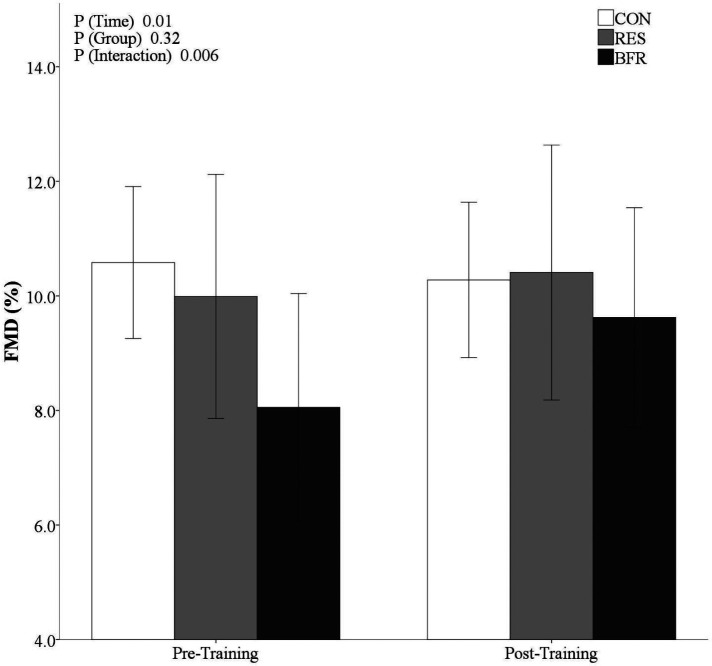
Results: At baseline all groups exhibited similar muscle strength and endurance and vascular function. At the end of training, RES and BFR groups significantly increased muscle strength (1RM) to a similar magnitude as compared to the CON group (p < 0.0001), but did not alter body composition. FMD significantly increased in RES and BFR groups compared to CON group (p = 0.006). VAS and PPI were similar between RES and BFR groups throughout the exercise sessions until VAS decreased in the BFR group after the last session compared to the RES group (p = 0.02).
Conclusion: Compared to RES, BFR resulted in similar muscular performance (strength and endurance) and vascular improvements at a lower exercise intensity, suggesting BFR is an effective alternative to high load resistance training. Further longitudinal studies may gain greater understanding regarding general muscle pain and soreness when using BFR.
Level of evidence: Therapy, Level 2.
Keywords: Blood flow restriction; Movement system; Pain; Resistance training; Vascular function.
© 2020 by the Sports Physical Therapy Section.
Figures
References
-
- Hughes L Paton B Rosenblatt B Gissane C Patterson SD. Blood flow restriction training in clinical musculoskeletal rehabilitation: a systematic review and meta-analysis. Br J Sports Med. 2017;51(13):1003-1011. - PubMed
-
- Loenneke JP Wilson JM Marin PJ Zourdos MC Bemben MG. Low intensity blood flow restriction training: a meta-analysis. Eur J Appl Physiol. 2012;112(5):1849-1859. - PubMed
-
- Whiteley R. Blood flow restriction training in rehabilitation: A useful adjunct or Lucy's latest trick? J Orthop Sports Phys Ther. 2019;49(5):294-298. - PubMed
-
- American College of Sports Medicine, Riebe D Ehrman JK Liguori G Magal M. ACSM's guidelines for exercise testing and prescription. Tenth Edition ed. Philidelphia: Wolters Kluwer; 2018.
-
- Takarada Y Takazawa H Sato Y Takebayashi S Tanaka Y Ishii N. Effects of resistance exercise combined with moderate vascular occlusion on muscular function in humans. J Appl Physiol (1985). 2000;88(6):2097-2106. - PubMed
LinkOut - more resources
Full Text Sources
Medical
Research Materials