


In-Season Repeated-Sprint Training in Hypoxia in International Field Hockey Players
- PMID: 33345057
- PMCID: PMC7739710
- DOI: 10.3389/fspor.2020.00066
In-Season Repeated-Sprint Training in Hypoxia in International Field Hockey Players
Abstract
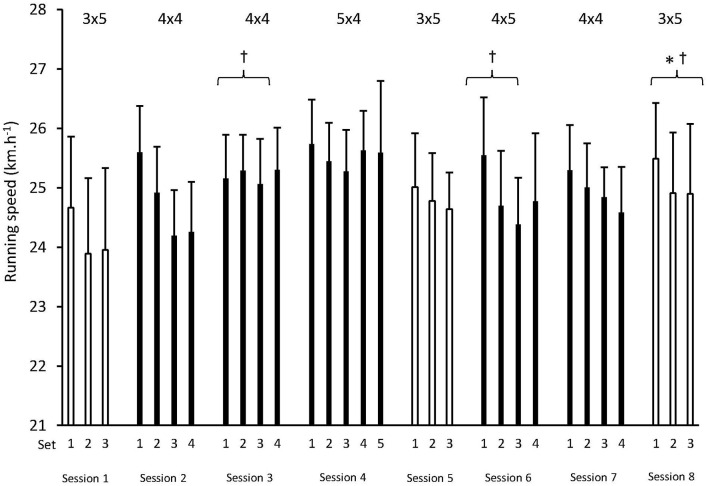
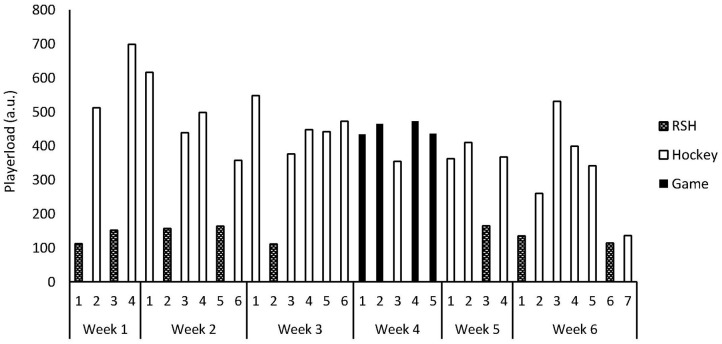
Repeated-sprint training in hypoxia (RSH) studies conducted "in-season" are scarce. This study investigated the effect of discontinuous, running-based RSH, on repeated-sprint treadmill performance in hypoxia in a team sport cohort, prior to international competition. Over a 6-week "in-season" period, 11 elite male players (Malaysia national team) completed eight multi-set RSH sessions on a non-motorized treadmill in a normobaric hypoxic chamber (FiO2 = 13.8%). Three testing sessions (Sessions 1, 5, and 8), involved three sets of 5 × 8-s sprints, with 52-s recovery between sprints and 4-5 min between sets. Training sessions (Sessions 2, 3, 4, 6, and 7) consisted of four to five sets of 4-5 × 8-s sprints. During testing sessions, maximum sprinting speed was recorded for each sprint with values averaged for each set. For each set, a peak speed and fatigue index were calculated. Data were compared using two-way repeated measures ANOVA (sessions × sets). Average speed per set increased between testing sessions (p = 0.001, = 0.49), with higher values in Session 8 (25.1 ± 0.9 km.h-1, +4 ± 3%, p = 0.005), but not Session 5 (24.8 ± 1.0 km.h-1, +3 ± 3%, p = 0.405), vs. Session 1 (24.2 ± 1.5 km.h-1). Peak sprinting speed in each set also increased across testing sessions (p = 0.008, = 0.382), with Session 8 (26.5 ± 1.1 km.h-1) higher than Session 5 (25.8 ± 1.0 km.h-1, +1 ± 4%, p = 0.06) and Session 1 (25.7 ± 1.5 km.h-1, +4 ± 4%, p = 0.034). Fatigue index differed between sessions (p = 0.04, = 0.331, Session 1; -6.8 ± 4.8%, Session 5; -3.8 ± 2%, Session 8; -5.3 ± 2.6%). In international field hockey players, a 6-week in-season RSH program improved average and peak, repeated treadmill sprint speeds following eight, but not five sessions.
Keywords: hockey; repeated-sprint ability; repeated-sprint training in hypoxia; sprint performance; team sports.
Copyright © 2020 James and Girard.
Figures
References
-
- Aldous J. W. F., Akubat I., Chrismas B. C. R., Watkins S. L., Mauger A. R., Midgley A. W., et al. . (2014). The reliability and validity of a soccer-specific nonmotorised treadmill simulation (intermittent soccer performance test). J. Strength Cond. Res. 28, 1971–1980. 10.1519/JSC.0000000000000310 - DOI - PubMed
LinkOut - more resources
Full Text Sources
