


Vibrio cholerae O1 transmission in Bangladesh: insights from a nationally representative serosurvey
- PMID: 33345203
- PMCID: PMC7738617
- DOI: 10.1016/S2666-5247(20)30141-5
Vibrio cholerae O1 transmission in Bangladesh: insights from a nationally representative serosurvey
Abstract
Background: Pandemic Vibrio cholerae from cholera-endemic countries around the Bay of Bengal regularly seed epidemics globally. Without reducing cholera in these countries, including Bangladesh, global cholera control might never be achieved. Little is known about the geographical distribution and magnitude of V cholerae O1 transmission nationally. We aimed to describe infection risk across Bangladesh, making use of advances in cholera seroepidemiology, therefore overcoming many of the limitations of current clinic-based surveillance.
Methods: We tested serum samples from a nationally representative serosurvey in Bangladesh with eight V cholerae-specific assays. Using these data with a machine-learning model previously validated within a cohort of confirmed cholera cases and their household contacts, we estimated the proportion of the population with evidence of infection by V cholerae O1 in the previous year (annual seroincidence) and used Bayesian geostatistical models to create high-resolution national maps of infection risk.
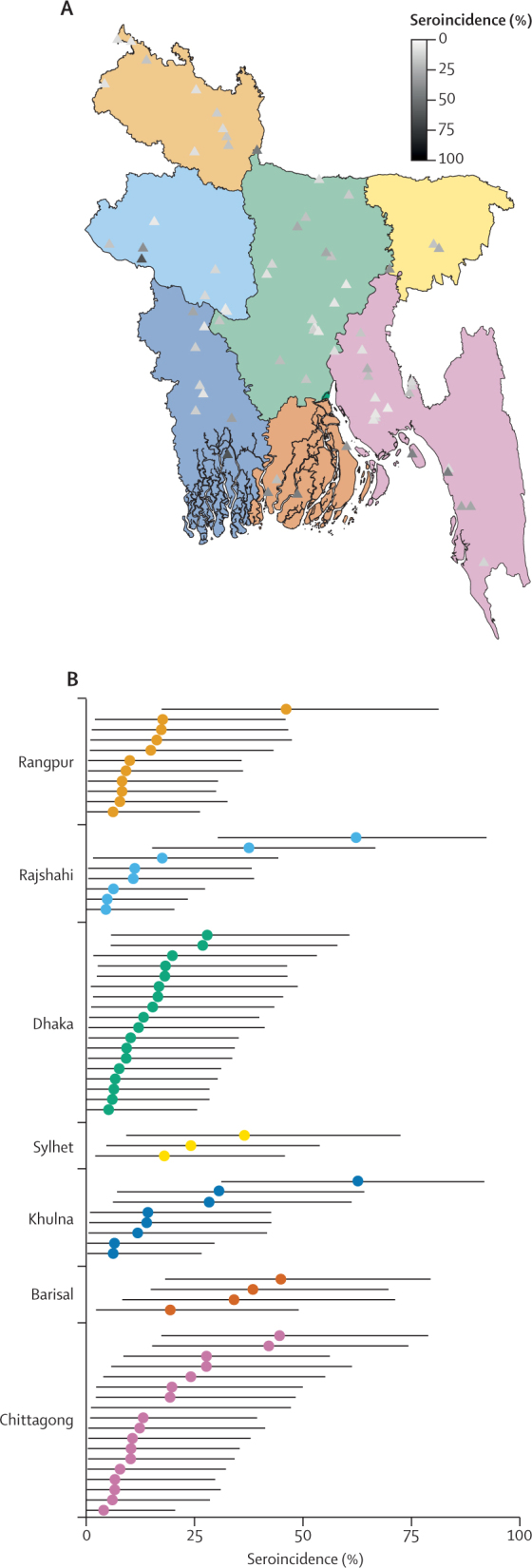
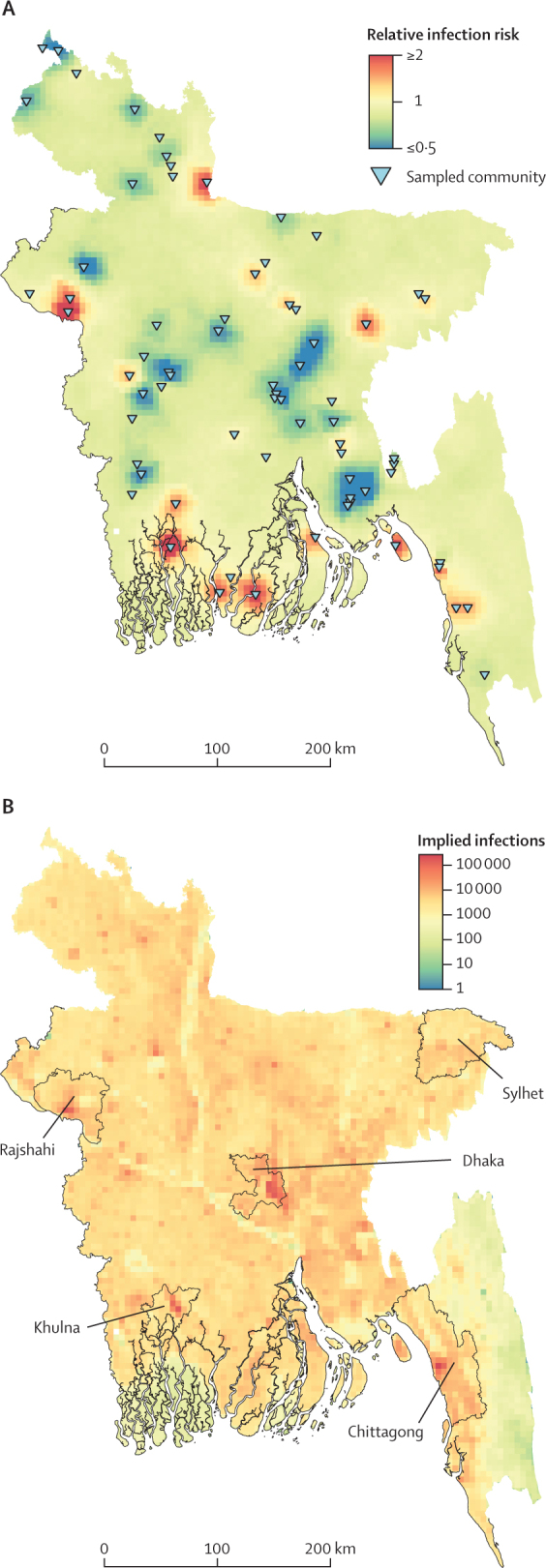
Findings: Between Oct 16, 2015, and Jan 24, 2016, we obtained and tested serum samples from 2930 participants (707 households) in 70 communities across Bangladesh. We estimated national annual seroincidence of V cholerae O1 infection of 17·3% (95% CI 10·5-24·1). Our high-resolution maps showed large heterogeneity of infection risk, with community-level annual infection risk within the sampled population ranging from 4·3% to 62·9%. Across Bangladesh, we estimated that 28·1 (95% CI 17·1-39·2) million infections occurred in the year before the survey. Despite having an annual seroincidence of V cholerae O1 infection lower than much of Bangladesh, Dhaka (the capital of Bangladesh and largest city in the country) had 2·0 (95% CI 0·6-3·9) million infections during the same year, primarily because of its large population.
Interpretation: Serosurveillance provides an avenue for identifying areas with high V cholerae O1 transmission and investigating key risk factors for infection across geographical scales. Serosurveillance could serve as an important method for countries to plan and monitor progress towards 2030 cholera elimination goals.
Funding: The Bill & Melinda Gates Foundation, National Institutes of Health, and US Centers for Disease Control and Prevention.
© 2020 The Author(s). Published by Elsevier Ltd. This is an Open Access article under the CC BY 4.0 license.
Figures
References
-
- Global Task Force on Cholera Control Ending cholera: a global roadmap to 2030. Oct 3, 2017. http://www.who.int/cholera/publications/global-roadmap/en/
-
- Weill F-X, Domman D, Njamkepo E. Genomic history of the seventh pandemic of cholera in Africa. Science. 2017;358:785–789. - PubMed
Publication types
MeSH terms
Grants and funding
LinkOut - more resources
Full Text Sources
Medical
