. 2021 Jan 14;64(1):26-41.
doi: 10.1021/acs.jmedchem.0c00931. Epub 2020 Dec 21.

Glycogen Synthase Kinase 3β: A New Gold Rush in Anti-Alzheimer's Disease Multitarget Drug Discovery?

Affiliations

Glycogen Synthase Kinase 3β: A New Gold Rush in Anti-Alzheimer's Disease Multitarget Drug Discovery?

Angela De Simone et al. J Med Chem. .

Abstract

Alzheimer's disease (AD), like other multifactorial diseases, is the result of a systemic breakdown of different physiological networks. As result, several lines of evidence suggest that it could be more efficiently tackled by molecules directed toward different dysregulated biochemical targets or pathways. In this context, the selection of targets to which the new molecules will be directed is crucial. For years, the design of such multitarget-directed ligands (MTDLs) has been based on the selection of main targets involved in the "cholinergic" and the "β-amyloid" hypothesis. Recently, there have been some reports on MTDLs targeting the glycogen synthase kinase 3β (GSK-3β) enzyme, due to its appealing properties. Indeed, this enzyme is involved in tau hyperphosphorylation, controls a multitude of CNS-specific signaling pathways, and establishes strict connections with several factors implicated in AD pathogenesis. In the present Miniperspective, we will discuss the reasons behind the development of GSK-3β-directed MTDLs and highlight some of the recent efforts to obtain these new classes of MTDLs as potential disease-modifying agents.


Conflict of interest statement

The authors declare no competing financial interest.

Figures
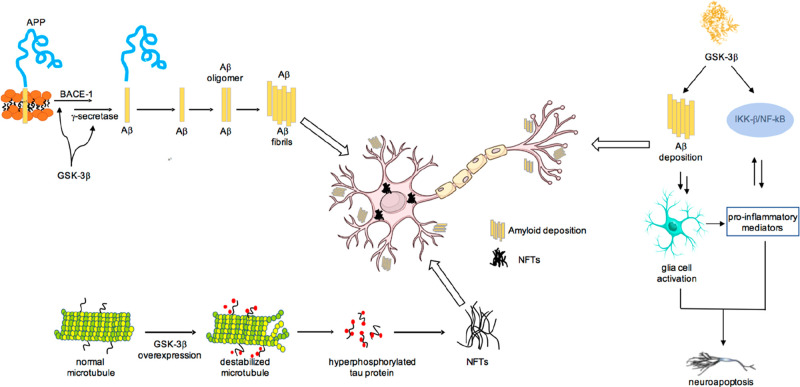
Figure 1
Figure 1
Involvement of GSK-3β in AD results from many activities. The most significant are reported in this figure. GSK-3β contributes to amyloid deposition production affecting the function of presenilin 1 (PS1) and the enzymatic cleavage of APP mediated by BACE-1; senile plaques are derived from the abnormal extracellular accumulation and deposition of Aβ peptide. GSK-3β is responsible for the hyperphosphorylation of tau protein and, as consequence, NFTs formation. GSK-3β is involved in neuroinflammation promoting the production of cytokines in astrocytes and microglia.
Figure 2
Figure 2
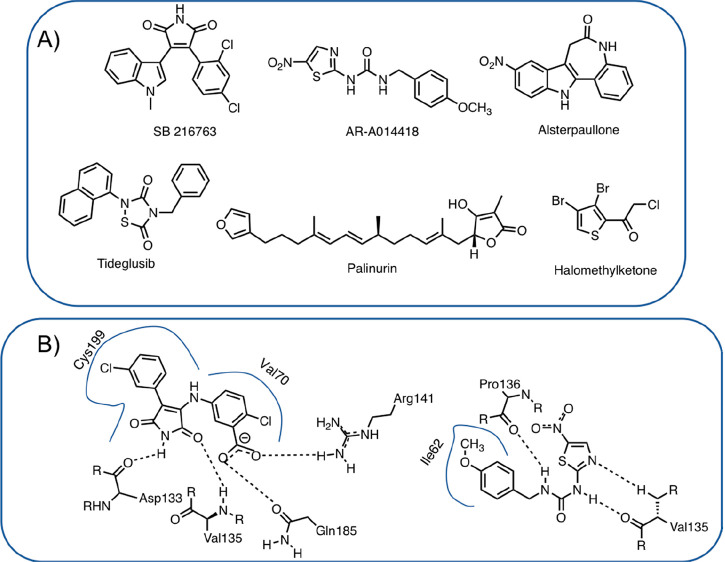
(A) Structure of selected GSK-3β inhibitors. (B) Schematic interactions of a maleimide-based GSK-3β inhibitor and AR-A014418 within the ATP-binding site (PDB codes 1Q4L and 1Q5K).
Figure 3
Figure 3
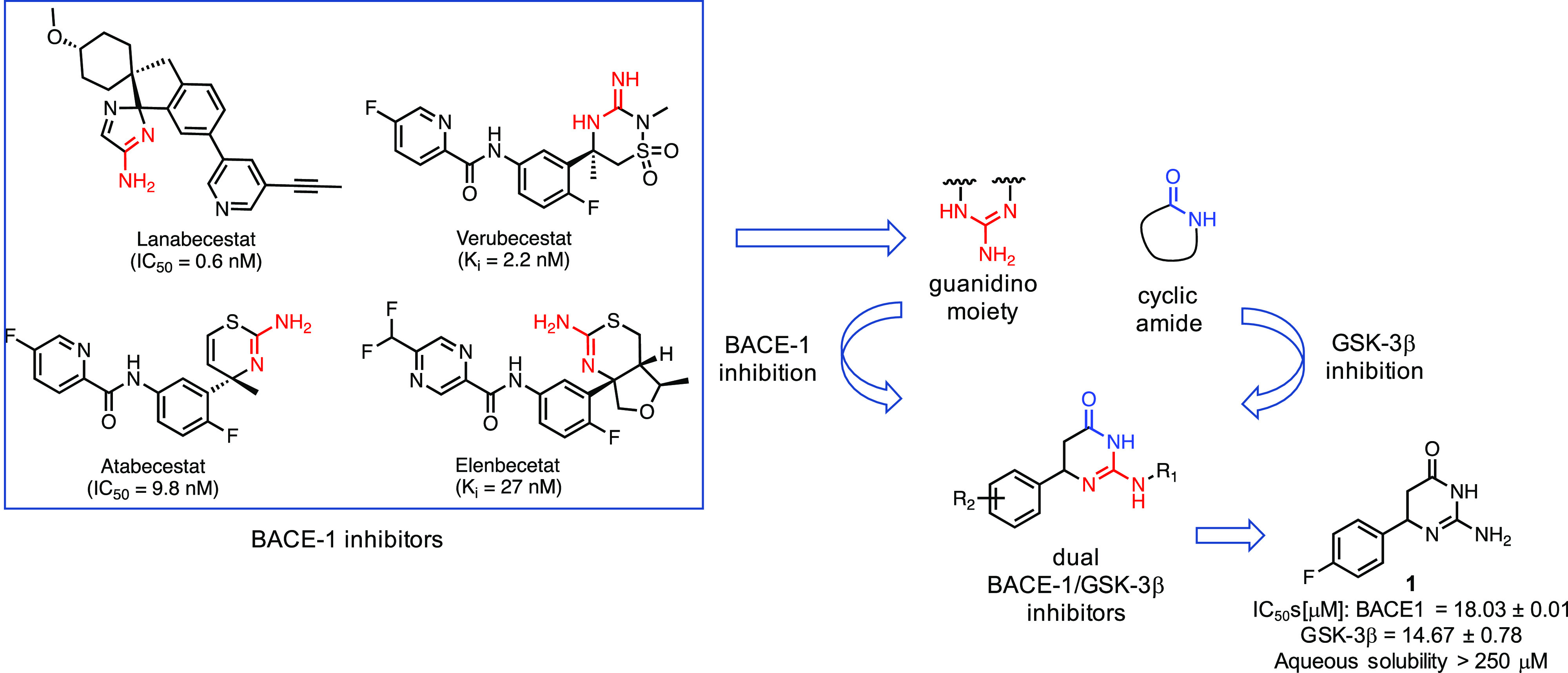
Design strategy leading to the discovery of dual GSK-3β/BACE-1 inhibitor 1. Triazinones were obtained combining structural features responsible for GSK-3β and BACE-1 inhibition, a cyclic amide and a guanidino moiety, respectively. Compound 1 is the most interesting of the series with an IC50 in the micromolar range against both proteins.
Figure 4
Figure 4
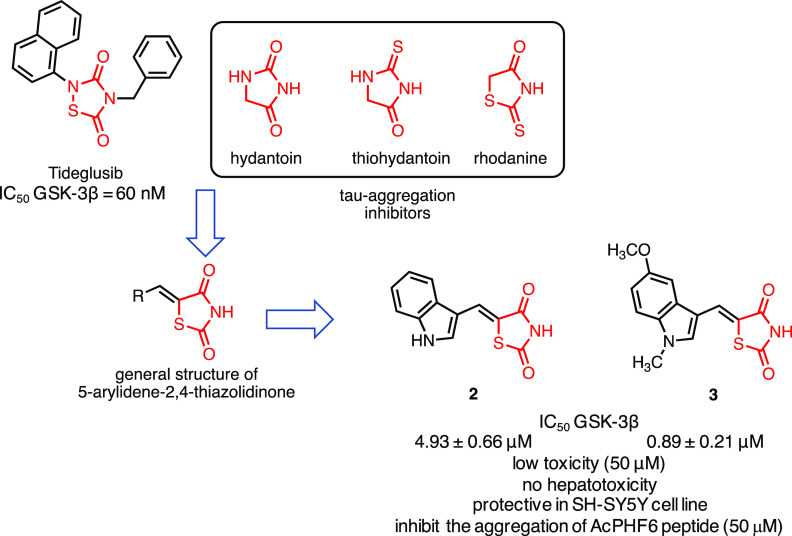
Design of dual GSK-3β/tau aggregation inhibitors. The 5-arylidene-2,4-thiazolidinedione has been designed taking into consideration that a five-member heterocycle is a moiety present in both GSK-3β and tau aggregation inhibitors and that a planar substituent in position 5 may increase both the selectivity toward GSK-3β and the interactions with the tau fibrils.
Figure 5
Figure 5
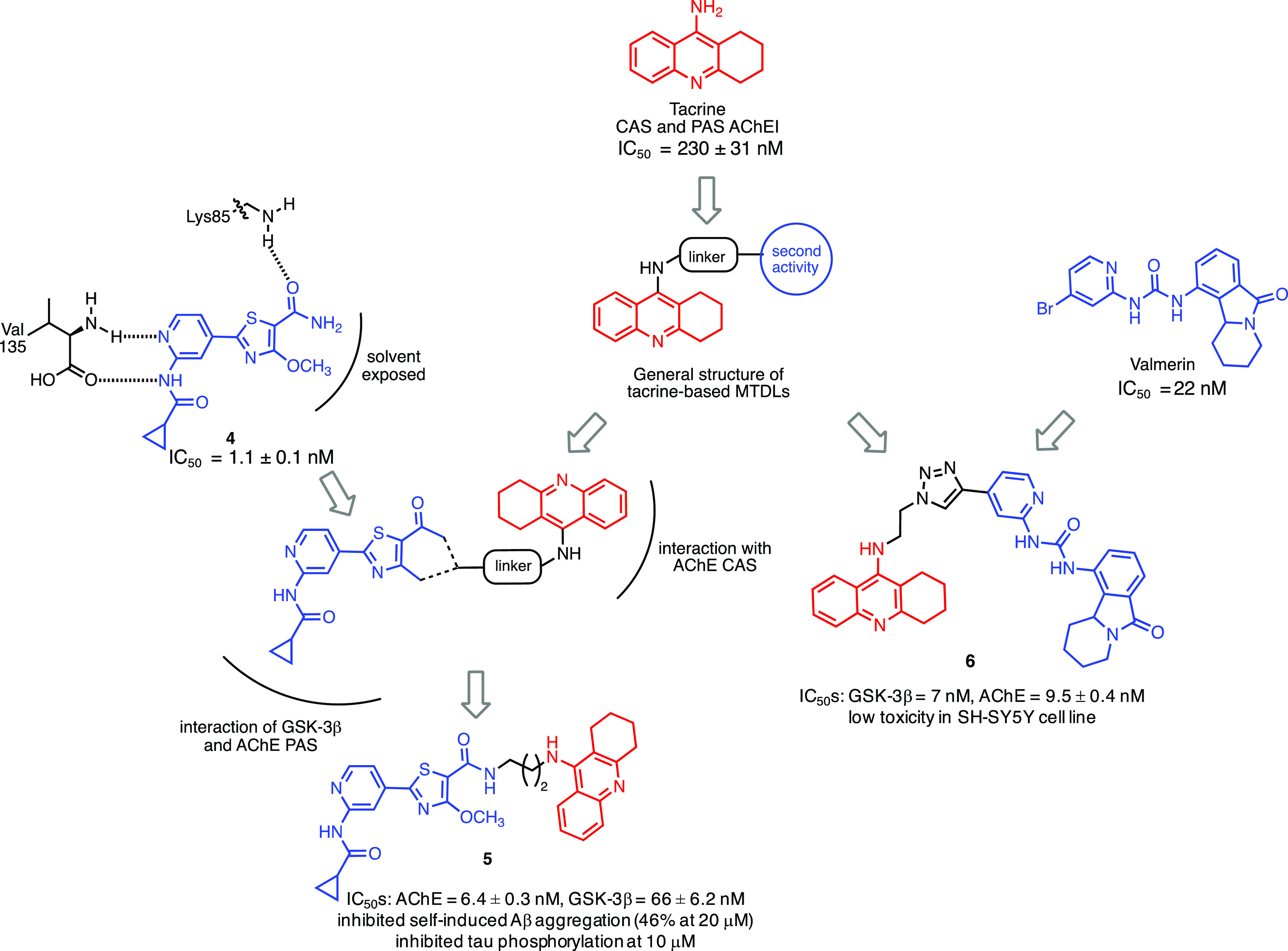
Design of dual GSK-3β/AChE inhibitors 5 and 6. Tacrine has been extensively used to develop MTDLs by linking a structure responsible for inducing a second biological effect. In the cases reported in the figure, GSK-3β inhibitor 4 has been coupled to tacrine to obtain compound 5 by taking advantage of the amide in 4 localized in solvent-exposed portion of the molecule. In the second example, to obtain compound 6, the structure of valmerin has been used as GSK-3β binding-fragment.
Figure 6
Figure 6
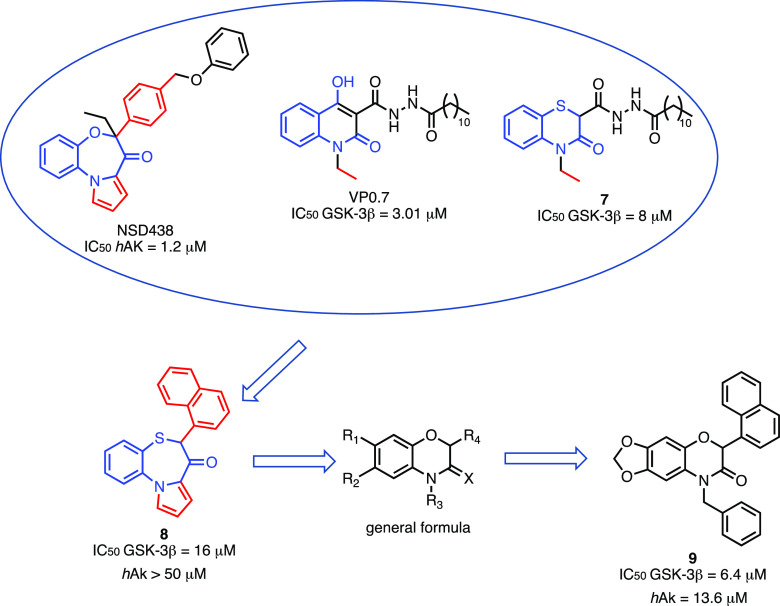
Design of dual GSK-3β/AK inhibitors. Compound 9, able to bind to both GSK-3β and hAK in the micromolar range of concentrations, has been obtained through a series of modifications of compound 8, developed by the same authors, that fails to bind to hAK.
Figure 7
Figure 7
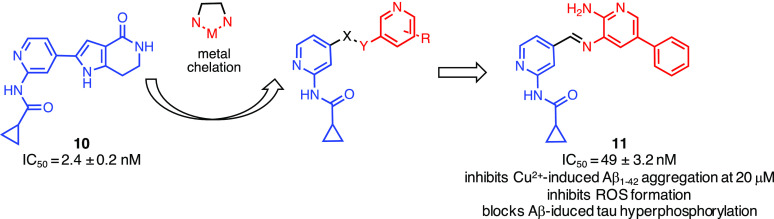
Design of dual GSK-3β inhibitors/metal chelators. The N-(pyridin-2-yl)cyclopropanecarboxamide, able to establish favorable interactions with GSK-3β, has been coupled with a substituted aminopyridine responsible for metal chelation.
Figure 8
Figure 8
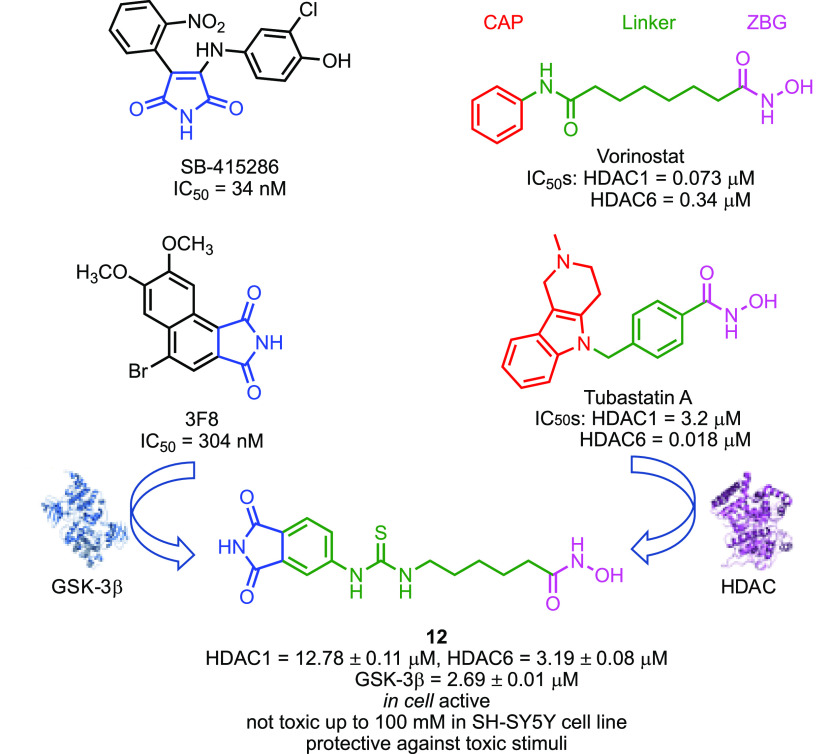
Design of dual GSK-3β/HDACs inhibitors. The phthalimide moiety, which interacts with the ATP-binding site of GSK-3β, and an hydroxamic acid, which chelates the Zn2+ located in the HDAC active site, were linked through an alkylthiourea chain.

References

    1. Ramsay R. R.; Popovic-Nikolic M. R.; Nikolic K.; Uliassi E.; Bolognesi M. L. A perspective on multi-target drug discovery and design for complex diseases. Clin Transl Med. 2018, 7, 3. 10.1186/s40169-017-0181-2. - DOI - PMC - PubMed
    1. Bolognesi M. L. Harnessing polypharmacology with medicinal chemistry. ACS Med. Chem. Lett. 2019, 10, 273–275. 10.1021/acsmedchemlett.9b00039. - DOI - PMC - PubMed
    1. Morphy R.; Rankovic Z. Designed multiple ligands. An emerging drug discovery paradigm. J. Med. Chem. 2005, 48, 6523–6543. 10.1021/jm058225d. - DOI - PubMed
    1. Peters J. U. Polypharmacology - foe or friend?. J. Med. Chem. 2013, 56, 8955–5971. 10.1021/jm400856t. - DOI - PubMed
    1. Cavalli A.; Bolognesi M. L.; Minarini A.; Rosini M.; Tumiatti V.; Recanatini M.; Melchiorre C. Multi-target-directed ligands to combat neurodegenerative diseases. J. Med. Chem. 2008, 51, 347–372. 10.1021/jm7009364. - DOI - PubMed

Publication types

MeSH terms

Substances