


Future Mobile Device Usage, Requirements, and Expectations of Physicians in German University Hospitals: Web-Based Survey
- PMID: 33346735
- PMCID: PMC7781804
- DOI: 10.2196/23955
Future Mobile Device Usage, Requirements, and Expectations of Physicians in German University Hospitals: Web-Based Survey
Abstract
Background: The use of mobile devices in hospital care constantly increases. However, smartphones and tablets have not yet widely become official working equipment in medical care. Meanwhile, the parallel use of private and official devices in hospitals is common. Medical staff use smartphones and tablets in a growing number of ways. This mixture of devices and how they can be used is a challenge to persons in charge of defining strategies and rules for the usage of mobile devices in hospital care.
Objective: Therefore, we aimed to examine the status quo of physicians' mobile device usage and concrete requirements and their future expectations of how mobile devices can be used.
Methods: We performed a web-based survey among physicians in 8 German university hospitals from June to October 2019. The online survey was forwarded by hospital management personnel to physicians from all departments involved in patient care at the local sites.
Results: A total of 303 physicians from almost all medical fields and work experience levels completed the web-based survey. The majority regarded a tablet (211/303, 69.6%) and a smartphone (177/303, 58.4%) as the ideal devices for their operational area. In practice, physicians are still predominantly using desktop computers during their worktime (mean percentage of worktime spent on a desktop computer: 56.8%; smartphone: 12.8%; tablet: 3.6%). Today, physicians use mobile devices for basic tasks such as oral (171/303, 56.4%) and written (118/303, 38.9%) communication and to look up dosages, diagnoses, and guidelines (194/303, 64.0%). Respondents are also willing to use mobile devices for more advanced applications such as an early warning system (224/303, 73.9%) and mobile electronic health records (211/303, 69.6%). We found a significant association between the technical affinity and the preference of device in medical care (χs2=53.84, P<.001) showing that with increasing self-reported technical affinity, the preference for smartphones and tablets increases compared to desktop computers.
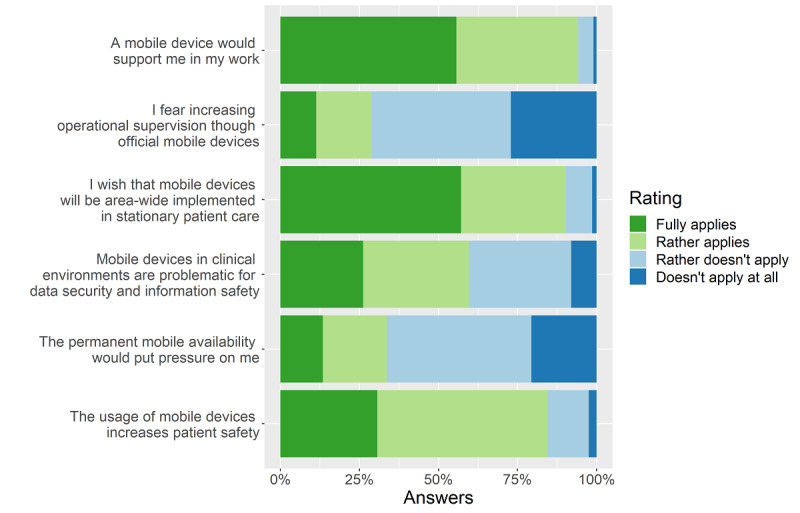
Conclusions: Physicians in German university hospitals have a high technical affinity and positive attitude toward the widespread implementation of mobile devices in clinical care. They are willing to use official mobile devices in clinical practice for basic and advanced mobile health uses. Thus, the reason for the low usage is not a lack of willingness of the potential users. Challenges that hinder the wider adoption of mobile devices might be regulatory, financial and organizational issues, and missing interoperability standards of clinical information systems, but also a shortage of areas of application in which workflows are adapted for (small) mobile devices.
Keywords: apps; device usage; expectations; hospital; mHealth; mobile applications; mobile devices; requirements; smartphones; tablets; working equipment.
©Oliver Maassen, Sebastian Fritsch, Julia Gantner, Saskia Deffge, Julian Kunze, Gernot Marx, Johannes Bickenbach. Originally published in the Journal of Medical Internet Research (http://www.jmir.org), 21.12.2020.
Conflict of interest statement
Conflicts of Interest: None declared.
Figures



References
-
- Tenzer F. Anzahl der Nutzer von Smartphones in Deutschland bis 2019. Statista. 2019. [2020-07-20]. https://de.statista.com/statistik/daten/studie/198959/umfrage/anzahl-der...
-
- Steinhubl SR, Muse ED, Topol EJ. The emerging field of mobile health. Sci Transl Med. 2015 Apr 15;7(283):283rv3. doi: 10.1126/scitranslmed.aaa3487. http://europepmc.org/abstract/MED/25877894 - DOI - PMC - PubMed
-
- Bhavnani SP, Narula J, Sengupta PP. Mobile technology and the digitization of healthcare. Eur Heart J. 2016 May 07;37(18):1428–38. doi: 10.1093/eurheartj/ehv770. http://europepmc.org/abstract/MED/26873093 - DOI - PMC - PubMed
-
- Triantafyllidis A, Kondylakis H, Votis K, Tzovaras D, Maglaveras N, Rahimi K. Features, outcomes, and challenges in mobile health interventions for patients living with chronic diseases: A review of systematic reviews. Int J Med Inform. 2019 Dec;132:103984. doi: 10.1016/j.ijmedinf.2019.103984. - DOI - PubMed
Publication types
MeSH terms
LinkOut - more resources
Full Text Sources
