


Comment
doi: 10.15252/embj.2020107097.
Epub 2020 Dec 21.
Stressin' and slicin': stress-induced tRNA fragmentation codon-adapts translation to repress cell growth
Affiliations
- PMID: 33346912
- PMCID: PMC7809787
- DOI: 10.15252/embj.2020107097
Item in Clipboard
Comment
Stressin' and slicin': stress-induced tRNA fragmentation codon-adapts translation to repress cell growth
EMBO J.
.
Abstract
Transfer RNAs (tRNAs) are central adaptors that decode genetic information during translation and have been long considered static cellular components. However, whether dynamic changes in tRNAs and tRNA-derived fragments actively contribute to gene regulation remains debated. In this issue, Huh et al (2020) highlight tyrosine tRNAGUA fragmentation at the nexus of an evolutionarily conserved adaptive codon-based stress response that fine-tunes translation to restrain growth in human cells.
© 2020 The Authors.
Figures
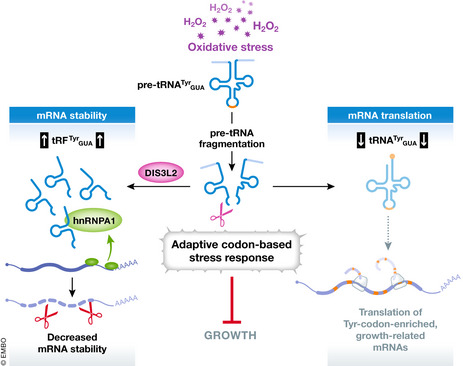
Schematic model depicts the adaptive codon‐based stress response governed by tyrosine tRNATyr
GUA fragmentation in human cells. Through an unknown mechanism, oxidative stress induces rapid depletion of pre‐tRNATyr
GUA and accumulation of tRNA fragments (tRFTyr
GUA) in an exoribonuclease DIS3L2‐dependent manner. Left, tRFTyr
GUA competes for hnRNPA1 binding with specific growth‐associated mRNA subsets promoting their destabilization. Right, pre‐tRNATyr
GUA fragmentation subsequently depletes mature tRNATyr
GUA, thereby hampering the translation of growth‐related mRNAs (e.g., USP3, EPCAM, and SCD) that are enriched in tyrosine codons. The synergistic effects on the transcriptome and translatome induced by the accumulation of tRFTyr
GUA and depletion of tRNATyr
GUA drive an evolutionarily conserved program that limits cell growth upon oxidative stress.
Comment on
-
A stress-induced tyrosine-tRNA depletion response mediates codon-based translational repression and growth suppression.EMBO J. 2021 Jan 15;40(2):e106696. doi: 10.15252/embj.2020106696. Epub 2020 Dec 21. EMBO J. 2021. PMID: 33346941 Free PMC article.
References
-
- Gingold H, Tehler D, Christoffersen NR, Nielsen MM, Asmar F, Kooistra SM, Christophersen NS, Christensen LL, Borre M, Sorensen KD et al (2014) A dual program for translation regulation in cellular proliferation and differentiation. Cell 158: 1281–1292 - PubMed
Publication types
MeSH terms
Substances
Grants and funding
LinkOut - more resources
Full Text Sources
