


doi: 10.1164/rccm.202011-4253LE.
Continuous Positive Airway Pressure Restores Declarative Memory Deficit in Obstructive Sleep Apnea
Affiliations
- PMID: 33347378
- PMCID: PMC8314910
- DOI: 10.1164/rccm.202011-4253LE
Item in Clipboard
Continuous Positive Airway Pressure Restores Declarative Memory Deficit in Obstructive Sleep Apnea
Am J Respir Crit Care Med.
.
No abstract available
Figures
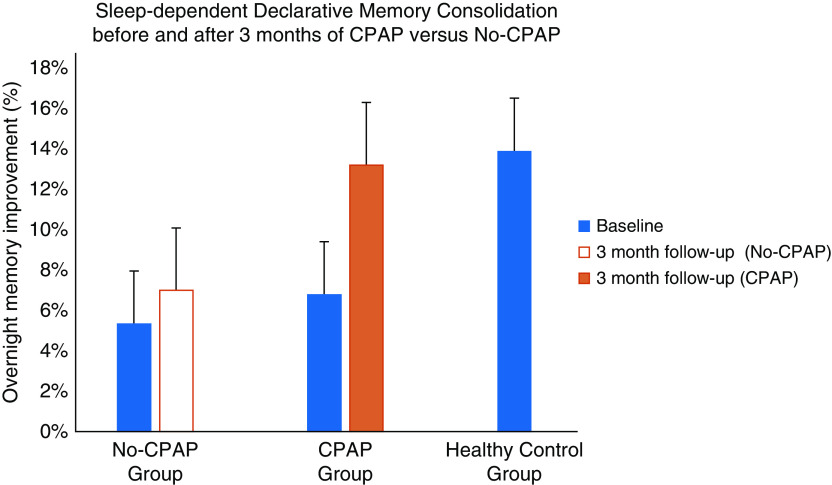
Overnight improvement on the declarative Verbal Paired-Associates (VPA) task for patients with obstructive sleep apnea (OSA), who were randomized to treatment with continuous positive airway pressure (CPAP) and lifestyle changes for 3 months (CPAP group, n = 15), patients with OSA who implemented lifestyle changes for 3 months (no-CPAP, n = 16), and healthy control subjects (n = 36). Baseline performance for all groups (blue) and performance after 3 months are displayed for the CPAP (orange) and no-CPAP (white) group. Mean overnight VPA improvement between initial baseline and after 3 months of treatment intervention demonstrated a significant improvement for the CPAP group (P = 0.01) but not for the no-CPAP group (P = 0.14), with a significant difference in mean improvement over time between groups (P = 0.02). After 3 months of treatment, the CPAP group achieved performance levels similar to those of healthy control subjects (13.2% vs. 13.9%; P = 0.78).
Comment in
-
Can N3 Period Duration Serve as a Predictor of Cognitive Dysfunction?Am J Respir Crit Care Med. 2021 Nov 15;204(10):1235-1236. doi: 10.1164/rccm.202105-1231LE. Am J Respir Crit Care Med. 2021. PMID: 34478349 Free PMC article. No abstract available.
-
Reply to Zheng et al.Am J Respir Crit Care Med. 2021 Nov 15;204(10):1236-1237. doi: 10.1164/rccm.202106-1414LE. Am J Respir Crit Care Med. 2021. PMID: 34478350 Free PMC article. No abstract available.
References
-
- Blackwell T, Yaffe K, Laffan A, Redline S, Ancoli-Israel S, Ensrud KE, et al. Osteoporotic Fractures in Men Study Group. Associations between sleep-disordered breathing, nocturnal hypoxemia, and subsequent cognitive decline in older community-dwelling men: the Osteoporotic Fractures in Men Sleep Study. J Am Geriatr Soc. 2015;63:453–461. - PMC - PubMed
-
- Wilson MA, McNaughton BL. Reactivation of hippocampal ensemble memories during sleep. Science. 1994;265:676–679. - PubMed
-
- McArdle N, Douglas NJ. Effect of continuous positive airway pressure on sleep architecture in the sleep apnea-hypopnea syndrome: a randomized controlled trial. Am J Respir Crit Care Med. 2001;164:1459–1463. - PubMed
Publication types
MeSH terms
Grants and funding
LinkOut - more resources
Full Text Sources
Medical
