


Knowledge, attitudes, and practices toward COVID-19 among university students in Japan and associated factors: An online cross-sectional survey
- PMID: 33347488
- PMCID: PMC7751858
- DOI: 10.1371/journal.pone.0244350
Knowledge, attitudes, and practices toward COVID-19 among university students in Japan and associated factors: An online cross-sectional survey
Abstract
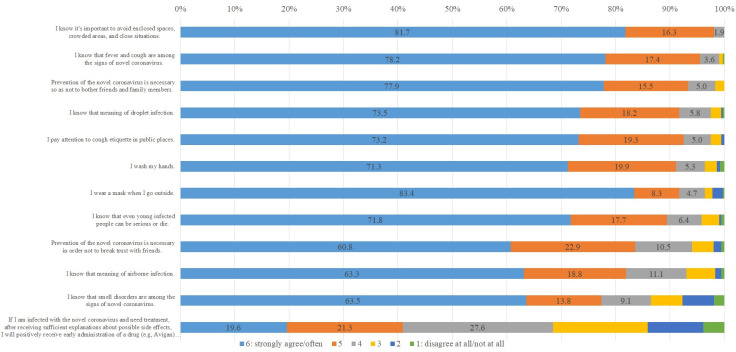
The coronavirus disease (COVID-19) pandemic has greatly altered peoples' daily lives, and it continues spreading as a crucial concern globally. Knowledge, attitudes, and practices (KAP) toward COVID-19 are related to individuals' adherence to government measures. This study evaluated KAP toward COVID-19 among university students in Japan between May 22 and July 16, 2020, via an online questionnaire, and it further investigated the associated determining KAP factors. Among the eligible respondents (n = 362), 52.8% were female, 79.0% were undergraduate students, 32.9% were students whose major university subjects were biology-related, 35.4% were from the capital region, and 83.7% were Japanese. The overall KAP of university students in Japan was high. All respondents (100%) showed they possessed knowledge on avoiding enclosed spaces, crowded areas, and close situations. Most respondents showed a moderate or higher frequency of washing their hands or wearing masks (both at 96.4%). In addition, 68.5% of respondents showed a positive attitude toward early drug administration. In the logistic regressions, gender, major subjects, education level, nationality, residence, and psychological factors (private self-consciousness and extroversion) were associated with knowledge or attitudes toward COVD-19 (p < 0.05). In the logistic and multiple linear regressions, capital regions, high basic knowledge, high information acquisition, correct information explanations contributed positively to preventative action (p < 0.05). Non-capital regions, male gender, non-bio-backgrounds, high public self-consciousness, high advanced knowledge, incorrect information explanations, and high extroversion contributed negatively to self-restraint (p < 0.05). Moreover, self-restraint was decreasing over time. These findings clarify the Japanese university students' KAP and the related factors in the early period of the COVID-19 pandemic, and they may help university managers, experts, and policymakers control the future spread of COVID-19 and other emerging infections.
Conflict of interest statement
The authors have declared that no competing interests exist.
Figures
References
-
- Coronavirus disease (COVID-19)–World Health Organization. [cited 22 Oct 2020]. Available: https://www.who.int/emergencies/diseases/novel-coronavirus-2019
-
- Center for Systems Science and Engineering (CSSE). COVID-19 Map—Johns Hopkins Coronavirus Resource Center. 2020. [cited 22 Oct 2020]. Available: https://coronavirus.jhu.edu/data
-
- Zhong B-L, Luo W, Li H-M, Zhang Q-Q, Liu X-G, Li W-T, et al. Knowledge, attitudes, and practices towards COVID-19 among Chinese residents during the rapid rise period of the COVID-19 outbreak: a quick online cross-sectional survey. Int J Biol Sci. 2020;16: 1745–1752. 10.7150/ijbs.45221 - DOI - PMC - PubMed
MeSH terms
LinkOut - more resources
Full Text Sources
Medical
