


Fitness benefits to bacteria of carrying prophages and prophage-encoded antibiotic-resistance genes peak in different environments
- PMID: 33347602
- PMCID: PMC7986917
- DOI: 10.1111/evo.14153
Fitness benefits to bacteria of carrying prophages and prophage-encoded antibiotic-resistance genes peak in different environments
Abstract
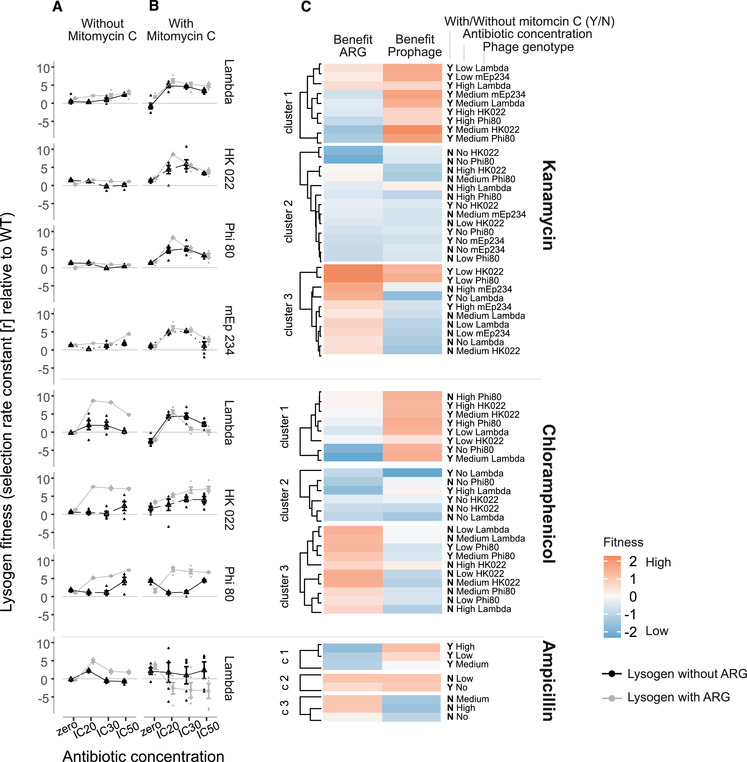
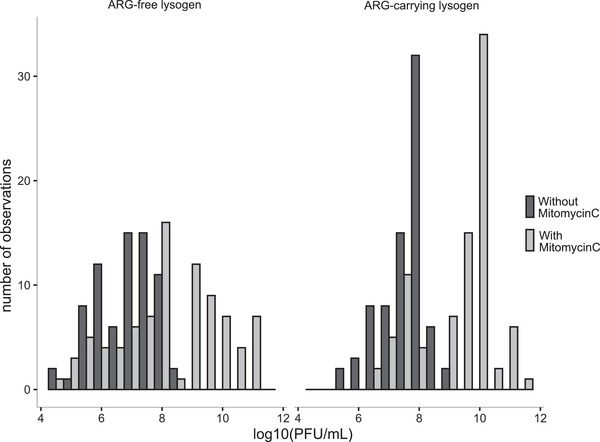
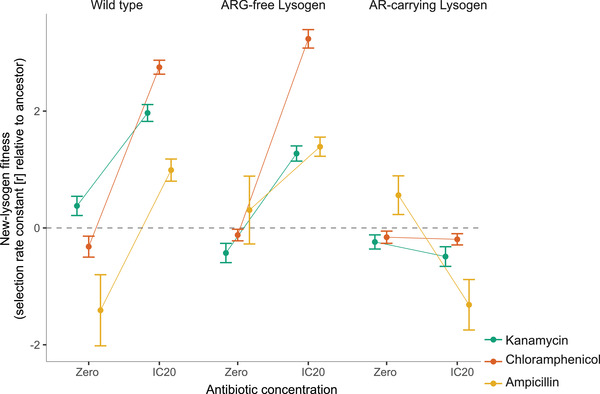
Understanding the role of horizontal gene transfer (HGT) in adaptation is a key challenge in evolutionary biology. In microbes, an important mechanism of HGT is prophage acquisition (phage genomes integrated into bacterial chromosomes). Prophages can influence bacterial fitness via the transfer of beneficial genes (including antibiotic-resistance genes, ARGs), protection from superinfecting phages, or switching to a lytic lifecycle that releases free phages infectious to competitors. We expect these effects to depend on environmental conditions because of, for example, environment-dependent induction of the lytic lifecycle. However, it remains unclear how costs/benefits of prophages vary across environments. Here, studying prophages with/without ARGs in Escherichia coli, we disentangled the effects of prophages alone and adaptive genes they carry. In competition with prophage-free strains, benefits from prophages and ARGs peaked in different environments. Prophages were most beneficial when induction of the lytic lifecycle was common, whereas ARGs were more beneficial upon antibiotic exposure and with reduced prophage induction. Acquisition of prophage-encoded ARGs by competing strains was most common when prophage induction, and therefore free phages, were common. Thus, selection on prophages and adaptive genes they carry varies independently across environments, which is important for predicting the spread of mobile/integrating genetic elements and their role in evolution.
Keywords: Antibiotic resistance; fitness; lysogen; mobile genetic elements; prophage; temperate phage.
© 2020 The Authors. Evolution published by Wiley Periodicals LLC on behalf of The Society for the Study of Evolution.
Conflict of interest statement
The authors have no conflict of interest to declare.
Figures
References
-
- Andersson, D. I. , and Levin B. R.. 1999. The biological cost of antibiotic resistance. Curr. Opin. Microbiol. 2:489‒493. - PubMed
-
- Blahova, J. , Kralikova K., Krcmery V., and Jezek P.. 1999. Transduction of antibiotic resistance in Pseudomonas aeruginosa: Relationship between lytic and transducing activity of phage isolate AP‐423. Acta. Virol. 43:395‒398. - PubMed
-
- Bondy‐Denomy, J. , and Davidson A. R.. 2014. When a Virus is not a Parasite: The Beneficial Effects of Prophages on Bacterial Fitness. J. Microbiol. 52:235‒242. - PubMed
Publication types
MeSH terms
Substances
Associated data
LinkOut - more resources
Full Text Sources
Other Literature Sources
Medical