


A complementary feeding and play intervention improves the home environment and mental development among toddlers in rural India
- PMID: 33347725
- PMCID: PMC7752118
- DOI: 10.1111/mcn.13066
A complementary feeding and play intervention improves the home environment and mental development among toddlers in rural India
Abstract
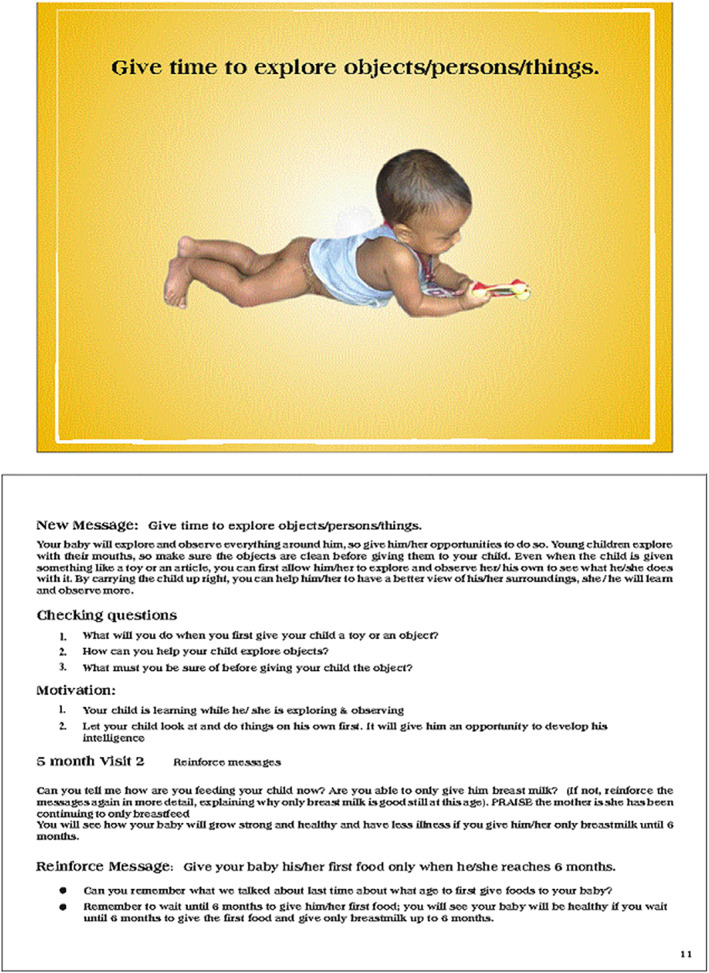
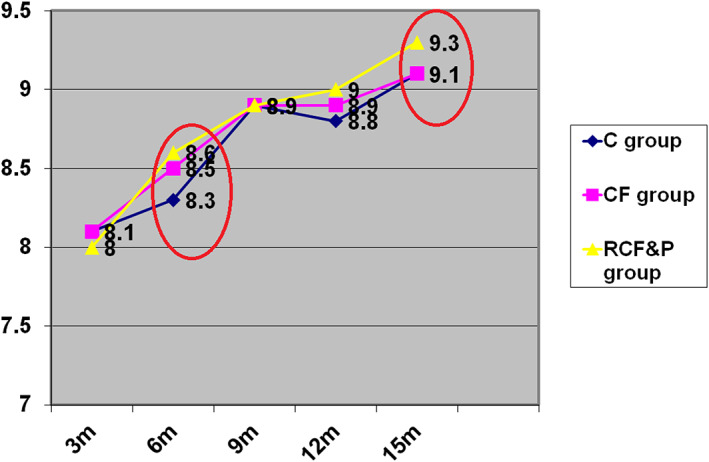
A cluster randomized trial design was used to test the efficacy of a behaviour change communication intervention on the quality of the home environment and infant development at 15 months of age. Children (n = 600) in rural South India were followed from 3 through 15 months of age. The control group (C group) received the standard of care, the complementary feeding group (CF group) received recommendations on complementary foods and the responsive complementary feeding and play group (RCF&P group) received recommendations on complementary foods plus skills on responsive feeding and play. The intervention was delivered in biweekly home visits to caregivers using flip charts. At postintervention, infants (n = 521) were assessed for development (Bayley-II scales) and their home environment was assessed (Home Observation for Measurement of the Environment [HOME] scale). Cluster adjusted analysis of variance showed no significant differences at baseline. The HOME score at 15 months differed by group, F(2, 38) = 6.41, P = 0.004; the CF and RCF&P groups had higher scores than the C group. Scores on subscales 'Opportunities for Variety in Daily Stimulation' and 'Caregiver Promotion of Child Development' (CPCD) were higher for the RCF&P group than for the C and CF groups. Mental development index (MDI) scores differed by group, F(2, 37) = 3.31, P = 0.04, with the RCF&P group showing higher scores than the C group (P < 0.04); no differences were noted in psychomotor development index (PDI) scores (P = 0.48). The subscales of HOME associated with MDI at 15 months were 'CPCD' and 'Cleanliness of Child' (R2 = 0.076). 'CPCD' was also associated with PDI (R2 = 0.039). A responsive complementary feeding and play intervention delivered through home visits benefitted children's mental development and caregiving environment at 15 months.
Keywords: behaviour change communication; cognitive development; home visits; integrated intervention; responsive feeding.
© 2020 The Authors. Maternal & Child Nutrition published by John Wiley & Sons, Ltd.
Conflict of interest statement
All authors (Fernandez‐Rao, Bentley, Griffiths, Balakrishna, Creed‐Kanashiro and Johnson) declare ‘no conflict of interest’.
Figures
References
-
- Bakermans‐Kranenburg, M. J. , Van Ijzendoorn, M. H. , & Bradley, R. H. (2005). Those who have, receive: The Matthew effect in early childhood intervention in home environment. Review of Educational Research, 575, 1–26. 10.3102/00346543075001001 - DOI
-
- Bandura, A. (1986). Social foundations of thought and action. Englewood Cliffs, New Jersey: Prentice‐Hall.
Publication types
MeSH terms
Grants and funding
LinkOut - more resources
Full Text Sources
Medical
Miscellaneous
