


Social Connection in Long-Term Care Homes: A Scoping Review of Published Research on the Mental Health Impacts and Potential Strategies During COVID-19
- PMID: 33347846
- PMCID: PMC9186333
- DOI: 10.1016/j.jamda.2020.11.025
Social Connection in Long-Term Care Homes: A Scoping Review of Published Research on the Mental Health Impacts and Potential Strategies During COVID-19
Abstract
Objectives: Good social connection is associated with better health and wellbeing. However, social connection has distinct considerations for people living in long-term care (LTC) homes. The objective of this scoping review was to summarize research literature linking social connection to mental health outcomes, specifically among LTC residents, as well as research to identify strategies to help build and maintain social connection in this population during COVID-19.
Design: Scoping review.
Settings and participants: Residents of LTC homes, care homes, and nursing homes.
Methods: We searched MEDLINE(R) ALL (Ovid), CINAHL (EBSCO), PsycINFO (Ovid), Scopus, Sociological Abstracts (ProQuest), Embase and Embase Classic (Ovid), Emcare Nursing (Ovid), and AgeLine (EBSCO) for research that quantified an aspect of social connection among LTC residents; we limited searches to English-language articles published from database inception to search date (July 2019). For the current analysis, we included studies that reported (1) the association between social connection and a mental health outcome, (2) the association between a modifiable risk factor and social connection, or (3) intervention studies with social connection as an outcome. From studies in (2) and (3), we identified strategies that could be implemented and adapted by LTC residents, families and staff during COVID-19 and included the articles that informed these strategies.
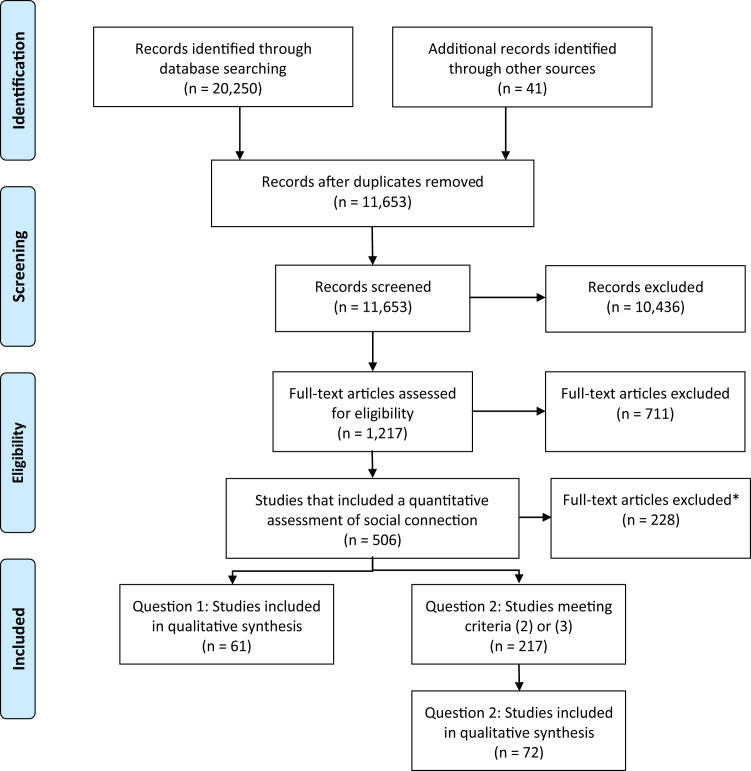
Results: We included 133 studies in our review. We found 61 studies that tested the association between social connection and a mental health outcome. We highlighted 12 strategies, informed by 72 observational and intervention studies, that might help LTC residents, families, and staff build and maintain social connection for LTC residents.
Conclusions and implications: Published research conducted among LTC residents has linked good social connection to better mental health outcomes. Observational and intervention studies provide some evidence on approaches to address social connection in this population. Although further research is needed, it does not obviate the need to act given the sudden and severe impact of COVID-19 on social connection in LTC residents.
Keywords: Social integration; loneliness; long-term care; nursing homes; social capital; social engagement; social isolation; social networks; social support.
Copyright © 2020 AMDA – The Society for Post-Acute and Long-Term Care Medicine. Published by Elsevier Inc. All rights reserved.
Figures
Similar articles
-
Consequences of loneliness/isolation and visitation restrictions on the mood of long-term care residents without severe dementia pre-COVID-19 and during COVID-19: a scoping review.BMJ Open. 2025 Mar 26;15(3):e090522. doi: 10.1136/bmjopen-2024-090522. BMJ Open. 2025. PMID: 40139711 Free PMC article.
-
Social integration and loneliness among long-term care home residents: protocol for a scoping review.BMJ Open. 2019 Dec 9;9(12):e033240. doi: 10.1136/bmjopen-2019-033240. BMJ Open. 2019. PMID: 31822544 Free PMC article.
-
Social connection measures for older adults living in long-term care homes: a systematic review protocol.Syst Rev. 2024 Feb 15;13(1):67. doi: 10.1186/s13643-024-02468-6. Syst Rev. 2024. PMID: 38360642 Free PMC article.
-
Home- and community-level predictors of social connection in nursing home residents: A scoping review.Health Sci Rep. 2022 Jul 20;5(4):e743. doi: 10.1002/hsr2.743. eCollection 2022 Jul. Health Sci Rep. 2022. PMID: 35873395 Free PMC article.
-
Social connection in long-term care homes: a qualitative study of barriers and facilitators.BMC Geriatr. 2024 Oct 22;24(1):857. doi: 10.1186/s12877-024-05454-8. BMC Geriatr. 2024. PMID: 39438797 Free PMC article.
Cited by
-
Social Connection is Essential in Long-Term Care Homes: Considerations During COVID-19 and Beyond.Can Geriatr J. 2021 Jun 1;24(2):151-153. doi: 10.5770/cgj.24.488. eCollection 2021 Jun. Can Geriatr J. 2021. PMID: 34079609 Free PMC article.
-
Relatives' perspectives on encounters and communication in nursing homes during the Covid-19 pandemic: a qualitative interview study.BMC Geriatr. 2022 Aug 25;22(1):706. doi: 10.1186/s12877-022-03364-1. BMC Geriatr. 2022. PMID: 36008775 Free PMC article.
-
The prevalence of, and factors associated with, a risk of depression in residential aged care services residents: Findings from the FIRST study.Australas J Ageing. 2024 Dec;43(4):811-817. doi: 10.1111/ajag.13358. Epub 2024 Jul 29. Australas J Ageing. 2024. PMID: 39073245 Free PMC article.
-
Quality of life, pain and use of analgesic, anxiolytic and antidepressant medication, in people living in care homes.Age Ageing. 2024 Sep 1;53(9):afae196. doi: 10.1093/ageing/afae196. Age Ageing. 2024. PMID: 39238123 Free PMC article. Clinical Trial.
-
Older people's experience and related factors while receiving home-based long-term care services: a qualitative study.BMC Nurs. 2024 Aug 21;23(1):580. doi: 10.1186/s12912-024-02234-y. BMC Nurs. 2024. PMID: 39169322 Free PMC article.
References
-
- Stall N.M., Johnstone J., McGeer A.J., et al. Finding the right balance: An evidence-informed guidance document to support the re-opening of Canadian nursing homes to family caregivers and visitors during the coronavirus disease 2019 pandemic. J Am Med Dir Assoc. 2020;21:1365–1370. e1367. - PMC - PubMed
-
- Holt-Lunstad J., Smith T.B., Baker M., et al. Loneliness and social isolation as risk factors for mortality: A meta-analytic review. Perspect Psychol Sci. 2015;10:227–237. - PubMed
Publication types
MeSH terms
LinkOut - more resources
Full Text Sources
Other Literature Sources
Medical
