Review
. 2020 Dec 17;12(12):1454.
doi: 10.3390/v12121454.

Exposure Risk of Chronic Wasting Disease in Humans

Affiliations
Review

Exposure Risk of Chronic Wasting Disease in Humans

Satish K Nemani et al. Viruses. .

Abstract

The majority of human prion diseases are sporadic, but acquired disease can occur, as seen with variant Creutzfeldt-Jakob disease (vCJD) following consumption of bovine spongiform encephalopathy (BSE). With increasing rates of cervid chronic wasting disease (CWD), there is concern that a new form of human prion disease may arise. Currently, there is no evidence of transmission of CWD to humans, suggesting the presence of a strong species barrier; however, in vitro and in vivo studies on the zoonotic potential of CWD have yielded mixed results. The emergence of different CWD strains is also concerning, as different strains can have different abilities to cross species barriers. Given that venison consumption is common in areas where CWD rates are on the rise, increased rates of human exposure are inevitable. If CWD was to infect humans, it is unclear how it would present clinically; in vCJD, it was strain-typing of vCJD prions that proved the causal link to BSE. Therefore, the best way to screen for CWD in humans is to have thorough strain-typing of harvested cervids and human CJD cases so that we will be in a position to detect atypical strains or strain shifts within the human CJD population.

Keywords: 129M/V polymorphism; CWD prions (PrPCWD); PRNP polymorphism; bovine spongiform encephalopathy (BSE); chronic wasting disease (CWD); proteinase K resistant prion protein (PK-resPrP); sporadic CJD; strains; variant Creutzfeldt–Jakob disease (vCJD); zoonotic potential.


Conflict of interest statement

The authors declare no conflict of interest.

Figures
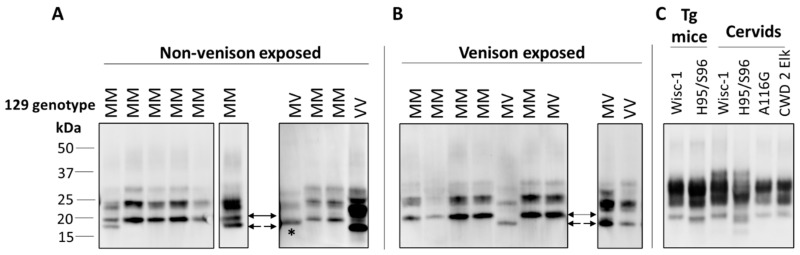
Figure 1
Figure 1
Immunoblot profiles of PK-resistant PrP from brains of Creutzfeldt–Jakob disease (CJD) patients, with or without exposure to venison, compared with chronic wasting disease (CWD) strains. (A,B) Typing studies for non-venison (A) and venison (B) exposed CJD cases were carried out as described previously [78], with 10% brain homogenates in lysis buffer (LB100) (100 mM Tris HCl pH 7.0, 100 mM NaCl, 10 mM EDTA, 0.5% Nonidet-P 40, 0.5% sodium deoxycholate) digested with 70 U/mL PK for 1 h at 37 °C. Different sample volumes were loaded or blots from different runs were included to obtain a similar PrP signal intensities for comparison of banding profiles. Type 1 (21 kDa) is indicated by a solid arrow, Type 2 (19 kDa) by dashed arrow, and 20 kDa from variably protease sensitive prionopathy (VPSPr) indicated with *. Primary Ab: 3F4. (C) Typing study of CWD strains, with 10% homogenates in LB100 pH 8.0 digested with 30 U/mL PK. Wisc-1 was propagated in Tg33 mice and H95/S96 was first passaged in Tg60 mice. BH from deer and elk harboring different polymorphisms was also analyzed. Primary Ab: Sha31
Figure 2
Figure 2
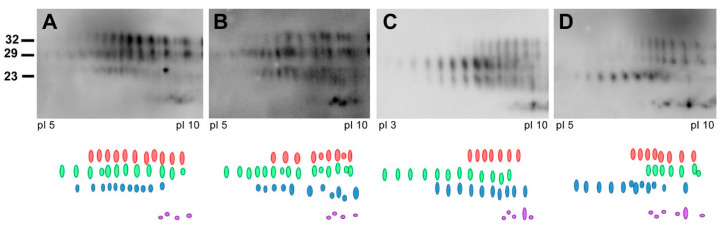
Representative images of PrPSc 2D-electrophoresis are shown. PrPSc was precipitated from brain homogenate using sarkosyl and NaPTA. Extracted proteins were separated in the first dimension on Ready-Strip IPC strips (Bio-Rad) and a pH gradient of 3–10. Following equilibration in SDS and reducing/alkylating agents, the second dimension of the gel was performed on Criterion Tris-HCL polyacrylamide precast gels (8–16%) prior to Western blotting. PrPSc was detected using the 3F4 antibody and an HRP secondary. Four strips of spots were identified at different molecular weights: 32 kDa (red), 29 kDa (green), 23k Da (blue) and 13/14 kDa (purple). (A) Non-venison exposed CJD subject; (BD) venison exposed CJD subjects.
Figure 3
Figure 3
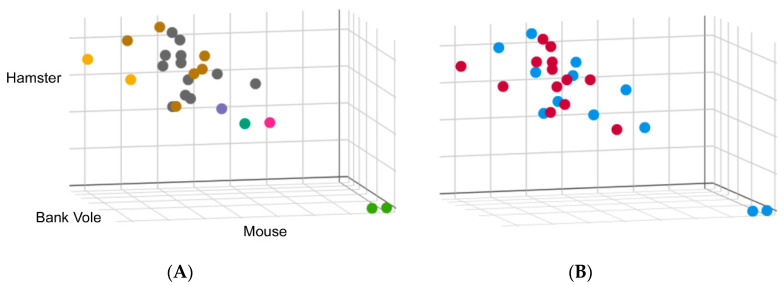
Real-time quaking-induced conversion (RT-QuIC) was performed on 10−4 dilutions of brain homogenate from 25 cases of sCJD using 3 different substrates: full-length mouse, hamster and bank vole. Conversion rate was measured by comparing the time at which fluorescence in a given reaction exceeds a pre-defined threshold, i.e., the lag phase. Lag phases for each case were normalized to a 263 K hamster brain homogenate run concurrently as a standard to allow direct comparison between each run. These values were plotted on a scatter plot where the axes represent the normalized lag phase for each substrate. (A) Cases were colored according to the biochemical subtypes: Type 1, shown in grey, and Type 2, shown in brown. Two cases where a mixture of Type 1 and Type 2 were identified are shown in yellow. Cases shown in green are two cases of variably protease sensitive prionopathy (VPSPr). A Type 1 case with a biochemically distinct denaturation profile is shown in green and two others that do not exhibit typical glycoform patterns by Western blot shown in pink and purple. (B) Data were colored to reflect RT-QuIC seeding from brains of CJD patients, with or without exposure to venison, shown as blue or red, respectively.

References

    1. Prusiner S.B. Novel proteinaceous infectious particles cause scrapie. Science. 1982;216:136–144. doi: 10.1126/science.6801762. - DOI - PubMed
    1. Gambetti P., Cali I., Notari S., Kong Q., Zou W.Q., Surewicz W.K. Molecular biology and pathology of prion strains in sporadic human prion diseases. Acta Neuropathol. 2011;121:79–90. doi: 10.1007/s00401-010-0761-3. - DOI - PMC - PubMed
    1. Puoti G., Bizzi A., Forloni G., Safar J.G., Tagliavini F., Gambetti P. Sporadic human prion diseases: Molecular insights and diagnosis. Lancet Neurol. 2012;11:618–628. doi: 10.1016/S1474-4422(12)70063-7. - DOI - PubMed
    1. Schwartz M. How the Cows Turned Mad by Maxime Schwartz—Paperback—University of California Press. [(accessed on 5 September 2020)]; Available online: https://www.ucpress.edu/book/9780520243378/how-the-cows-turned-mad.
    1. Anderson R.M., Donnelly C.A., Ferguson N.M., Woolhouse M.E.J., Watt C.J., Udy H.J., MaWhinney S., Dunstan S.P., Southwood T.R.E., Wilesmith J.W., et al. Transmission dynamics and epidemiology of BSE in British cattle. Nature. 1996;382:779–788. doi: 10.1038/382779a0. - DOI - PubMed

Publication types