


Identification of Markers Predicting Clinical Course in Patients with IgG4-Related Ophthalmic Disease by Unbiased Clustering Analysis
- PMID: 33348892
- PMCID: PMC7766793
- DOI: 10.3390/jcm9124084
Identification of Markers Predicting Clinical Course in Patients with IgG4-Related Ophthalmic Disease by Unbiased Clustering Analysis
Abstract
Purpose: To describe the clinical features of patients with immunoglobulin G4 (IgG4)-related ophthalmic disease (IgG4-ROD) grouped by unbiased cluster analysis using peripheral blood test data and to find novel biomarkers for predicting clinical features.
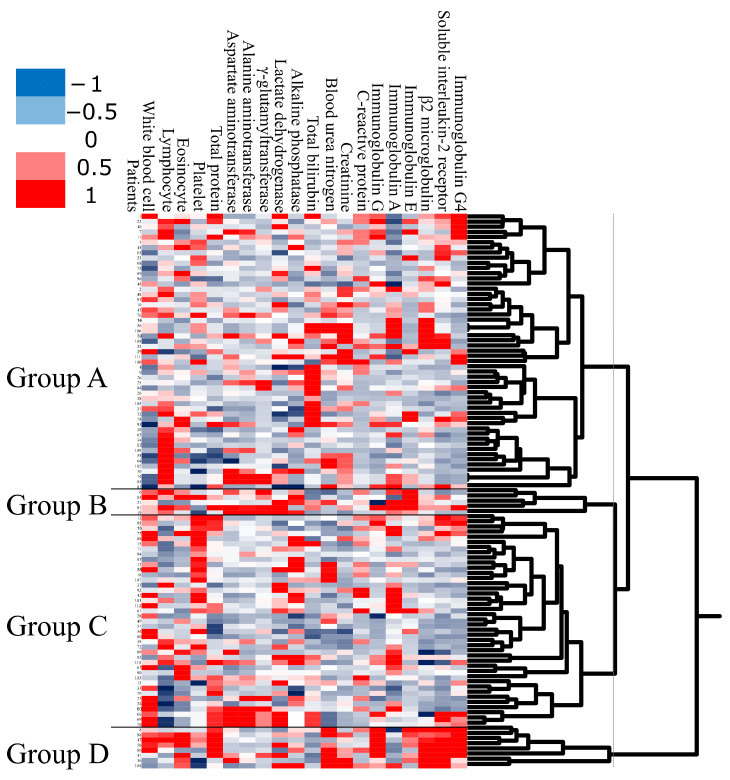
Methods: One hundred and seven patients diagnosed with IgG4-ROD were divided into four groups by unsupervised hierarchical cluster analysis using peripheral blood test data. The clinical features of the four groups were compared and novel markers for prediction of clinical course were explored.
Results: Unbiased cluster analysis divided patients into four groups. Group B had a significantly higher frequency of extraocular muscle enlargement (p < 0.001). The frequency of patients with decreased best corrected visual acuity (BCVA) was significantly higher in group D (p = 0.002). Receiver operating characteristic (ROC) curves for the prediction of extraocular muscle enlargement and worsened BCVA using a panel consisting of important blood test data identified by machine learning yielded areas under the curve of 0.78 and 0.86, respectively. Clinical features were compared between patients divided into two groups by the cutoff serum IgE or IgG4 level obtained from ROC curves. Patients with serum IgE above 425 IU/mL had a higher frequency of extraocular muscle enlargement (25% versus 6%, p = 0.004). Patients with serum IgG4 above 712 mg/dL had a higher frequency of decreased BCVA (37% versus 5%, p ≤ 0.001).
Conclusion: Unsupervised hierarchical clustering analysis using routine blood test data differentiates four distinct clinical phenotypes of IgG4-ROD, which suggest differences in pathophysiologic mechanisms. High serum IgG4 is a potential predictor of worsened BCVA, and high serum IgE is a potential predictor of extraocular muscle enlargement in IgG4-ROD patients.
Keywords: IgG4-related ophthalmic disease; biomarker; decreased best corrected visual acuity; extraocular muscle enlargement; unbiased cluster analysis.
Conflict of interest statement
No conflicting relationship exists for any author.
Figures


References
-
- Stone J.H., Khosroshahi A., Deshpande V., Chan J.K., Heathcote J.G., Aalberse R., Azumi A., Bloch D.B., Brugge W.R., Carruthers M.N. Recommendations for the nomenclature of IgG4-related disease and its individual organ system manifestations. Arthritis Rheum. 2012;64:3061–3067. doi: 10.1002/art.34593. - DOI - PMC - PubMed
-
- Wallace Z.S., Zhang Y., Perugino C.A., Naden R., Choi H.K., Stone J.H., ACR/EULAR IgG4-RD Classification Criteria Committee Clinical phenotypes of IgG4-related disease: an analysis of two international cross-sectional cohorts. Ann. Rheum. Dis. 2019;78:406–412. doi: 10.1136/annrheumdis-2018-214603. - DOI - PMC - PubMed
LinkOut - more resources
Full Text Sources
