


Targeted sequencing of Parkinson's disease loci genes highlights SYT11, FGF20 and other associations
- PMID: 33349842
- PMCID: PMC7940168
- DOI: 10.1093/brain/awaa401
Targeted sequencing of Parkinson's disease loci genes highlights SYT11, FGF20 and other associations
Abstract
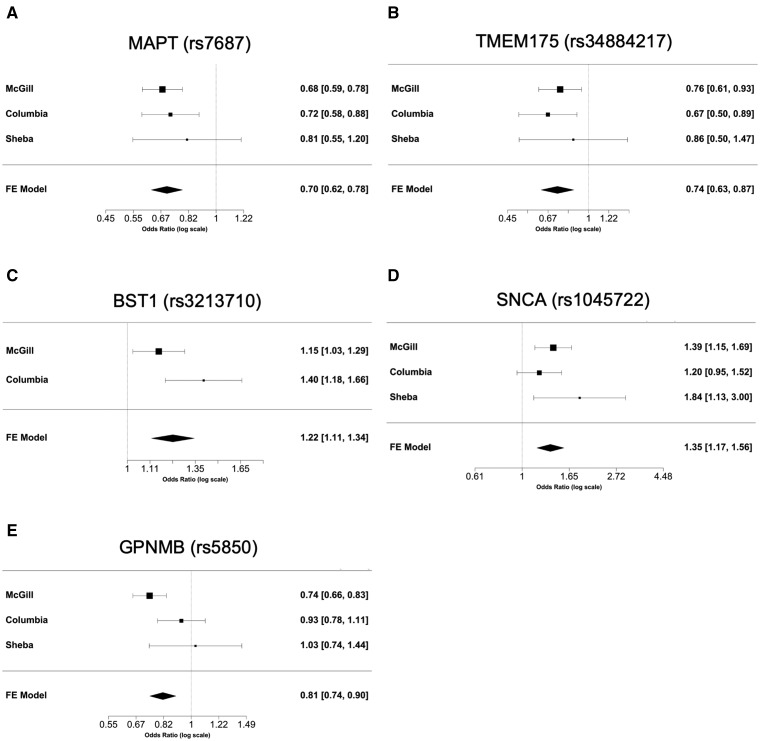
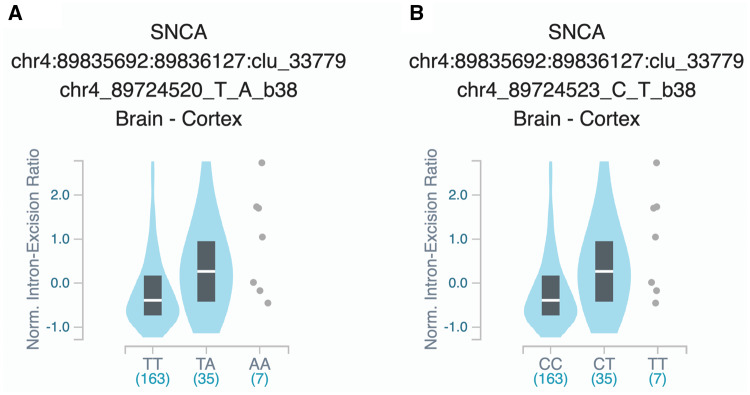
Genome-wide association studies (GWAS) have identified numerous loci associated with Parkinson's disease. The specific genes and variants that drive the associations within the vast majority of these loci are unknown. We aimed to perform a comprehensive analysis of selected genes to determine the potential role of rare and common genetic variants within these loci. We fully sequenced 32 genes from 25 loci previously associated with Parkinson's disease in 2657 patients and 3647 controls from three cohorts. Capture was done using molecular inversion probes targeting the exons, exon-intron boundaries and untranslated regions (UTRs) of the genes of interest, followed by sequencing. Quality control was performed to include only high-quality variants. We examined the role of rare variants (minor allele frequency < 0.01) using optimized sequence Kernel association tests. The association of common variants was estimated using regression models adjusted for age, sex and ethnicity as required in each cohort, followed by a meta-analysis. After Bonferroni correction, we identified a burden of rare variants in SYT11, FGF20 and GCH1 associated with Parkinson's disease. Nominal associations were identified in 21 additional genes. Previous reports suggested that the SYT11 GWAS association is driven by variants in the nearby GBA gene. However, the association of SYT11 was mainly driven by a rare 3' UTR variant (rs945006601) and was independent of GBA variants (P = 5.23 × 10⁻⁵ after exclusion of all GBA variant carriers). The association of FGF20 was driven by a rare 5' UTR variant (rs1034608171) located in the promoter region. The previously reported association of GCH1 with Parkinson's disease is driven by rare non-synonymous variants, some of which are known to cause dopamine-responsive dystonia. We also identified two LRRK2 variants, p.Arg793Met and p.Gln1353Lys, in 10 and eight controls, respectively, but not in patients. We identified common variants associated with Parkinson's disease in MAPT, TMEM175, BST1, SNCA and GPNMB, which are all in strong linkage disequilibrium with known GWAS hits in their respective loci. A common coding PM20D1 variant, p.Ile149Val, was nominally associated with reduced risk of Parkinson's disease (odds ratio 0.73, 95% confidence interval 0.60-0.89, P = 1.161 × 10⁻³). This variant is not in linkage disequilibrium with the top GWAS hits within this locus and may represent a novel association. These results further demonstrate the importance of fine mapping of GWAS loci, and suggest that SYT11, FGF20, and potentially PM20D1, BST1 and GPNMB should be considered for future studies as possible Parkinson's disease-related genes.
Keywords: Parkinson’s disease; association study; genetic fine mapping; risk loci; sequencing.
© The Author(s) (2020). Published by Oxford University Press on behalf of the Guarantors of Brain. All rights reserved. For permissions, please email: journals.permissions@oup.com.
Figures
References
-
- Amaral CEM, Lopes PF, Ferreira JCC, Alves EAC, Montenegro MVB, Costa ETD, et al. GBA mutations p.N370S and p.L444P are associated with Parkinson's disease in patients from Northern Brazil. Arq Neuro-Psiquiatr 2019; 77: 73–9. - PubMed
Publication types
MeSH terms
Substances
Grants and funding
LinkOut - more resources
Full Text Sources
Medical
Molecular Biology Databases
Miscellaneous
