Quarantine Facility for Patients with COVID-19 with Mild Symptoms in Korea: Experience from Eighteen Residential Treatment Centers
- PMID: 33350187
- PMCID: PMC7752259
- DOI: 10.3346/jkms.2020.35.e429
Quarantine Facility for Patients with COVID-19 with Mild Symptoms in Korea: Experience from Eighteen Residential Treatment Centers
Abstract
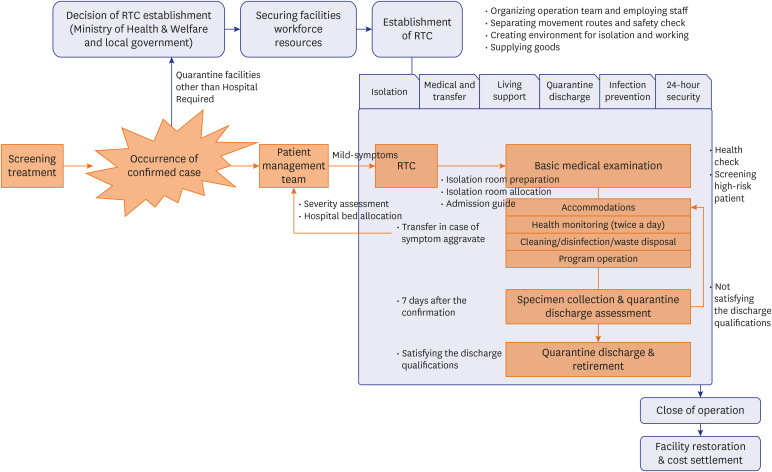
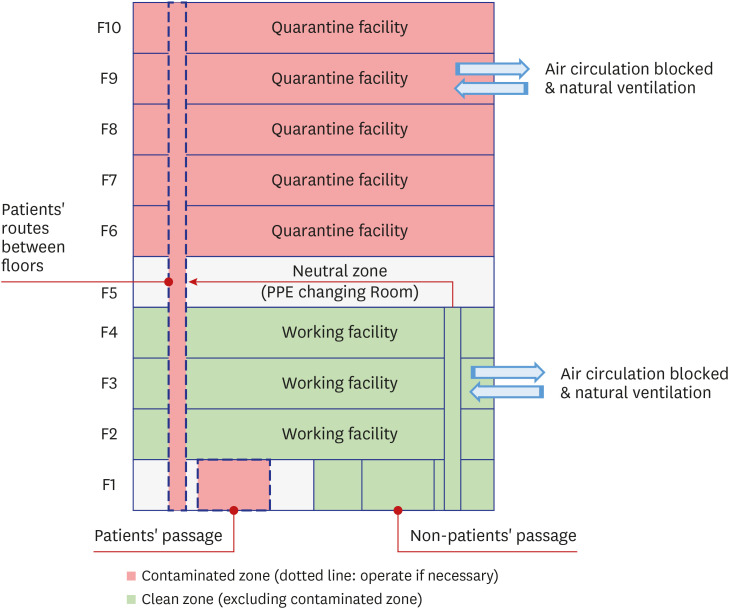
With the rapid spread of coronavirus disease 2019 (COVID-19), a particularly sharp increase in the number of confirmed cases in Daegu and Gyeongbuk regions at the end of February, Korea faced an unprecedented shortage of medical resources, including hospital beds. To cope with this shortage, the government introduced a severity scoring system for patients with COVID-19 and designed a new type of quarantine facility for treating and isolating patients with mild symptoms out of the hospital, namely, the Residential Treatment Center (RTC). A patient with mild symptoms was immediately isolated in the RTC and continuously monitored to detect changes in symptoms. If the symptoms aggravate, the patient was transferred to a hospital. RTCs were designed by creating a quarantine environment in existing lodging facilities capable of accommodating > 100 individuals. The facilities were entirely divided into a clean zone (working area) and contaminated zone (patient zone), separating the space, air, and movement routes, and the staff wore level D personal protective equipment (PPE) in the contaminated zone. The staffs consisted of medical personnel, police officers, soldiers, and operation personnel, and worked in two or three shifts per day. Their duty was mainly to monitor the health conditions of quarantined patients, provide accommodations, and regularly collect specimens to determine if they can be released. For the past two months, RTCs secured approximately 4,000 isolation rooms and treated approximately 3,000 patients with mild symptoms and operated stably without additional spread of the disease in and out of the centers. Based on these experience, we would like to suggest the utilization of RTCs as strategic quarantine facilities in pandemic situations.
Keywords: COVID-19; Coronavirus; Isolation; Korea; Residential Treatment Center.
© 2020 The Korean Academy of Medical Sciences.
Conflict of interest statement
The authors have no potential conflicts of interest to disclose.
Figures
References
-
- Ministry of Health and Welfare. A Round-table Conference with Cooperating Hospitals for the COVID-19 RTCs. Sejong: Ministry of Health and Welfare; 2020.
-
- Central Disaster Management Headquarters, Central Disease Control Headquarters. Guidelines for the Operation of COVID-19 Residential Treatment Centers. Sejong: Ministry of Health and Welfare; 2020.
Publication types
MeSH terms
LinkOut - more resources
Full Text Sources
Medical
Miscellaneous