Serologic Survey of Mosquito-Borne Viruses in Hunter-Harvested White-Tailed Deer (Odocoileus virginianus), New York State
- PMID: 33350367
- PMCID: PMC7866319
- DOI: 10.4269/ajtmh.20-1090
Serologic Survey of Mosquito-Borne Viruses in Hunter-Harvested White-Tailed Deer (Odocoileus virginianus), New York State
Abstract
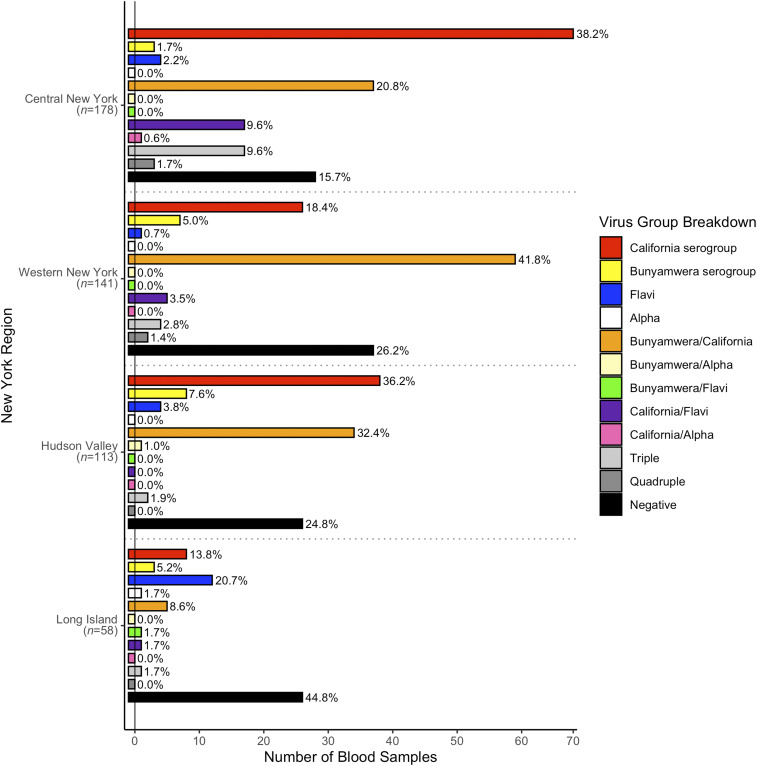
Sera from white-tailed deer (WTD, Odocoileus virginianus) hunter-harvested throughout New York State (NYS), 2007-2015, were tested by plaque reduction neutralization for antibodies against nine mosquito-borne viruses from the families Peribunyaviridae, Flaviviridae, and Togaviridae. Overall, 76.1% (373/490) of sampled WTD were seropositive against at least one virus, and 38.8% were exposed to multiple viruses. The seropositivity rate in adult WTD (78.0%) was significantly greater (P < 0.0001) than that in fawns (47.7%). Neutralizing antibodies against California serogroup viruses were most common in WTD sampled across all regions (67.1%), followed by the Bunyamwera serogroup (BUN) (37.6%). Jamestown Canyon and Cache Valley orthobunyaviruses were responsible for most California and BUN infections, respectively. Seroprevalence rates to West Nile virus were higher in samples originating from Long Island (LI) (19.0%) than in those originating from the central (7.3%), western (5.0%), and Hudson Valley (4.4%) regions of NYS. Antibodies to Eastern equine encephalitis virus were seen primarily in WTD from central NYS (5.1%), where annual enzootic activity occurs, but low rates were documented in western NYS (1.4%) and LI (1.7%). Low rates of Potosi and LaCrosse orthobunyavirus, and Highlands J virus antibodies were detected over the course of this investigation. St. Louis encephalitis virus (or a closely related virus) antibodies were detected in samples collected from central and western NYS, suggesting local virus transmission despite a lack of evidence from routine mosquito surveillance. Serologic results demonstrate the value of WTD in NYS as an indicator of arbovirus distribution and recent transmission on a relatively fine spatial scale.
Figures

References
-
- Friend M, Halterman LG, 1967. Serologic survey of two deer herds in New York State. Bull Wildl Dis Assoc 3: 32–34.
-
- Emmons RW, 1968. Serologic survey of a deer herd in California for arbovirus infections. Bull Wildl Dis Assoc 4: 78–80. - PubMed
-
- Trainer DO, Hanson RP, 1969. Serologic evidence of arbovirus infections in wild ruminants. Am J Epidemiol 90: 354–358. - PubMed
-
- Issel CJ, Trainer DO, Thompson WH, 1972. Serologic evidence of infections of white-tailed deer in Wisconsin with three California group arboviruses (La Crosse, trivittatus, and Jamestown Canyon). Am J Trop Med Hyg 21: 985–988. - PubMed
-
- Issel CJ, Hoff GL, Trainer DO, 1973. Serologic evidence of infection of white-tailed deer in Texas with three California group arboviruses, (Jamestown Canyon, San Angelo, and Keystone). J Wildl Dis 9: 245–248. - PubMed
Publication types
MeSH terms
Substances
Supplementary concepts
LinkOut - more resources
Full Text Sources
Other Literature Sources
Medical