


Home-Based Resistance Training for Older Subjects during the COVID-19 Outbreak in Italy: Preliminary Results of a Six-Months RCT
- PMID: 33352676
- PMCID: PMC7767132
- DOI: 10.3390/ijerph17249533
Home-Based Resistance Training for Older Subjects during the COVID-19 Outbreak in Italy: Preliminary Results of a Six-Months RCT
Abstract
Background: The aim of this study was to evaluate the effect of a six-month home-based resistance-training program on muscle health and physical performance in healthy older subjects during the unique condition of home confinement caused by the COVID-19 pandemic.
Methods: This was a randomized-controlled study that enrolled older participants that were allocated to either an experimental group performing the six-months exercise prescription (EXE) or a control group (CON). At the beginning (PRE), and after 6 months (POST), participants were assessed for muscle strength, balance, gait assessment and body composition by dual energy X-ray absorptiometry and magnetic resonance imaging. Normality distribution of data was checked with the D'Agostino and Pearson test and changes between PRE and POST were assessed by paired Student's t-test while percentage and absolute changes between groups at POST were tested by unpaired t-test.
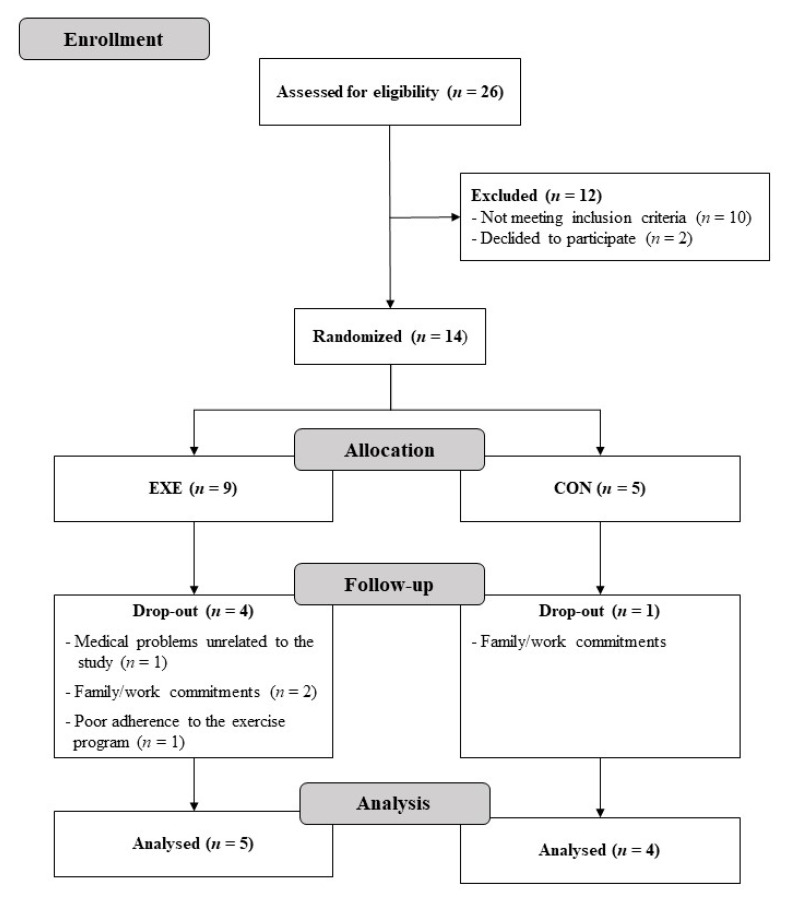
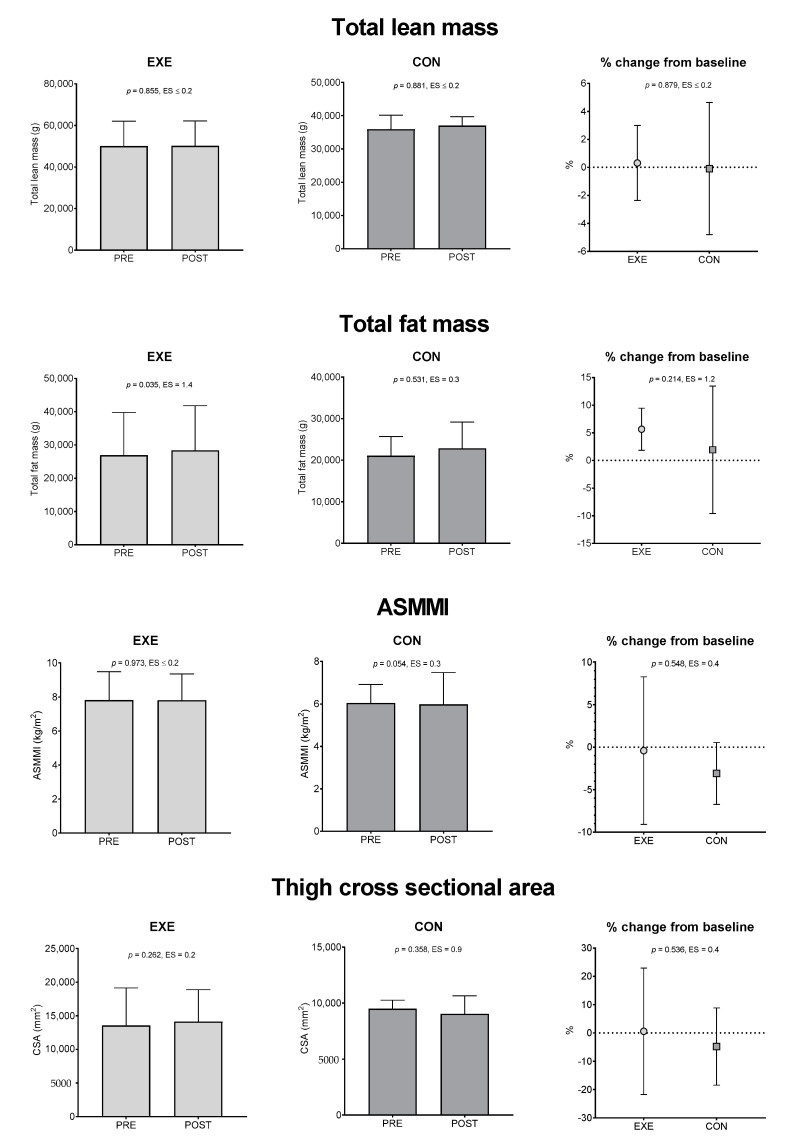
Results: Nine participants were included for the final analysis: EXE, n = 5 (age: 66 ± 4; BMI: 27.5 ± 3.7) and CON, n = 4 (age: 71 ± 9; BMI: 24.2 ± 4.1). Significant PRE-to-POST changes were observed in the EXE group only in the chair-stand test (+19.8%, p = 0.048 and ES:1.0, moderate) and in total fat mass (+5.0%, p = 0.035 and ES:1.4, large) with no between-group differences. Moreover, EXE had significantly higher absolute thigh CSA values than CON at POST (14.138 ± 2977 vs. 9039 ± 1015, p = 0.0178, ES = 1.7). No other within- and between-group differences were detected.
Conclusions: The home-based resistance-training program during the lockdown period, caused by the COVID-19 outbreak, determined only within-group improvement in lower limb muscle strength but not in muscle mass and composition in older subjects. Home confinement may partially explain the increase in total body fat due to a reduced daily PA regime and altered diet pattern.
Keywords: DXA; aging; exercise; magnetic resonance imaging; risk of fall; sarcopenia.
Conflict of interest statement
The authors declare no conflict of interest.
Figures
References
-
- Aguirre L.E., Villareal D.T. Frailty: Pathophysiology, Phenotype and Patient Care. Volume 176. Karger Publishers; Basel, Switzerland: 2016. Physical Exercise as Therapy for Frailty; pp. 139–148. - DOI
-
- Bull F., Saad Al-Ansari S., Biddle S., Borodulin K., Buman M., Cardon G., Carty C., Chaput J.-P., Chastin S., Chou R., et al. World Health Organization 2020 Guidelines on Physical Activity and Sedentary Behaviour. Br. J. Sports Med. 2020;54:1451–1462. doi: 10.1136/bjsports-2020-102955. - DOI - PMC - PubMed
