


Conceptual Models of Food Choice: Influential Factors Related to Foods, Individual Differences, and Society
- PMID: 33353240
- PMCID: PMC7766596
- DOI: 10.3390/foods9121898
Conceptual Models of Food Choice: Influential Factors Related to Foods, Individual Differences, and Society
Abstract
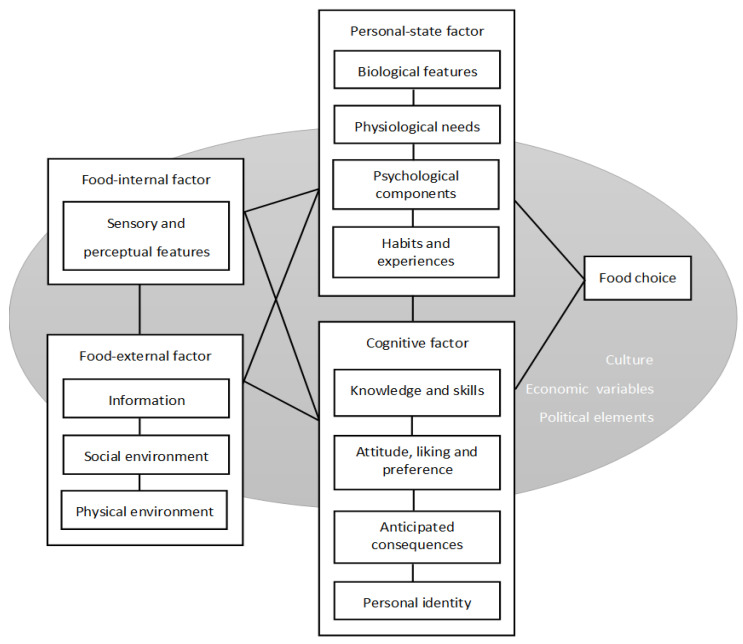
Understanding individual food choices is critical for transforming the current food system to ensure healthiness of people and sustainability of the planet. Throughout the years, researchers from different fields have proposed conceptual models addressing factors influencing the food choice, recognized as a key leverage to improve planetary and human health. However, a multidisciplinary approach is needed to better understand how different factors are involved and interact with each other in the decision-making process. The present paper reviews and analyzes existing models, providing an intact point-of-view by integrating key elements into a bigger framework. Key determinants of general food choice are identified and categorized, including food-internal factor (sensory and perceptual features), food-external factors (information, social environment, physical environment), personal-state factors (biological features and physiological needs, psychological components, habits and experiences), cognitive factors (knowledge and skills, attitude, liking and preference, anticipated consequences, and personal identity), as well as sociocultural factors (culture, economic variables, political elements). Moreover, possible directions of influence among the factors towards final food choice were discussed. The need of multidisciplinary impulses across research field with the support of empirical data are crucial for understanding factors influencing food choice as well as for enriching existing conceptual models. The framework proposed here would serve as a roadmap for facilitating communications and collaborations between research fields in a structural and systematic way.
Keywords: consumer behavior; context of choice; decision making; food system; healthy and sustainable food choices.
Conflict of interest statement
The authors declare no conflict of interest.
Figures
References
-
- FAO. IFAD. UNICEF. WFP. WHO . Transforming Food Systems for Affordable Healthy Diets. FAO; Rome, Italy: 2020. The State of Food Security and Nutrition in the World 2020.
-
- 2020 Global Nutrition Report: Action on Equity to End Malnutrition. Development Initiatives; Bristol, UK: 2020.
-
- World Health Organization Physical Activity. [(accessed on 8 April 2020)]; Available online: https://www.who.int/news-room/fact-sheets/detail/physical-activity.
-
- World Health Organization Noncommunicable diseases. [(accessed on 8 April 2020)]; Available online: http://www.emro.who.int/noncommunicable-diseases/causes/unhealthy-diets.....
Publication types
LinkOut - more resources
Full Text Sources
