


Essential Medicines in Universal Health Coverage: A Scoping Review of Public Health Law Interventions and How They Are Measured in Five Middle-Income Countries
- PMID: 33353250
- PMCID: PMC7765934
- DOI: 10.3390/ijerph17249524
Essential Medicines in Universal Health Coverage: A Scoping Review of Public Health Law Interventions and How They Are Measured in Five Middle-Income Countries
Abstract
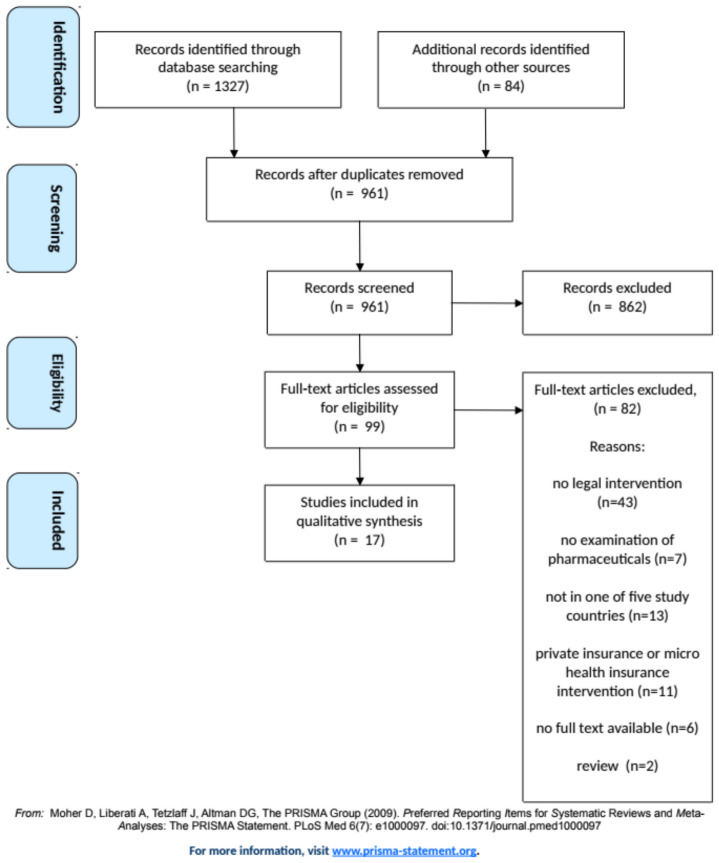
Very few studies exist of legal interventions (national laws) for essential medicines as part of universal health coverage in middle-income countries, or how the effect of these laws is measured. This study aims to critically assess whether laws related to universal health coverage use five objectives of public health law to promote medicines affordability and financing, and to understand how access to medicines achieved through these laws is measured. This comparative case study of five middle-income countries (Ecuador, Ghana, Philippines, South Africa, Ukraine) uses a public health law framework to guide the content analysis of national laws and the scoping review of empirical evidence for measuring access to medicines. Sixty laws were included. All countries write into national law: (a) health equity objectives, (b) remedies for users/patients and sanctions for some stakeholders, (c) economic policies and regulatory objectives for financing (except South Africa), pricing, and benefits selection (except South Africa), (d) information dissemination objectives (ex. for medicines prices (except Ghana)), and (e) public health infrastructure. The 17 studies included in the scoping review evaluate laws with economic policy and regulatory objectives (n = 14 articles), health equity (n = 10), information dissemination (n = 3), infrastructure (n = 2), and sanctions (n = 1) (not mutually exclusive). Cross-sectional descriptive designs (n = 8 articles) and time series analyses (n = 5) were the most frequent designs. Change in patients' spending on medicines was the most frequent outcome measure (n = 5). Although legal interventions for pharmaceuticals in middle-income countries commonly use all objectives of public health law, the intended and unintended effects of economic policies and regulation are most frequently investigated.
Keywords: access to medicines; drug; essential medicines; health insurance; health services accessibility; insurance; legislation; middle income country; pharmaceutical policy; pharmaceutical services; universal health coverage; universal health insurance.
Conflict of interest statement
The authors declare no conflict of interest.
Figures
References
-
- Lu Y., Hernandez P., Abegunde D., Edejer T. Medicines Expenditures. World Health Organization; Geneva, Switzerland: 2011. The world medicines situation 2011; pp. 35–38.
-
- Clarke D., Rajan D., Schmets G. Creating a Supportive Legal Environment for Universal Health Coverage. Volume 94. Bull World Health Organisation; Geneva, Switzerland: 2016. [(accessed on 2 October 2020)]. p. 482. Available online: http://www.who.int/entity/bulletin/volumes/94/7/16-173591.pdf. - PMC - PubMed
-
- Gostin L., Monahan J.T., Kaldor J., DeBartolo M., A Friedman E., Gottschalk K., Kim S.C., Alwan A., Binagwaho A., Burci G.L., et al. The legal determinants of health: Harnessing the power of law for global health and sustainable development. [(accessed on 9 November 2020)];Lancet. 2019 393:1857–1910. doi: 10.1016/S0140-6736(19)30233-8. Available online: http://www.ncbi.nlm.nih.gov/pubmed/31053306. - DOI - PMC - PubMed
Publication types
MeSH terms
LinkOut - more resources
Full Text Sources
Medical
