


Increased Hepatic Fat Content in Patients with Resistance to Thyroid Hormone Beta
- PMID: 33353459
- PMCID: PMC8290309
- DOI: 10.1089/thy.2020.0651
Increased Hepatic Fat Content in Patients with Resistance to Thyroid Hormone Beta
Erratum in
-
Correction to: Increased Hepatic Fat Content in Patients with Resistance to Thyroid Hormone Beta, by Chaves et al. Thyroid 2021;31(7):1127-1134. DOI: 10.1089/thy.2020.0651.Thyroid. 2021 Sep;31(9):1447-1448. doi: 10.1089/thy.2020.0651.correx. Epub 2021 Aug 31. Thyroid. 2021. PMID: 34468202 Free PMC article. No abstract available.
Abstract
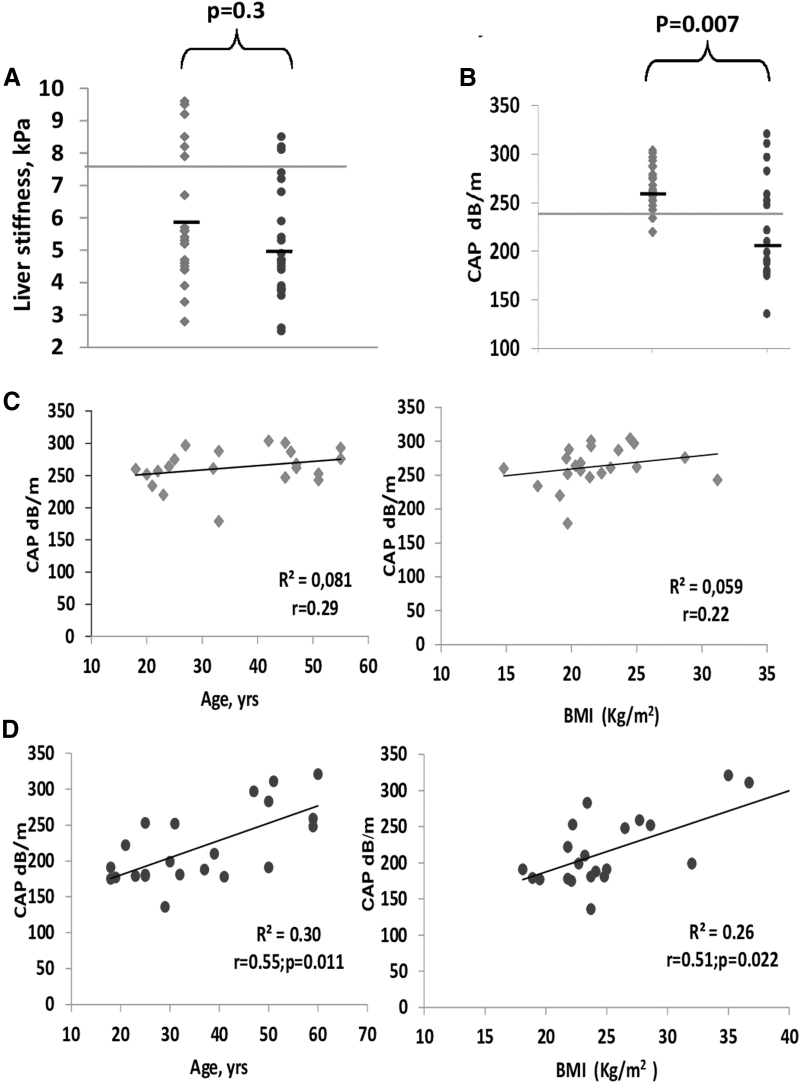
Background: Thyroid hormone (TH) has important functions in controlling hepatic lipid metabolism. Individuals with resistance to thyroid hormone beta (RTHβ) who harbor mutations in the THRB gene experience loss-of-function of thyroid hormone receptor beta (TRβ), which is the predominant TR isoform expressed in the liver. We hypothesized that individuals with RTHβ may have increased hepatic steatosis. Methods: Controlled attenuation parameter (CAP) was assessed in individuals harboring the R243Q mutation of the THRB gene (n = 21) and in their wild-type (WT) first-degree relatives (n = 22) using the ultrasound-based transient elastography (TE) device (FibroScan). All participants belonged to the same family, lived on the same small island, and were therefore exposed to similar environmental conditions. CAP measurements and blood samples were obtained after an overnight fast. The observers were blinded to the status of the patients. Results: The hepatic fat content was increased in RTHβ individuals compared with their WT relatives (CAP values of 263 ± 21 and 218.7 ± 43 dB/m, respectively, p = 0.007). The CAP values correlated with age and body mass index (BMI) (age: r = 0.55, p = 0.011; BMI: r = 0.51, p = 0.022) in the WT first-degree relatives but not in RTHβ individuals, suggesting that the defect in TRβ signaling was predominant over the effects of age and obesity. Circulating free fatty acid levels were significantly higher in RTHβ individuals (0.29 ± 0.033 vs. 0.17 ± 0.025 mmol/L, p = 0.02). There was no evidence of insulin resistance evaluated by the homeostatic model assessment of insulin resistance in both groups studied. Conclusions: Our findings provide evidence that impairments in intrahepatic TRβ signaling due to mutations of the THRB gene can lead to hepatic steatosis, which emphasizes the influence of TH in the liver metabolism of lipids and provides a rationale for the development TRβ-selective thyromimetics. Consequently, new molecules with a very high TRβ affinity and hepatic selectivity have been developed for the treatment of lipid-associated hepatic disorders, particularly nonalcoholic fatty liver disease.
Keywords: hepatic steatosis; resistance to thyroid hormone beta; thyroid hormones; transient elastography.
Conflict of interest statement
No competing financial interests exist.
Figures
References
-
- Mantovani A, Nascimbeni F, Lonardo A, Zoppini G, Bonora E, Mantzoros CS, Targher G 2018. Association between primary hypothyroidism and nonalcoholic fatty liver disease: a systematic review and meta-analysis. Thyroid 28:1270–1284 - PubMed
-
- Bruinstroop E, Dalan R, Cao Y, Bee YM, Chandran K, Cho LW. 2018. Low-dose levothyroxine reduces intrahepatic lipid content in patients with type 2 diabetes mellitus and NAFLD. J Clin Endocrinol Metab 103:2698–2706 - PubMed
-
- Harrison SA, Bashir MR, Guy CG, Zhou R, Moylan CA, Frias JP, Alkhouri N, Bansal MB 2019. Resmetirom (MGL-3196) for the treatment of non-alcoholic steatohepatitis: a multicentre, randomised, double-blind, placebo-controlled, phase 2 trial. Lancet 394:2012–2024 - PubMed
-
- Anselmo J, Cao D, Karrison T, Weiss R, Refetoff S 2004. Fetal loss associated with excess thyroid hormone exposure. JAMA 292:691–695 - PubMed
Publication types
MeSH terms
Substances
Grants and funding
LinkOut - more resources
Full Text Sources
Other Literature Sources
Medical
Miscellaneous
