


Decision regret, adverse outcomes, and treatment choice in men with localized prostate cancer: Results from a multi-site randomized trial
- PMID: 33353864
- PMCID: PMC8213859
- DOI: 10.1016/j.urolonc.2020.11.038
Decision regret, adverse outcomes, and treatment choice in men with localized prostate cancer: Results from a multi-site randomized trial
Abstract
Introduction: Men diagnosed with localized prostate cancer must navigate a highly preference-sensitive decision between treatment options with varying adverse outcome profiles. We evaluated whether use of a decision support tool previously shown to decrease decisional conflict also impacted the secondary outcome of post-treatment decision regret.
Methods: Participants were randomized to receive personalized decision support via the Personal Patient Profile-Prostate or usual care prior to a final treatment decision. Symptoms were measured just before randomization and 6 months later; decision regret was measured at 6 months along with records review to ascertain treatment choices. Regression modeling explored associations between baseline variables including race and D`Amico risk, study group, and 6-month variables regret, choice, and symptoms.
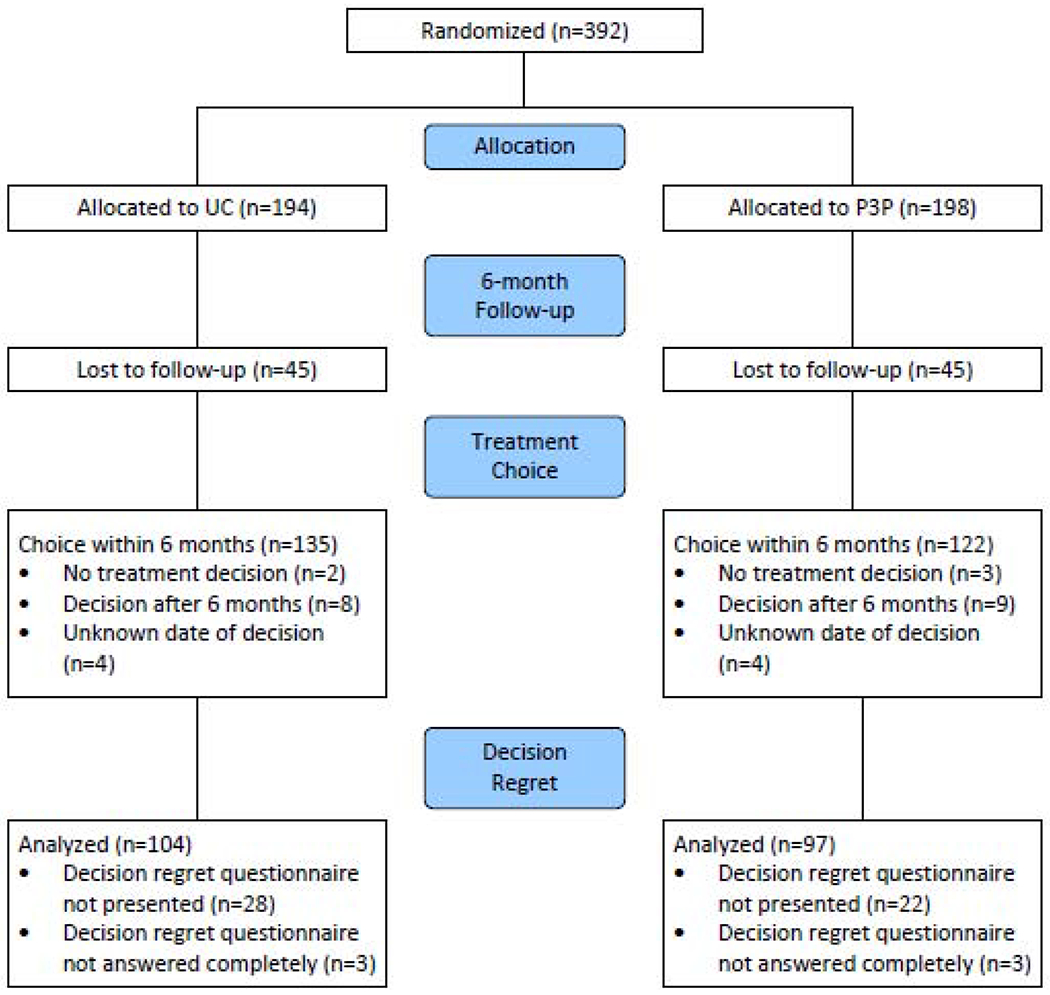
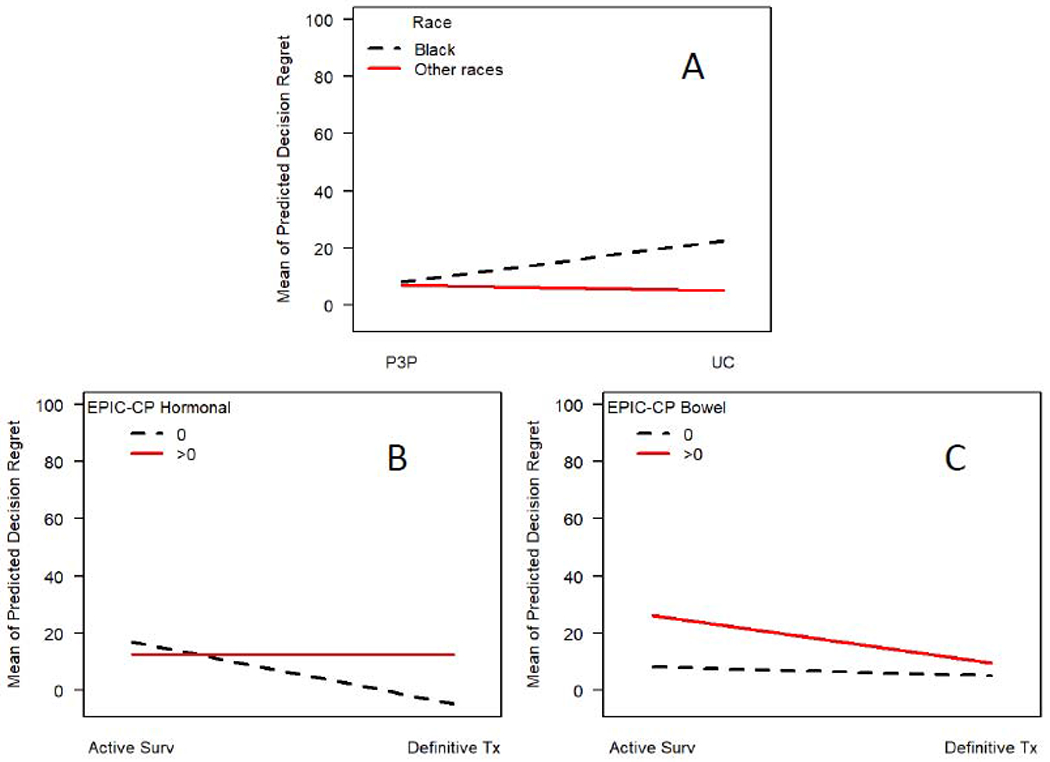
Results: At 6 months, 287 of 392 (73%) men returned questionnaires of which 257 (89%) had made a treatment choice. Of that group, 201 of 257 (78%) completely answered the regret scale. Regret was not significantly different between participants randomized to the P3P intervention compared to the control group (P = 0.360). In univariate analyses, we found that Black men, men with hormonal symptoms, and men with bowel symptoms reported significantly higher decision regret (all P < 0.01). Significant interactions were detected between race and study group (intervention vs. usual care) in the multivariable model; use of the Personal Patient Profile-Prostate was associated with significantly decreased decisional regret among Black men (P = 0.037). Interactions between regret, symptoms and treatment revealed that (1) men choosing definitive treatment and reporting no hormonal symptoms reported lower regret compared to all others; and (2) men choosing active surveillance and reporting bowel symptoms had higher regret compared to all others.
Conclusion: The Personal Patient Profile-Prostate decision support tool may be most beneficial in minimizing decisional regret for Black men considering treatment options for newly-diagnosed prostate cancer.
Trial registration: NCT01844999.
Keywords: Decision regret; Decision support techniques; Prostate cancer.
Copyright © 2020 Elsevier Inc. All rights reserved.
Figures
References
-
- Chou R et al. , “U.S. Preventive Services Task Force Evidence Syntheses, formerly Systematic Evidence Reviews,” in Treatments for Localized Prostate Cancer: Systematic Review to Update the 2002 U.S. Preventive Services Task Force Recommendation. Rockville (MD): Agency for Healthcare Research and Quality (US), 2011. - PubMed
-
- Gupta D, Lee Chuy K, Yang JC, Bates M, Lombardo M, and Steingart RM, “Cardiovascular and Metabolic Effects of Androgen-Deprivation Therapy for Prostate Cancer,” (in eng), Journal of oncology practice / American Society of Clinical Oncology, vol. 14, no. 10, pp. 580–587, October 2018, doi: 10.1200/jop.18.00178. - DOI - PubMed
-
- Parker PA et al. , “Relationship between illness uncertainty, anxiety, fear of progression and quality of life in men with favourable-risk prostate cancer undergoing active surveillance,” (in eng), BJU international, vol. 117, no. 3, pp. 469–77, March 2016, doi: 10.1111/bju.13099. - DOI - PMC - PubMed
-
- Hoffman RM et al. , “Treatment Decision Regret Among Long-Term Survivors of Localized Prostate Cancer: Results From the Prostate Cancer Outcomes Study,” (in eng), Journal of clinical oncology : official journal of the American Society of Clinical Oncology, vol. 35, no. 20, pp. 2306–2314, July 10 2017, doi: 10.1200/jco.2016.70.6317. - DOI - PMC - PubMed
Publication types
MeSH terms
Associated data
Grants and funding
LinkOut - more resources
Full Text Sources
Other Literature Sources
Medical
