Comment
doi: 10.7554/eLife.64948.
How well can we separate genetics from the environment?
Affiliations
- PMID: 33355092
- PMCID: PMC7758058
- DOI: 10.7554/eLife.64948
Item in Clipboard
Comment
How well can we separate genetics from the environment?
Elife.
.
Abstract
A simulation study demonstrates a better method for separating genetic effects from environmental effects in genome-wide association studies, but there is still some way to go before this becomes a "solved" problem.
Keywords: GWAS; demographic history; epidemiology; genetics; genomics; global health; none; polygenic scores; population stratification.
© 2020, Blanc and Berg.
Conflict of interest statement
JB, JB No competing interests declared
Figures
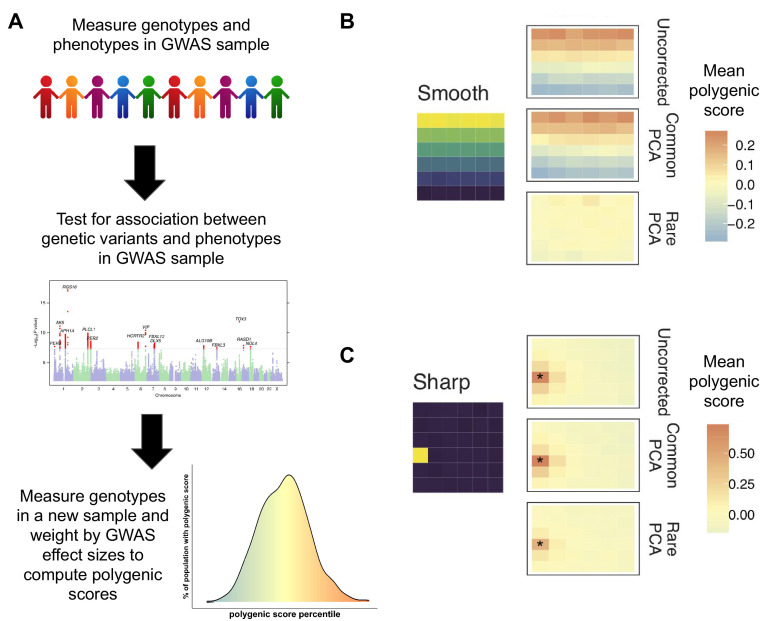
(A) A genome-wide associate study (GWAS) measures the trait of interest (phenotype) and the genotype of a sample of individuals and uses this data (middle graph) to see which genetic variants (represented by individual dots) are associated with the trait of interest (shown in red). This information is used to compute the polygenic score of individuals not in the original sample. Individuals with a higher polygenic score (orange) are predicted to have a higher trait value (e.g. to be taller or to have a greater risk of disease), while those with a lower polygenic score are predicted to have a lower trait value (bottom graph). (B) Mathieson and Zaidi simulated genetic data for a population that separated into subpopulations in the recent past; the environment was simulated as a six-by-six grid (left) in which environmental factors associated with the trait of interest vary smoothly from top to bottom. The uncorrected mean polygenic scores (top right) have a structure that clearly mirrors the structure in the environment. Correcting the scores with the 'common PCA' approach (middle right) does not solve this problem, but correction with the 'rare PCA' approach (bottom right) does. (C) However, when differences in the environmental factors were localized to a single square in the grid (shown in yellow), not even the rare PCA model could eliminate the correlation between genetic and environmental effects (indicated by asterix).
Comment on
-
Demographic history mediates the effect of stratification on polygenic scores.Elife. 2020 Nov 17;9:e61548. doi: 10.7554/eLife.61548. Elife. 2020. PMID: 33200985 Free PMC article.
References
Publication types
MeSH terms
LinkOut - more resources
Full Text Sources