Estimating the cost of interventions to improve water, sanitation and hygiene in healthcare facilities across India
- PMID: 33355264
- PMCID: PMC7754631
- DOI: 10.1136/bmjgh-2020-003045
Estimating the cost of interventions to improve water, sanitation and hygiene in healthcare facilities across India
Abstract
Introduction: Despite increasing utilisation of institutional healthcare in India, many healthcare facilities (HCFs) lack access to basic water, sanitation and hygiene (WASH) services. WASH services protect patients by improving infection prevention and control (IPC), which in turn can reduce the burden of healthcare-associated infections (HAIs). However, data on the cost of implementing WASH interventions in Indian HCFs are limited.
Methods: We surveyed 32 HCFs across India, varying in size, type and setting to obtain the direct costs of providing improved water supply, sanitation and IPC-supporting infrastructure. We calculated the average costs of WASH interventions and the number of HCFs nationwide requiring investments in WASH to estimate the financial cost of improving WASH across India's public healthcare system over 1 year.
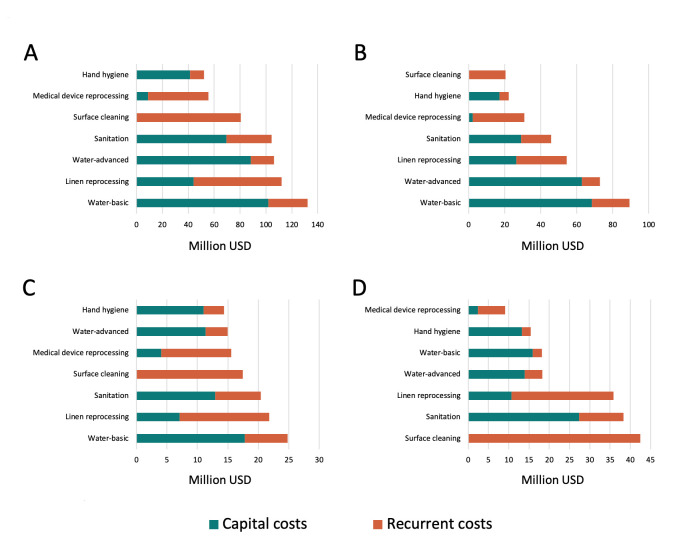
Results: Improving WASH across India's public healthcare sector and sustaining services among upgraded facilities for 1 year would cost US$354 million in capital costs and US$289 million in recurrent costs from the provider perspective. The most costly interventions were those on water (US$238 million), linen reprocessing (US$112 million) and sanitation (US$104 million), while the least costly were interventions on hand hygiene (US$52 million), medical device reprocessing (US$56 million) and environmental surface cleaning (US$80 million). Overall, investments in rural HCFs would account for 64.4% of total costs, of which 52.3% would go towards primary health centres.
Conclusion: Improving IPC in Indian public HCFs can aid in the prevention of HAIs to reduce the spread of antimicrobial resistance. Although WASH is a necessary component of IPC, coverage remains low in HCFs in India. Using ex-post costs, our results estimate the investment levels needed to improve WASH across the Indian public healthcare system and provide a basis for policymakers to support IPC-related National Action Plan activities for antimicrobial resistance through investments in WASH.
Keywords: disease; disorder; health economics; health policy; health systems; or injury; other infection; public health.
© Author(s) (or their employer(s)) 2020. Re-use permitted under CC BY-NC. No commercial re-use. See rights and permissions. Published by BMJ.
Conflict of interest statement
Competing interests: None declared.
Figures
References
-
- Watson J, D'Mello-Guyett L, Flynn E, et al. Interventions to improve water supply and quality, sanitation and handwashing facilities in healthcare facilities, and their effect on healthcare-associated infections in low-income and middle-income countries: a systematic review and supplementary scoping review. BMJ Glob Health 2019;4:e001632. 10.1136/bmjgh-2019-001632 - DOI - PMC - PubMed
-
- WHO, UNICEF, SHARE Water, sanitation and hygiene in health care facilities: global strategy, burden of disease, and evidence and action priorities. London, 2016. Available: https://www.who.int/water_sanitation_health/facilities/healthcare-facili...
Publication types
MeSH terms
Substances
LinkOut - more resources
Full Text Sources