Review
. 2021 Jan;383(1):507-524.
doi: 10.1007/s00441-020-03365-9. Epub 2020 Dec 23.

Extrinsic neuromodulation in the rodent olfactory bulb

Affiliations
Review

Extrinsic neuromodulation in the rodent olfactory bulb

Daniela Brunert et al. Cell Tissue Res. 2021 Jan.

Abstract

Evolutionarily, olfaction is one of the oldest senses and pivotal for an individual's health and survival. The olfactory bulb (OB), as the first olfactory relay station in the brain, is known to heavily process sensory information. To adapt to an animal's needs, OB activity can be influenced by many factors either from within (intrinsic neuromodulation) or outside (extrinsic neuromodulation) the OB which include neurotransmitters, neuromodulators, hormones, and neuropeptides. Extrinsic sources seem to be of special importance as the OB receives massive efferent input from numerous brain centers even outweighing the sensory input from the nose. Here, we review neuromodulatory processes in the rodent OB from such extrinsic sources. We will discuss extrinsic neuromodulation according to points of origin, receptors involved, affected circuits, and changes in behavior. In the end, we give a brief outlook on potential future directions in research on neuromodulation in the OB.

Keywords: Neuromodulation; Olfactory bulb; Olfactory processing; Perception; Rodents.


Conflict of interest statement

The authors declare that they have no competing interests.

Figures
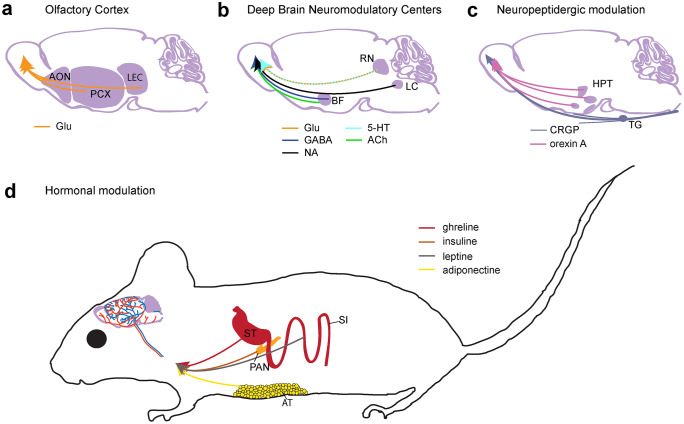
Fig. 1
Fig. 1
Types of extrinsic neuromodulatory inputs to the OB. Neuronal (ac) as well as non-neuronal (d) sources of OB effective neuromodulatory cues. Brain-derived sources are marked in light purple while other colors mark sources outside the brain. While neuronal sources stem from fibers of brain centers projecting to the OB, non-neuronal sources secrete their cues to the bloodstream to be effective on OB receptors. (Abbreviations: AON anterior olfactory nucleus, PC piriform cortex, LEC lateral entorhinal cortex, RN raphe nuclei, LC locus coeruleus, BF basal forebrain, HPT hypothalamus, TG trigeminal ganglion, ST stomach, SI small intestine, PAN pancreas, AT adipose tissue)
Fig. 2
Fig. 2
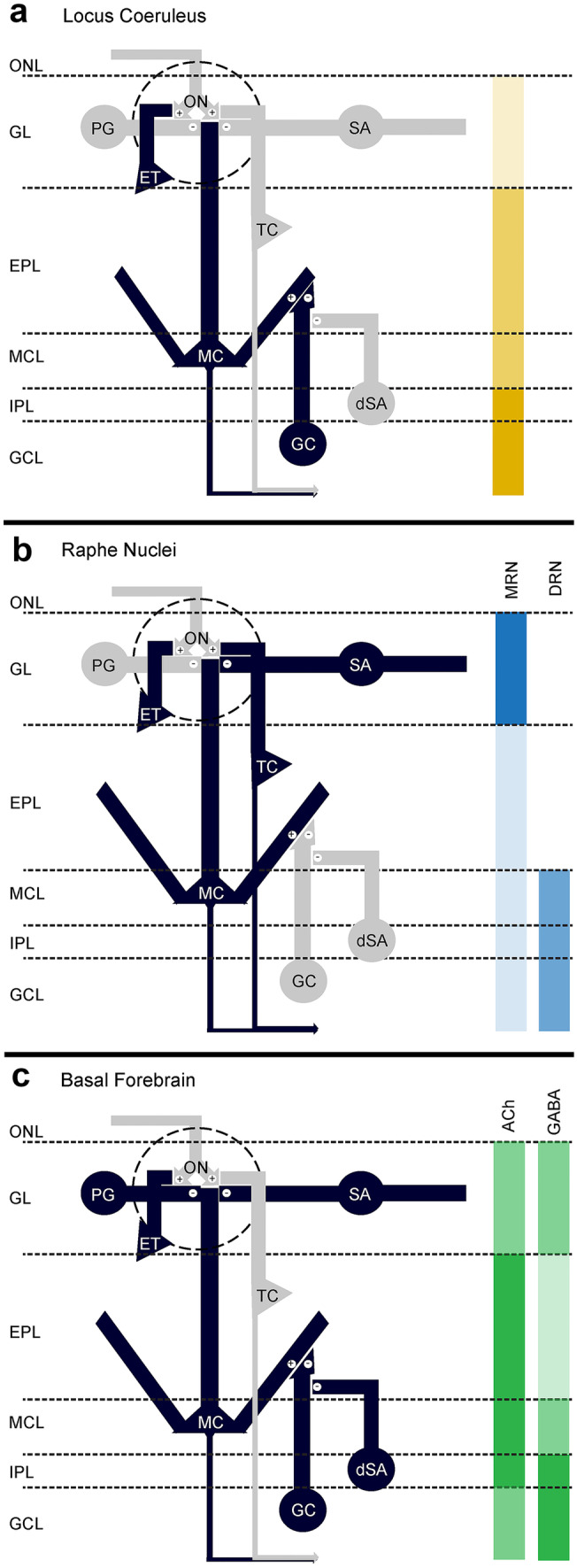
Targets of projections from neuromodulatory centers. Innervation strength and putatively affected OB cells for fibers from locus coeruleus (a, yellow), raphe nuclei (b, blue), and basal forebrain (c, green). Putatively affected cell types in the basal scheme of the olfactory bulb neuronal circuits are marked in black for each neuromodulatory center. Relative innervation density is marked on the right as color depth. OB modulation from BF is separated into cholinergic (ACh) and GABAergic (GABA) fibers, while innervation from raphe nuclei is separated into fibers coming from median (MRN) and dorsal raphe (DRN). (Abbreviations: ONL olfactory nerve layer, GL glomerular layer, EPL external plexiform layer, MCL mitral cell layer, IPL internal plexiform layer, GCL granule cell layer, ON olfactory nerve, PG periglomerular cells, SA short axon cells, ETC external tufted cells, MT mitral and tufted cells, GC granule cells, dSA deep short axon cells)
Fig. 3
Fig. 3
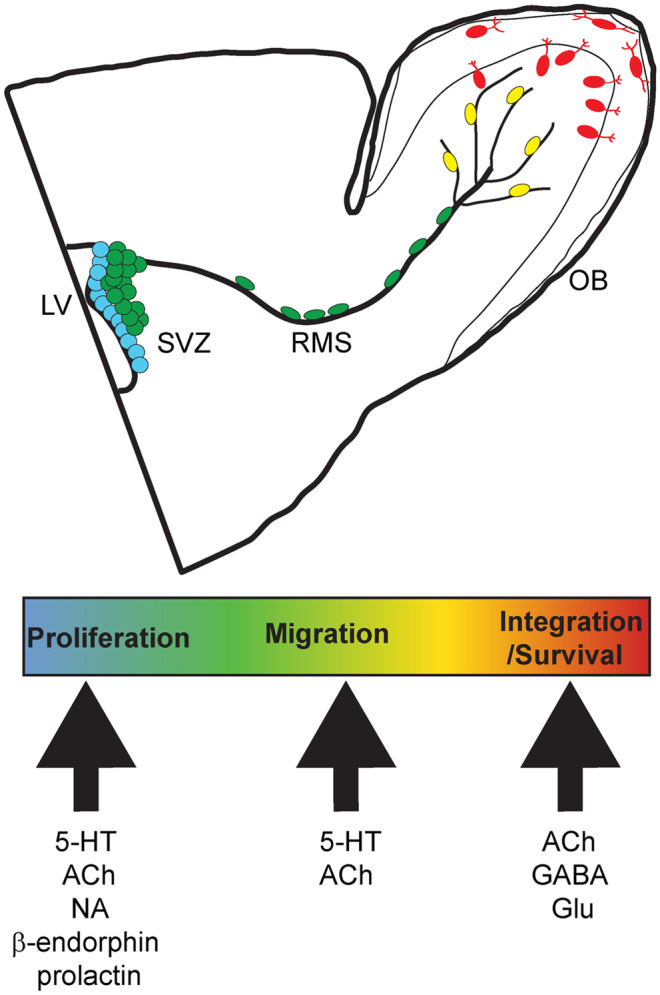
Neuromodulatory influences in adult neurogenesis (adapted from (Rikani et al. 2013). Neuromodulatory transmitters coming from deep brain neuromodulatory centers, olfactory cortex, or hypothalamus can influence olfactory processing not only by immediate effects but also by acting on proliferation (blue), migration (tangential (green), radial (yellow)), or differentiation and survival (red) of adult-born neurons. Neuromodulators acting on a specific process are listed under the respective arrows. (Abbreviations: OB olfactory bulb, RMS rostral migratory stream, SVZ subventricular zone, LV lateral ventricle)

References

    1. Ackels T, Jordan R, Schaefer AT, Fukunaga I. Respiration-locking of olfactory receptor and projection neurons in the mouse olfactory bulb and its modulation by brain state. Front Cell Neurosci. 2020;14:220. - PMC - PubMed
    1. Agostinelli LJ, Geerling JC, Scammell TE. Basal forebrain subcortical projections. Brain Struct Funct. 2019;224:1097–1117. - PMC - PubMed
    1. Alonso M, Lepousez G, Sebastien W, Bardy C, Gabellec MM, Torquet N, Lledo PM. Activation of adult-born neurons facilitates learning and memory. Nat Neurosci. 2012;15:897–904. - PubMed
    1. Aqrabawi AJ, Kim JC. Olfactory memory representations are stored in the anterior olfactory nucleus. Nat Commun. 2020;11:1246. - PMC - PubMed
    1. Arenkiel BR, Hasegawa H, Yi JJ, Larsen RS, Wallace ML, Philpot BD, Wang F, Ehlers MD. Activity-induced remodeling of olfactory bulb microcircuits revealed by monosynaptic tracing. PLoS ONE. 2011;6:e29423. - PMC - PubMed

LinkOut - more resources