. 2021 Jan;100(1):39-46.
doi: 10.1016/j.psj.2020.09.080. Epub 2020 Oct 9.

Comparative analysis of key immune protection factors in H9N2 avian influenza viruses infected and immunized specific pathogen-free chicken

Affiliations

Comparative analysis of key immune protection factors in H9N2 avian influenza viruses infected and immunized specific pathogen-free chicken

Manman Dai et al. Poult Sci. 2021 Jan.

Abstract

H9N2 avian influenza viruses (AIV) continue to circulate in vaccinated chicken flocks in China, which prompted us to investigate the differential immune protection factors induced by H9N2 AIV infection and immunization for analyzing the reason of protection deficiency of H9N2 AIV inactivated vaccine. In this study, we firstly explored virus-induced optimal immune responses in chicken after H9N2 AIV infection. And, we found that H9N2 hemagglutination inhibition (HI) antibody level, antiviral interferon-stimulated genes including 2',5'-oligoadenylate synthetase-like and myxovirus resistance 1, CD8+ T cell response in peripheral blood lymphocytes (PBL) accompanied by the cytotoxicity-associated genes, including poly (ADP-ribose) polymerase and IFN-r play important roles in defending against H9N2 infection. Besides, we observed that vaccine immunization triggered the similar H9N2 HI antibody level as viral infection, the increase of CD4+ T cell percentage instead of CD8+ T cell percentage in PBL. Moreover, we further made a comparative analysis of immune-related gene expression profile in PBL and lung after H9N2 AIV infection and immunization, respectively. The results showed that vaccine immunization contributed to the up-regulation of Th2 cytokine. But the deficiency of cytotoxicity-associated genes induced by H9N2 AIV inactivated vaccine may be the potential key reason of protection deficiency. These findings provide evidence and direction for developing effective H9N2 AIV vaccines.

Keywords: H9N2 AIV infection; T cell; chicken; immune-related gene; vaccine immunization.


Figures

Figure 1
Figure 1
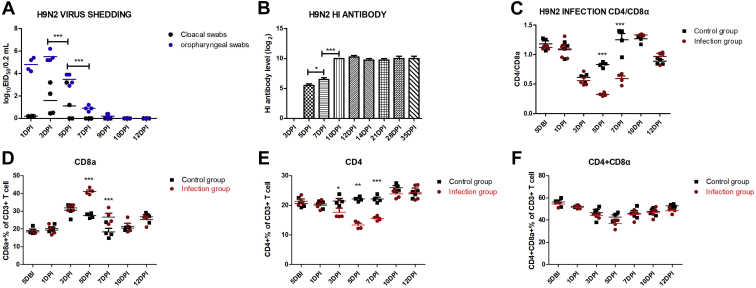
Monitor of H9N2 virus shedding, HI antibody level, and T lymphocyte percentage after infection. Four chickens of infected and control groups were randomly selected for sampling to detect the viral load of cloacal swabs and oropharyngeal swabs (A), H9N2 HI antibody level (B), the percentage of CD3+CD8+ T cell (D), the percentage of CD3+CD4+T cell (E), the percentage of CD3+CD4+CD8+ T cell (F), and the ratio of CD3+CD4+ / CD3+CD8+ (C). Each sample collected 1 × 10⁵ cells for flow cytometric analysis. H9N2 virus shedding and H9N2 HI antibody in the control group were all negative at all time points (data not shown). The one-way or two-way ANOVA was used for statistical comparison. ns P > 0.05, ∗P < 0.05, ∗∗P < 0.01, ∗∗∗P < 0.001. Abbreviations: DPI, days postinfection; HI, hemagglutination inhibition.
Figure 2
Figure 2
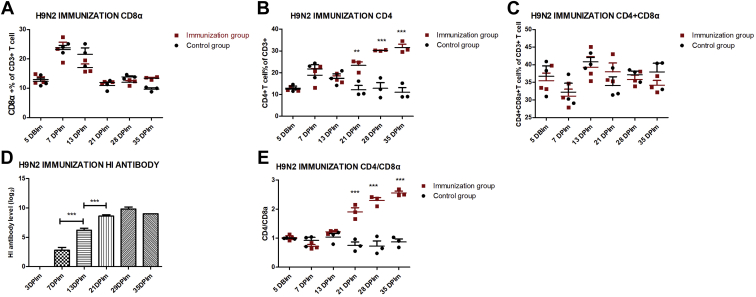
Monitor of T lymphocyte percentage and HI antibody after H9N2 AIV inactivated vaccine immunization. Five chickens of immunized and control groups were randomly selected for sampling to detect the HI antibody level (D). In the control group, H9N2 HI antibody was negative from 3 d post immunization (DPIm) to 35 DPIm (data not shown). From 5 d before immunization (DBIm) to 35 DPIm, peripheral blood lymphocytes (PBL) derived from 3 chickens of immunized and control groups were isolated to detect the percentage of CD3+CD8+ T cell (A), the percentage of CD3+CD4+T cell (B), the percentage of CD3+CD4+CD8+ T cell (C), and the ratio of CD3+CD4+/CD3+CD8+ (E). The one-way or two-way ANOVA was used for statistical comparison. ∗∗P < 0.01, ∗∗∗P < 0.001. Abbreviations: AIV, avian influenza viruses; HI, hemagglutination inhibition.
Figure 3
Figure 3
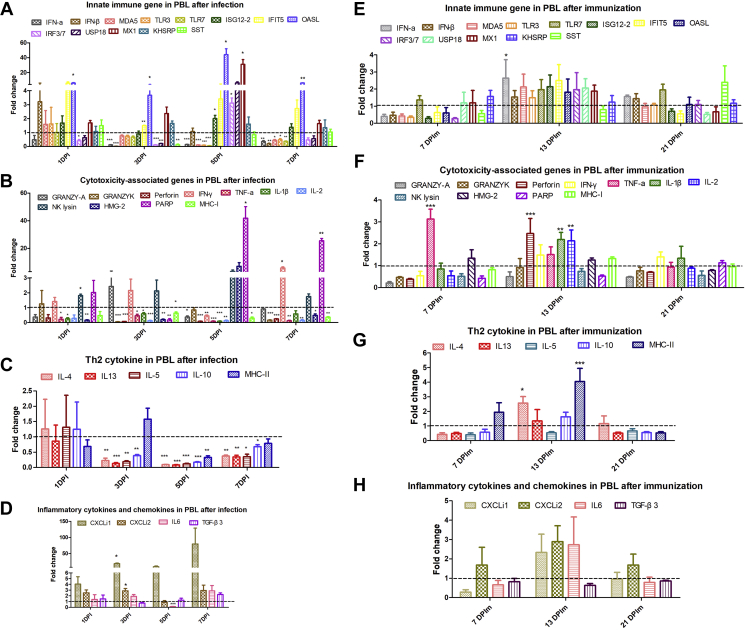
Monitor of immune-related genes expression in PBL after H9N2 AIV infection and immunization, respectively. Expressions of immune-related gene in PBL were detected by quantitative real-time polymerase chain reaction (qRT-PCR). In the H9N2 AIV infected and immunization experiments, the total RNA of PBL was extracted derived from 3 chickens of each group. And, the data were collected from 3 biological samples in each group, each sample performed in triplicate. The results were presented as means ± SEM, and the paired t test was used for statistical comparison. ns P > 0.05, ∗P < 0.05, ∗∗P < 0.01, ∗∗∗P < 0.001. Abbreviations: AIV, avian influenza viruses; IFN-γ, interferon-γ; IFIT5, interferon-induced proteins with tetratricopeptide repeats 5; IRF7, interferon response factor 7; IL, interleukin; KHSRP, K-homology splicing regulatory protein; MX1, myxovirus resistance 1; OASL, 2′,5’-oligoadenylate synthetase-like; PARP, poly (ADP-ribose) polymerase; PBL, peripheral blood lymphocyte; SST, somatostatin; TLR, Toll-like receptor.
Figure 4
Figure 4
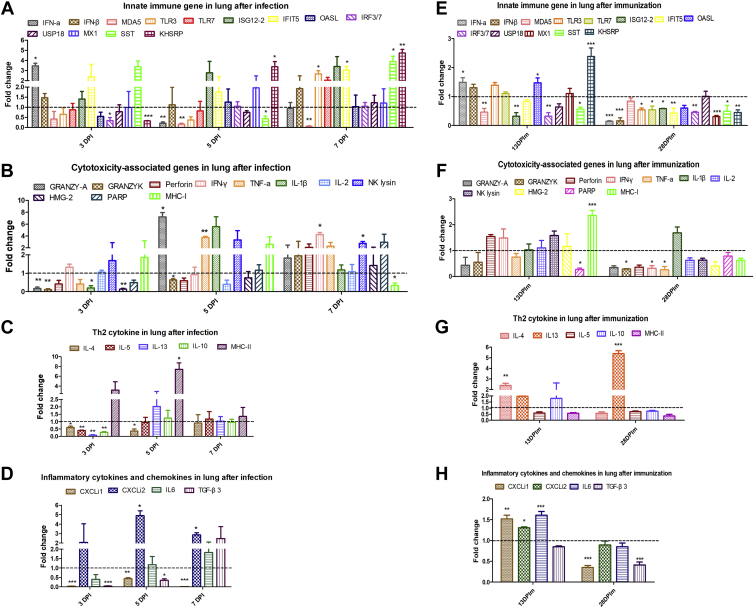
Monitor of immune-related genes expression in lung after H9N2 AIV infection and immunization, respectively. Expressions of immune-related gene in lung were detected by qRT-PCR. In the H9N2 AIV-infected experiment, the total RNA of lung cell suspensions was extracted derived from 3 chickens of infected and control groups, respectively. In the H9N2 AIV immunization experiment, the total RNA of lung cell suspensions was extracted derived from 2 chickens of immunized and control groups, respectively. The data were collected from 3 biological samples in each group, each sample performed in triplicate. The results were presented as means ± SEM, and the 2-way ANOVA was used for statistical comparison. ns P > 0.05, ∗P < 0.05, ∗∗P < 0.01, ∗∗∗P < 0.001. Abbreviations: AIV, avian influenza viruses; IFN-γ, interferon-γ; IFIT5, interferon-induced proteins with tetratricopeptide repeats 5; IRF7, interferon response factor 7; IL, interleukin; KHSRP, K-homology splicing regulatory protein; MX1, myxovirus resistance 1; OASL, 2′,5’-oligoadenylate synthetase-like; PARP, poly (ADP-ribose) polymerase; PBL, peripheral blood lymphocyte; SST, somatostatin; TLR, Toll-like receptor.
Supplementary Figure 1
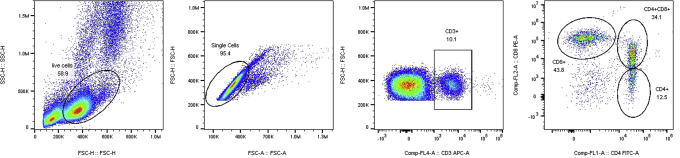
Gating strategy for analysis of T lymphocyte percentage in PBL with the CD3+ (APC), CD4+ (FITC) and CD8α+ (PE) antibodies.

References

    1. Dai M., Li S., Shi K., Liao J., Sun H., Liao M. Systematic identification of host immune key factors influencing viral infection in PBL of ALV-J infected SPF chicken. Viruses. 2020;12:114. - PMC - PubMed
    1. Dai M., Xu C., Chen W., Liao M. Progress on chicken T cell immunity to viruses. Cell. Mol. Life Sci. 2019;76:2779–2788. - PMC - PubMed
    1. Edwards S. OIE laboratory standards for avian influenza. Dev. Biol. (Basel) 2006;124:159–162. - PubMed
    1. Fu L., Wang X., Zhai J., Qi W., Jing L., Ge Y., Gao X., Liu C., Lv X., Zheng S. Changes in apoptosis, proliferation and T lymphocyte subtype on thymic cells of SPF chickens infected with reticuloendotheliosis virus. Mol. Immunol. 2019;111:87–94. - PubMed
    1. Li Y., Liu M., Sun Q., Zhang H., Zhang H., Jiang S., Liu S., Huang Y. Genotypic evolution and epidemiological characteristics of H9N2 influenza virus in Shandong Province, China. Poult. Sci. 2019;98:3488–3495. - PubMed