


Baseline characteristics as 3-year predictors of tooth fracture and crack progression: Findings from The National Dental Practice-Based Research Network
- PMID: 33358237
- PMCID: PMC8767416
- DOI: 10.1016/j.adaj.2020.09.023
Baseline characteristics as 3-year predictors of tooth fracture and crack progression: Findings from The National Dental Practice-Based Research Network
Abstract
Background: The authors of this practice-based study estimated the risk of experiencing tooth fractures and crack progression over 3 years and correlated baseline patient-, tooth-, and crack-level characteristics with these outcomes.
Methods: Two-hundred-and-nine National Dental Practice-Based Research Network dentists enrolled a convenience sample of 2,601 participants with a cracked vital posterior tooth that had been examined for at least 1 recall visit over 3 years. Data were collected at the patient, tooth, and crack levels at baseline, annual follow-up visits, and any interim visits. Associations between these characteristics and the subsequent same-tooth fractures and crack progression were quantified.
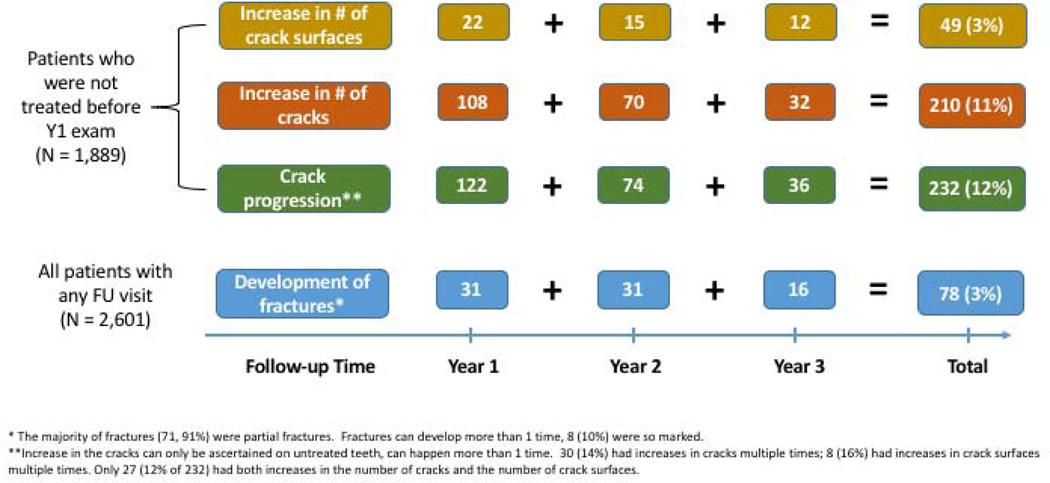
Results: Of the 2,601 teeth with a crack or cracks at baseline, 78 (3.0%; 95% confidence interval, 2.4% to 3.7%) subsequently developed a fracture. Of the 1,889 patients untreated before year 1, 232 (12.3%; 95% confidence interval, 10.9% to 13.8%) had some type of crack progression. Baseline tooth-level characteristics associated with tooth fracture were the tooth was maxillary and had a wear facet through enamel and a crack was detectable with an explorer, on the facial surface, and in a horizontal direction. Crack progression was associated with males and teeth with multiple cracks at baseline; teeth with a baseline facial crack were less likely to show crack progression. There was no commonality between characteristics associated with tooth fracture and those associated with crack progression.
Conclusions: Development of tooth fractures and crack progression over 3 years were rare occurrences. Specific characteristics were associated with the development of tooth fracture and crack progression, although none were common to both.
Practical implications: This information can aid dentists in assessing factors that place posterior cracked teeth at risk of experiencing adverse outcomes.
Keywords: Cracked teeth; crack progression; tooth fracture.
Copyright © 2021 American Dental Association. Published by Elsevier Inc. All rights reserved.
Figures
Comment in
-
Practicing Abroad.J Am Dent Assoc. 2021 Jun;152(6):423. doi: 10.1016/j.adaj.2021.04.009. J Am Dent Assoc. 2021. PMID: 34044971 No abstract available.
-
Tooth Fractures and Cracks.J Am Dent Assoc. 2021 Jun;152(6):423-424. doi: 10.1016/j.adaj.2021.04.010. J Am Dent Assoc. 2021. PMID: 34044972 No abstract available.
References
-
- Hilton TJ, Ferracane JL, Madden T, Barnes C. Cracked Teeth: A Practice-based Prevalence Survey. J Dent Res 2007; 86: abst 2044.
-
- Bader JD, Shugars DA, Roberson TM; Using crowns to prevent tooth fracture. CommunityDent Oral Epidemiol 1996; 24; 47–51. - PubMed
-
- Cameron CE Cracked Tooth Syndrome. J Am Dent Assoc 1964; 68, 405–411. - PubMed
MeSH terms
Grants and funding
LinkOut - more resources
Full Text Sources
Other Literature Sources
